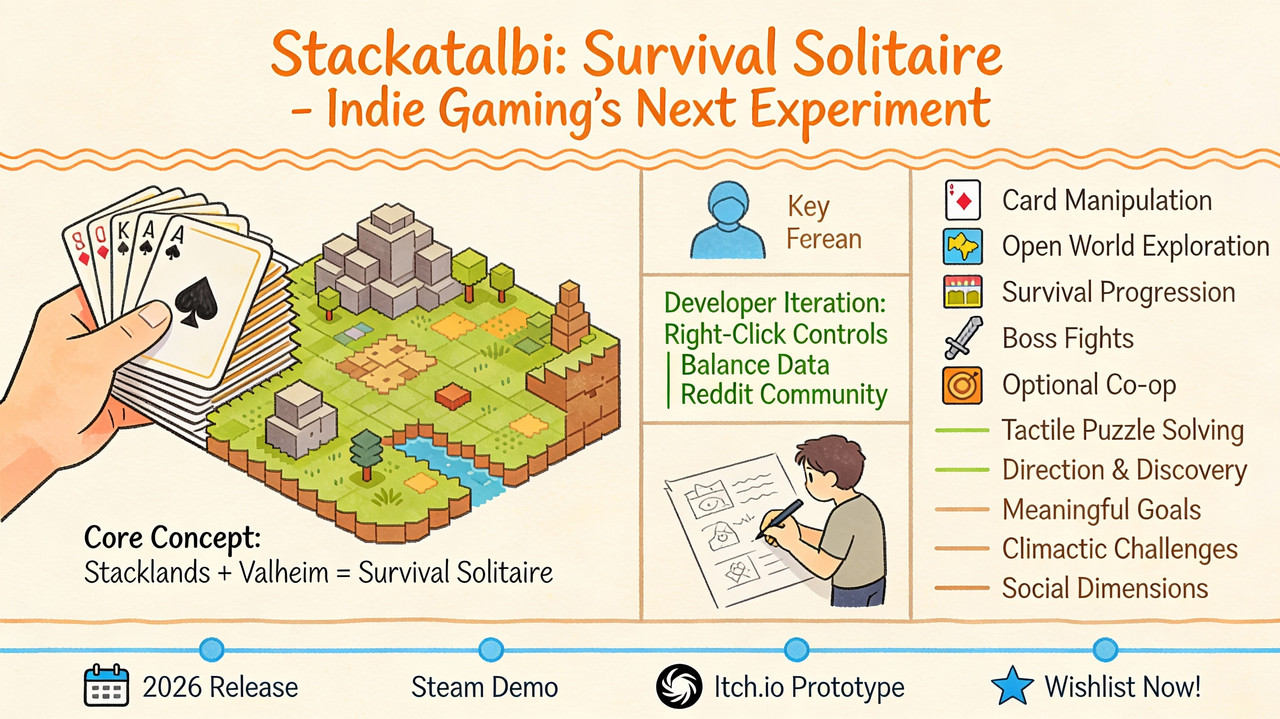
What if you took Stacklands’ card-stacking village building mechanics but removed all the villagers? What if you dropped a single hero into a massive open world inspired by Valheim and let them stack cards to survive? What if you added online co-op so friends could experience this bizarre concept together? That’s Stackatalbi in a nutshell, a solo-developed project from Matt at Kupilas Media that some players have dubbed survival solitaire. The name might sound silly, but after watching gameplay and trying the web prototype, it becomes clear this weird mashup might be exactly what fans of both games have been craving.
Stacking Cards to Survive
Stacklands became a surprise hit by taking city-building concepts and translating them into card mechanics. You stacked a Villager card onto a Tree card to get Wood. Stack Wood cards together to build structures. Combine cards in clever ways to create increasingly complex villages while managing resources and fighting off monsters. The genius was making these abstract city-building concepts tactile and immediate through physical card manipulation.
Stackatalbi keeps that core stacking mechanic but reimagines the entire framework. Instead of managing multiple villagers in a compact play area, you control a single hero card exploring a vast open world map. You still stack cards to gather resources and craft items, but now you’re dragging your hero across environments filled with forests, lakes, mines, and dangerous creatures. It’s the difference between playing city-building SimCity versus action-RPG Skyrim, translated into card game form.
The crafting system works through card combinations just like Stacklands. Stack your hero on a tree to chop wood. Combine wood cards at a campfire to create tools. Stack raw meat on flames to cook food. The familiar logic carries over while serving a completely different gameplay loop focused on personal survival rather than village management. You’re not building a civilization. You’re keeping one person alive in hostile wilderness.

The Valheim Connection
Developer Matt cites Valheim as the other primary inspiration alongside Stacklands, and that influence shows in Stackatalbi’s structure. Like Valheim, you explore biomes with increasing difficulty, hunt animals for food, fish in lakes and rivers, farm crops for sustainable food sources, and grow stronger to fight progressively tougher bosses. The progression mirrors Viking survival game perfectly, just executed through card mechanics instead of third-person action.
Valheim succeeded by making survival accessible and forgiving compared to genre contemporaries. Death wasn’t catastrophic. Resource gathering felt rewarding rather than tedious. Building was creative without being demanding. Stackatalbi seems to adopt that same philosophy. The Crafting Info window guides you toward recipe discoveries. Difficulty settings let you choose between Beginner, Normal, and Survival modes based on your preferred challenge level. It’s designed for enjoyment rather than frustration.
The open world exploration creates natural progression as you venture further from your starting location. Early areas provide basic resources like wood and stone. Push deeper and you’ll find metal ores for better equipment, dangerous enemies guarding valuable loot, and bosses blocking access to new biomes. This structure gives each play session clear goals, whether you’re preparing for the next boss fight or gathering specific resources for a crafting project.
Online Co-Op Adds Multiplayer Chaos
One of Stackatalbi’s most exciting features is optional online co-op for two players. The current web prototype on Itch.io is single-player only, but the upcoming Steam demo will showcase the multiplayer functionality. Playing card-based survival with a friend introduces interesting coordination challenges. Do you split up to gather resources more efficiently, or stick together for safety? Who handles farming while the other explores? How do you coordinate boss fights when you’re both manipulating cards?
Matt specifically wanted to gain experience in multiplayer development, which explains why co-op is optional rather than mandatory. You can enjoy the full experience solo if you prefer focused survival gameplay, or invite a friend when you want social chaos. This flexibility mirrors games like Don’t Starve Together, where the core experience works solo but transforms into something different with cooperation.

The Steam demo will be crucial for testing whether the multiplayer implementation works smoothly. Card manipulation games can get messy with multiple people interacting simultaneously. Clear ownership of cards, smooth synchronization, and intuitive cooperative mechanics will determine whether co-op enhances the experience or creates frustration. Given Matt’s transparency about development progress and willingness to iterate based on feedback, there’s reason to be optimistic.
Solving Stacklands’ Overwhelming Problem
Matt openly admits what drove him to create Stackatalbi: Stacklands became overwhelming as you added more villagers. Managing dozens of cards representing different villagers, resources, buildings, and enemies created visual clutter and cognitive load. What started as elegant simplicity devolved into frantic micromanagement. Instead of relaxing card manipulation, you were constantly juggling priorities across a crowded board.
By focusing on a single hero card, Stackatalbi eliminates that problem entirely. You’re never managing multiple characters simultaneously. Every decision revolves around your one protagonist and their immediate needs. Hungry? Find food. Cold? Light a campfire. Threatened? Craft weapons. The scope narrows from city-builder complexity to personal survival, making moment-to-moment gameplay more focused and less stressful.
This design decision also creates stronger player identification with the hero. In Stacklands, villagers were interchangeable resources. Lose one and you’d just make another. In Stackatalbi, your hero is you. Their progression represents your progression. Equipping better gear, unlocking new abilities, and defeating bosses feels personally meaningful rather than abstractly strategic. It’s the difference between playing The Sims versus playing an action-RPG with a defined protagonist.
Control Schemes and Accessibility
Stackatalbi initially used drag-and-drop movement for the player card, which makes sense given the Stacklands inspiration. Based on playtester feedback, Matt added an alternative RTS-style right-click-to-move control scheme that can be toggled in settings. This flexibility acknowledges that different players have different preferences for how they interact with card-based games.
The game also works surprisingly well on mobile devices through the Itch.io web prototype, though text scaling remains a challenge on smaller screens. Pinch-to-zoom and two-finger right-click functionality provide workarounds, showing thoughtful consideration for different platforms. Whether these mobile controls make it to the final Steam release remains to be seen, but the groundwork exists for potential mobile ports down the line.
Anonymous gameplay balance data collection helps Matt understand where players struggle. The system tracks whether you defeated zero, one, or two bosses and identifies problematic areas without collecting personal information. Players can opt out through menu settings if privacy concerns outweigh the benefits of helping development. This data-driven approach to balance should result in a more polished final release.
The Solo Developer Journey
Matt develops Stackatalbi entirely solo under Kupilas Media, handling programming, design, art, and marketing. His active presence on Reddit sharing updates and gathering feedback demonstrates the community-first approach that helps indie games succeed. He’s transparent about inspirations, honest about challenges, and responsive to suggestions. This openness builds goodwill that often translates into word-of-mouth marketing more valuable than any advertising budget.
The name Stackatalbi comes from Finnish word takatalvi, meaning an extended cold spell in spring that feels like winter returning. Matt wanted Scandinavian vibes matching Valheim’s Norse mythology aesthetic while incorporating Stack to highlight the card mechanics. The result sounds like a character name, giving the project personality beyond just Stacklands Clone Number Seven.
Scope management is crucial for solo developers, and Stackatalbi feels appropriately sized. The core loop is proven through Stacklands. The open world structure borrows from established survival games. Co-op adds complexity but remains optional so it doesn’t block single-player completion. Matt isn’t trying to revolutionize multiple genres simultaneously. He’s combining proven concepts in a novel way that leverages his skills and interests.
Standing Out in Crowded Genres
Both card games and survival games are saturated markets. Stacklands already proved card-based village building works. Valheim and countless others dominate open-world survival. What gives Stackatalbi its unique identity is the specific intersection of these mechanics. Card-based open world survival with co-op isn’t a crowded space. In fact, it might be completely empty except for this project.
The survival solitaire nickname captures why this concept resonates. Solitaire’s card manipulation feels meditative and satisfying. Survival games provide goals and progression. Combine them and you get gameplay that’s simultaneously relaxing and purposeful. You’re not stressed about losing everything to permadeath, but you’re also not aimlessly clicking cards without direction. It occupies a sweet spot between cozy and challenging.
Success will depend on execution. The web prototype proves the concept functions. The upcoming Steam demo needs to show that multiplayer works smoothly and content depth justifies the asking price. If Matt can deliver a polished experience with enough biomes, bosses, and crafting recipes to sustain 10-15 hours of gameplay, Stackatalbi could carve out its niche among fans of both parent genres.
Frequently Asked Questions
When does Stackatalbi release?
Stackatalbi is scheduled for release in 2026 on PC via Steam. A specific date hasn’t been announced. A Steam demo featuring online co-op is coming soon, and a single-player web prototype is currently available on Itch.io.
What platforms will Stackatalbi be available on?
Currently confirmed for PC through Steam. The web prototype works on desktop browsers and has limited mobile compatibility, suggesting potential for mobile ports, though nothing is officially announced.
Is Stackatalbi multiplayer?
Stackatalbi features optional online co-op for two players. You can play the entire game solo or invite a friend. The single-player web prototype is available now, with multiplayer showcased in the upcoming Steam demo.
Who is developing Stackatalbi?
Matt, a solo developer working under the studio name Kupilas Media, is creating Stackatalbi. He handles all programming, design, art, and marketing independently.
What games inspired Stackatalbi?
The two primary inspirations are Stacklands for its card-stacking mechanics and Valheim for its open-world survival structure. Matt wanted to combine Stacklands’ satisfying card manipulation with Valheim’s exploration and progression.
How does Stackatalbi differ from Stacklands?
Instead of managing multiple villagers in a compact area, you control a single hero exploring a vast open world. The focus shifts from city-building and population management to personal survival, exploration, and combat progression.
Are there difficulty options?
Yes, Stackatalbi offers three difficulty settings: Beginner (easier than previous versions), Normal (standard challenge), and Survival (more difficult experience). This allows players to tailor the challenge to their preferences.
Can I try Stackatalbi before it releases?
Yes, a free single-player web prototype is available on Itch.io. An upcoming Steam demo will add online co-op functionality. Check the Steam page to wishlist and receive notification when the demo launches.
What control schemes does the game use?
Stackatalbi supports both drag-and-drop card movement and RTS-style right-click-to-move controls. Players can toggle between control schemes in the settings menu based on personal preference.
What’s the meaning behind the name Stackatalbi?
The name derives from Finnish word takatalvi, meaning an extended spring cold spell. Stack refers to the card-stacking mechanic, while the alteration to Talbi gives it a character name feel with Scandinavian vibes matching the game’s aesthetic.
Final Thoughts
Stackatalbi represents the kind of creative experimentation that makes indie gaming exciting. Instead of chasing trends or copying successful formulas wholesale, Matt identified specific elements he loved from two different games and asked what happens if you combine them in a new way. The answer is survival solitaire, a concept that sounds ridiculous until you actually see it working. Card manipulation satisfies the part of your brain that enjoys tactile puzzle solving. Open world exploration provides direction and discovery. Survival progression creates meaningful goals. Boss fights offer climactic challenges. Optional co-op adds social dimensions. Each element complements the others rather than competing for attention, suggesting thoughtful design rather than feature bloat thrown at the wall hoping something sticks.
What makes Stackatalbi particularly promising is Matt’s willingness to iterate based on feedback. Adding right-click movement controls shows responsiveness to playtester input. Implementing anonymous balance data collection demonstrates commitment to improving pain points. Active community engagement through Reddit builds relationships with potential players before launch. These aren’t just smart marketing moves. They’re signs of a developer who cares about making something people will genuinely enjoy.
The 2026 release window gives Matt time to polish the experience while maintaining momentum through the playable prototype and upcoming Steam demo. Wishlisting on Steam helps algorithm visibility crucial for solo developers without marketing budgets. Trying the Itch.io prototype and providing constructive feedback contributes directly to improving the final product. For players who loved Stacklands but found it overwhelming, or who adore Valheim but want something fresh, Stackatalbi offers exactly the kind of weird hybrid that sometimes becomes the next surprise indie hit.
Sometimes the best games come from developers asking what if questions nobody else thought to ask. What if cards became open world survival? What if solitaire had bosses and co-op? What if you could stack your way through Valheim? The answers might be stranger than expected, but strange doesn’t mean bad. Strange often means interesting, and interesting is what the indie scene does best. Stackatalbi is definitely interesting, and come 2026, we’ll find out if interesting translates into great.