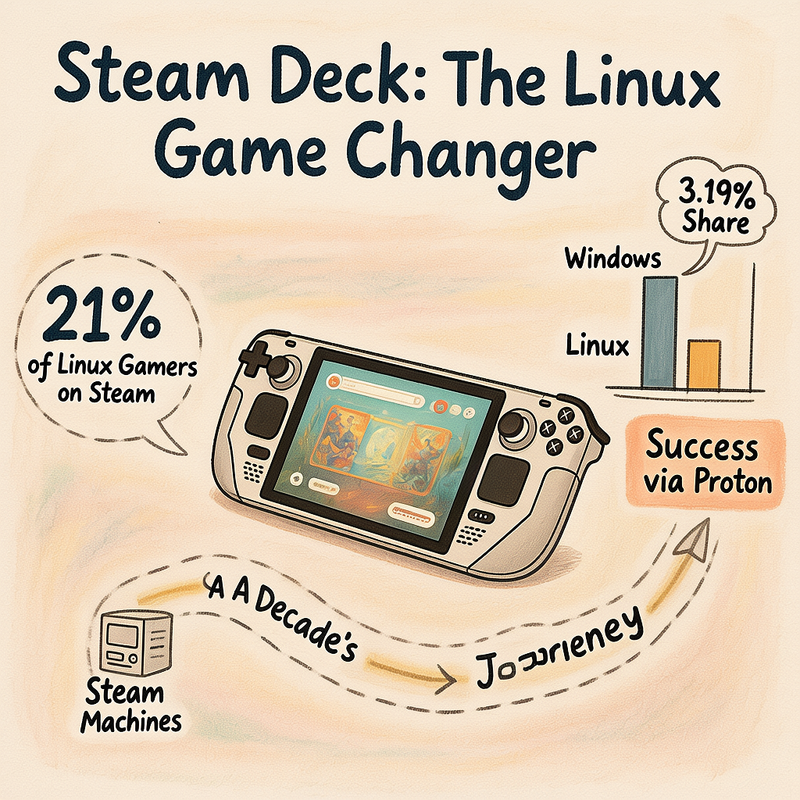
Valve’s latest Steam Hardware Survey for January 2026 dropped some fascinating numbers that reveal the Steam Deck is doing far more than just selling handheld gaming devices. The portable PC now accounts for over 21% of all Linux users on Steam, contributing to Linux’s overall platform share climbing to 3.19% after hitting an all-time high of 3.2% in November 2025. For context, that might sound small until you remember Linux represented barely 1% of Steam users just a few years ago. The Steam Deck is quietly winning a platform war Valve tried and failed to fight a decade ago.
- The Numbers Behind the Victory
- The Original Steam Machines Disaster
- Proton Changed Everything
- Why Linux Gaming Still Faces Challenges
- The Competition Isn’t Really Competing
- What the Steam Machine Means For This
- The Bigger Picture For Open Source
- What 2026 Holds
- FAQs About Steam Deck and Linux Gaming
- Conclusion
The Numbers Behind the Victory
According to data compiled by FRVR and reported across gaming outlets, the Steam Deck now holds a market share of 6.60% among Linux gamers specifically when you break down the distribution types. But the headline number is that 21% figure representing how much of Steam’s entire Linux user base is playing on the handheld rather than traditional desktop Linux installations.
That 3.19% overall Linux market share might seem minuscule compared to Windows dominating at over 96%, but the trajectory matters more than the absolute numbers. Linux adoption on Steam has been steadily climbing largely because the Steam Deck runs SteamOS, Valve’s Debian-based Linux distribution. Every Steam Deck sold adds another Linux user to the platform, whether that person knows or cares about operating systems.
The Steam Deck has sold approximately 5.6 million units globally according to recent estimates, with some analyses suggesting the number may have crossed 4 million by early 2025 and continued climbing throughout the year. That’s millions of devices contributing to Linux gaming adoption without users needing to understand terminal commands or driver compatibility issues.
The Original Steam Machines Disaster
What makes this success particularly sweet for Valve is that it represents redemption for one of the company’s most spectacular hardware failures. The original Steam Machines launched in 2015 as Valve’s ambitious attempt to create a living room gaming console ecosystem running Linux. Multiple manufacturers produced various configurations at different price points, all running SteamOS.
The initiative crashed and burned immediately. Steam Machines were expensive, confusing, and suffered from the fundamental problem that most PC games at the time didn’t run on Linux. Valve’s Steam Controller, designed alongside the machines, also flopped despite some genuinely innovative features like dual touchpads and extensive customization. The entire project was quietly abandoned, becoming a punchline about Valve’s hardware ambitions.
Fast forward to 2022, and Valve learned from those mistakes. The Steam Deck succeeded where Steam Machines failed by being a single unified product with clear value proposition rather than a fragmented ecosystem. It ran the same SteamOS but now benefited from Proton, Valve’s compatibility layer that lets Windows games run on Linux with minimal performance loss. And crucially, it was portable, filling a niche that didn’t compete directly with existing gaming PCs or consoles.

Proton Changed Everything
The secret weapon enabling Steam Deck’s success is Proton, Valve’s fork of Wine that translates Windows API calls to Linux equivalents in real-time. Before Proton, gaming on Linux meant relying on native Linux builds that most developers never bothered creating. The library was pathetically small compared to Windows.
Proton flipped that dynamic by making the vast majority of Windows games playable on Linux without developers lifting a finger. Valve introduced a Deck Verification system categorizing games as Verified, Playable, Unsupported, or Unknown based on testing. Verified games run perfectly on Steam Deck with no tweaks needed. Playable games work but might require some manual configuration or have minor issues.
The result is that Steam Deck users have access to most of their existing Steam libraries despite the handheld running Linux. That compatibility eliminated the chicken-and-egg problem that killed Steam Machines. Developers don’t need to port to Linux, users don’t need to sacrifice their game collections, and Valve doesn’t need to convince an entire industry to support a niche platform.
Why Linux Gaming Still Faces Challenges
Despite the Steam Deck’s success, Linux gaming still struggles with anti-cheat compatibility. Many competitive multiplayer games use kernel-level anti-cheat systems designed for Windows that don’t function on Linux. Epic Games’ Easy Anti-Cheat and BattlEye both support Linux now, but implementation requires developers to manually enable it.
Games like Destiny 2, Valorant, Rainbow Six Siege, and League of Legends remain unplayable on Steam Deck because their anti-cheat won’t run on Linux. Valve has been working with anti-cheat providers to improve compatibility, hoping the upcoming Steam Machine console will provide additional leverage by demonstrating Linux gaming’s commercial viability beyond handhelds.
This anti-cheat problem represents the single biggest barrier to Linux becoming a true alternative to Windows for gaming. Single-player and co-op games generally work great through Proton. Competitive multiplayer games with aggressive anti-cheat remain a dice roll.

The Competition Isn’t Really Competing
When you look at the broader handheld gaming PC market, the Steam Deck’s dominance becomes even more impressive. Research from IDC compiled by The Verge shows that of the approximately 6 million handheld gaming PCs shipped from 2022 through 2024, roughly 4 million were Steam Decks. That’s about 67% market share.
Competitors like the ASUS ROG Ally, Lenovo Legion Go, and MSI Claw all run Windows rather than Linux, positioning themselves as more powerful alternatives with better compatibility. But they’re also significantly more expensive, with most starting at $600-700 compared to the Steam Deck’s $399 entry price. That price difference matters enormously when you’re asking people to take a chance on a new gaming form factor.
More importantly, those Windows-based competitors don’t contribute to Linux adoption at all. Every ROG Ally or Legion Go sold is another Windows device in the ecosystem. The Steam Deck stands alone as the Linux option, which means Valve doesn’t need to outsell the competition to win the platform war. They just need to keep selling enough units to maintain momentum.
What the Steam Machine Means For This
Valve’s upcoming Steam Machine console, expected to launch sometime in early 2026, represents the next phase of this Linux gaming strategy. Unlike the original 2015 Steam Machines, this will be a single unified product from Valve itself rather than a fragmented ecosystem of third-party manufacturers.
If the Steam Machine succeeds even modestly, it will add millions more Linux gaming devices to the ecosystem. That growing install base gives Valve leverage when negotiating with game developers and anti-cheat providers about Linux compatibility. It’s hard to ignore a platform that represents potentially 10+ million active users.
The pricing will be crucial. Leaks and speculation suggest Valve is targeting aggressive pricing similar to the Steam Deck, potentially undercutting PlayStation 5 and Xbox Series X while offering comparable performance. That’s viable because Valve makes money from game sales rather than hardware, allowing them to sell at cost or even minor losses.

The Bigger Picture For Open Source
Beyond just gaming, the Steam Deck’s success represents validation for open-source platforms competing against proprietary ecosystems. For decades, Linux desktop adoption stalled because normal consumers had no compelling reason to deal with its quirks when Windows worked fine for their needs.
Gaming was Linux’s Achilles heel. You simply couldn’t play most games, making it a non-starter for anyone who viewed gaming as important. The Steam Deck solved that problem not through grassroots adoption but through corporate investment. Valve spent years and millions of dollars developing Proton specifically to make Windows games work seamlessly on Linux.
That investment is now paying dividends as the Steam Deck proves you can build successful consumer products on open-source foundations without sacrificing compatibility or user experience. Whether this translates to broader Linux desktop adoption remains questionable, but it at least demonstrates that open platforms can compete when backed by sufficient resources and strategic vision.
What 2026 Holds
The January 2026 hardware survey numbers suggest momentum is continuing rather than plateauing. The 3.19% Linux share is down slightly from November’s 3.2% high, but seasonal fluctuations are normal. The important trend is that Linux representation has grown consistently since the Steam Deck launched in 2022.
With the Steam Machine expected to launch soon and the Steam Deck continuing to sell steadily, 2026 could see Linux break 4% or even 5% of Steam’s total user base. That would represent a genuinely significant milestone, proving Linux gaming has evolved from niche hobby to viable alternative platform.
Of course, Windows will continue dominating for the foreseeable future. But the question isn’t whether Linux will overtake Windows. It’s whether Linux can carve out enough market share to make developers care about compatibility. If Linux reaches 5-10% of Steam users, that becomes too large to ignore. Valve’s strategy is working precisely because they’re not trying to convince people to switch operating systems. They’re just selling great gaming hardware that happens to run Linux under the hood.

FAQs About Steam Deck and Linux Gaming
What percentage of Steam users are on Linux now?
As of January 2026, Linux represents 3.19% of Steam’s total user base according to Valve’s hardware survey, down slightly from November 2025’s all-time high of 3.2% but still showing significant growth compared to previous years.
How many Steam Decks has Valve sold?
Estimates suggest Valve has sold approximately 5.6 million Steam Deck units globally since launch in 2022, with the device accounting for roughly 67% of all handheld gaming PC shipments during that period.
Why does the Steam Deck run Linux instead of Windows?
Valve uses Linux (specifically SteamOS) to avoid Windows licensing costs, maintain full control over the operating system, and promote open-source gaming. Proton compatibility layer lets Windows games run on Linux without native ports.
What games don’t work on Steam Deck?
Games with aggressive anti-cheat systems often don’t work, including Destiny 2, Valorant, Rainbow Six Siege, and League of Legends. Most single-player and co-op games work fine through Proton compatibility.
How does the Steam Deck compare to competitors?
The Steam Deck dominates with roughly 4 million of 6 million total handheld PC sales from 2022-2024. It’s cheaper at $399 versus $600-700 for competitors like ROG Ally and Legion Go, though less powerful.
What happened to the original Steam Machines?
Valve’s 2015 Steam Machines failed due to high prices, confusing ecosystem fragmentation, and poor Linux game compatibility before Proton existed. The Steam Deck succeeded by being a single unified product with better compatibility.
When does the new Steam Machine release?
Valve’s new Steam Machine console is expected to launch in early 2026, though no specific date has been announced. It will be a single unified product from Valve rather than multiple third-party manufacturers.
Can you install Windows on Steam Deck?
Yes, Steam Deck supports Windows installation, though Valve doesn’t officially recommend it. Most users stick with SteamOS because Proton handles game compatibility well and the interface is optimized for handheld use.
Conclusion
The Steam Deck accounting for 21% of all Linux gamers on Steam represents more than just a successful hardware launch. It’s validation of a decade-long strategy that survived spectacular failure with the original Steam Machines and eventually found success through iteration, technical investment in Proton, and smart product positioning. Valve didn’t convince millions of people to become Linux enthusiasts. They just made a great handheld gaming device that happened to run Linux, and that accidental evangelism is accomplishing what years of desktop Linux advocacy never could. The 3.19% overall Linux share still looks tiny compared to Windows’ dominance, but the trajectory matters more than the absolute numbers. Three years ago, Linux barely registered. Now it represents millions of active gamers, and that install base grows with every Steam Deck sold. Whether the upcoming Steam Machine can replicate that success in the living room remains to be seen, but Valve’s already won the more important battle. They proved you can build commercially successful gaming hardware on open-source foundations without sacrificing user experience or game compatibility. And they did it by focusing on making great products rather than preaching platform ideology. Sometimes the best way to win a war is to make people forget they’re fighting one.