Taki Udon didn’t sleep for a year. The solo developer behind SuperStation – a MiSTer FPGA console designed for perfect retro accuracy – worked 12 hours a day, 6 days a week to ship his dream hardware. In a raw interview, he breaks down the brutal reality of solo hardware development, why ‘failure can’t be an option,’ and how batch production barely kept him solvent.
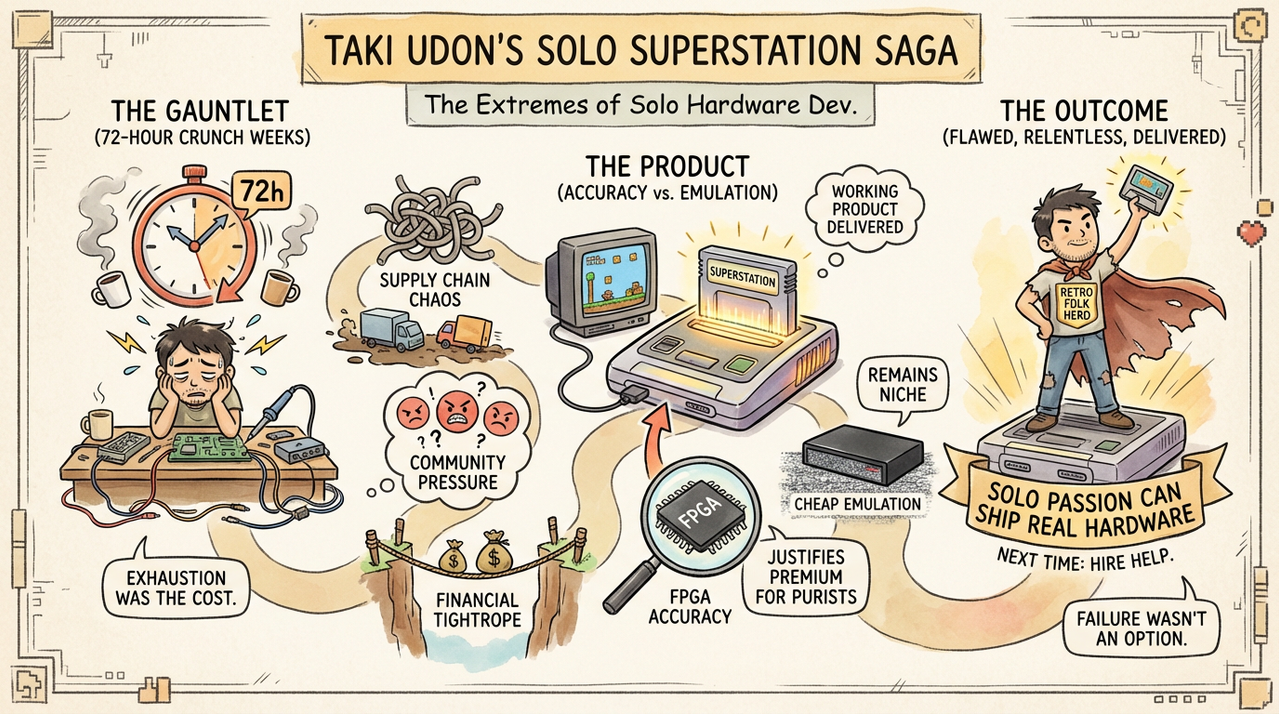
The 72-Hour Week Reality
SuperStation isn’t Taki’s first rodeo. Known for MiSTer Pi (Raspberry Pi MiSTer clone) and R² handhelds, he understood FPGA retro hardware demands. But SuperStation raised stakes – full MiSTer compatibility, PS1-focused form factor, HDMI/micro HDMI switching, all built solo from Taiwan. ‘I couldn’t delegate PCB design, firmware, or assembly,’ Taki explained. Crunch hit 12-hour days immediately, weekends included.
Batch production saved finances but crushed time management. Assemble 100 units, ship worldwide, repeat. Each batch required sourcing components across China supply chains, customs clearance, individual testing. No team meant Taki handled customer support, packaging, marketing simultaneously. Sleep averaged 4-5 hours nightly; weekends disappeared entirely.
Why FPGA When Emulation Exists
MiSTer FPGA recreates original console hardware gate-by-gate using reconfigurable chips. Emulation approximates via software, FPGA recreates exactly. Result? Pixel-perfect accuracy, zero input lag, save states without compatibility breaks. Taki’s SuperStation targets MiSTer users wanting dedicated box over DE10-Nano dev board + SD card setup.
SuperStation differentiates with PS1 ergonomics – controller ports, AV output, micro HDMI for portable CRTs. Taki prioritizes shoot ’em ups where 1-frame lag kills runs. ‘NSO adds 3-5 frames latency; MiSTer adds zero,’ he claims. Community validates – shmup players swear by FPGA timing precision.
| Aspect | MiSTer FPGA | Software Emulation |
|---|---|---|
| Input Lag | 0 frames | 2-8 frames |
| Accuracy | Hardware exact | 85-95% visual |
| Save States | Core-independent | Version-dependent |
| Cost | $200-400 | $50-150 |
| Portability | Low (specialized board) | High (any PC) |

Batch Production Survival
Taki rejected Kickstarter after MiSTer FPGA clones flooded market. Batch sales via website minimized risk – sell 100 units, produce 100 units. Profit margins razor-thin after FPGA chips ($80+ each), PCBs, global shipping. Taiwan manufacturing helped quality control but supply chain delays crushed schedules.
Customer demands escalated workload. ‘Ship faster’ emails arrived while Taki tested individual units. Component shortages forced design compromises – headphone jack sacrificed for micro HDMI. Preorder holders waited 18+ months, testing Taki’s Discord communication limits. He delivered every unit despite delays.
The ‘Failure Can’t Be an Option’ Mindset
Taki’s interview reveals solo dev psychology. No safety net, no team backup, no venture capital. One failed batch bankrupts project. ’12-hour days became normal because stopping meant failing,’ he admits. Community pressure added weight – MiSTer enthusiasts demanded perfection from every competitor.
Reddit reactions split. r/Games praised dedication (494 upvotes) but questioned crunch sustainability. Commenters noted Taki set unrealistic timelines, launched side projects during delays. Others defended solo hardware dev realities – no team means founder does everything. Preorder veterans shared war stories of waiting 18 months for Super5 FPGA handheld.
SuperStation Technical Highlights
Core MiSTer DE10-Nano FPGA board powers all systems – NES to PS1. Taki’s enclosure adds PS1 ergonomics, dual HDMI switching, analog AV output. Custom firmware simplifies core switching vs official MiSTer menus. Supports MiSTer community cores, updates via SD card.
- PS1/N64/Saturn perfect cores
- 0-frame input lag shmups
- Save states across core updates
- Disc swapping via software
- Portable CRT compatibility
FPGA vs Retro Collecting Wars
Retro gaming splits three ways: original hardware, FPGA recreations, software emulation. Taki targets FPGA purists willing to pay premium for accuracy. Casual players stick with $50 Anbernic handhelds running RetroArch. Diehards preserve CRTs, light guns, dancing mats.
Community critiques FPGA hype. ‘85% accuracy at 30% cost makes emulation king,’ argues one Redditor. Shmup players counter latency kills precision games. Taki positions SuperStation as enthusiast gateway – easier than MiSTer dev boards, cheaper than Analogue pockets.

Lessons for Solo Hardware Devs
Taki’s year reveals indie hardware truths. Prototyping easy, scaling production hell. Component costs explode at volume. Global shipping eats margins. Customer support consumes dev time. Batch production beats crowdfunding but demands iron discipline.
Success metrics mixed. SuperStation shipped, earned profit, built reputation. Taki burned out, alienated preorder holders, faced crunch criticism. Community respects delivery but warns against solo heroics. Future projects likely delegate manufacturing, hire support staff.
Frequently Asked Questions
What’s SuperStation?
MiSTer FPGA console with PS1 ergonomics. Recreates NES/PS1/Saturn hardware exactly using reconfigurable chips. Zero input lag, perfect accuracy.
Why FPGA over emulation?
Hardware-exact timing, 0-frame lag, save states without core breakage. Essential for shmups, light gun games, scanline purists.
Is Taki Udon still crunching?
SuperStation complete. Taking break after 18-month sprint. Future projects planned with manufacturing partners.
SuperStation price?
$250-350 depending batch. Includes DE10-Nano FPGA, custom case, cables. Cheaper than official MiSTer + enclosure combos.
Batch production explained
Sell 100 units online, produce exactly 100. Minimizes risk vs Kickstarter. Delays common due component sourcing.
MiSTer vs Analogue FPGA?
MiSTer open-source, community cores. Analogue proprietary, premium pricing. SuperStation bridges gap with consumer design.
Worth buying for casual retro?
No. Emulation handhelds cheaper, easier. FPGA for purists chasing perfect accuracy, low latency.
Conclusion
Taki Udon’s SuperStation saga reveals solo hardware dev extremes. 72-hour crunch weeks delivered working product against supply chain chaos, community pressure, financial tightropes. FPGA accuracy justifies premium for purists, remains niche vs cheap emulation. Taki survives as retro hardware folk hero – flawed, relentless, delivered. Next time he’ll hire help, but SuperStation proves solo passion can ship real hardware. Failure wasn’t an option; exhaustion was the cost.