Most games try to balance everything carefully, patching out powerful combinations and nerfing strategies that feel too strong. Trinity Archetype takes the opposite approach. This upcoming roguelike turn-based RPG from indie studio Machinator Corp actively encourages you to find broken builds, exploit ridiculous synergies, and unleash combinations so overpowered they’d make other developers panic. With a Kickstarter campaign that wrapped up in December 2025 and Early Access scheduled for Q2 2026, Trinity Archetype is building a community around one simple philosophy: if it’s in the game, it’s fair play.
Craft Your Own Skills With Millions of Combinations
The core hook of Trinity Archetype is its skill-crafting system built around runes. Every character starts with a set of base skills that serve as templates. These skills contain multiple rune slots that you fill throughout each run. Runes fundamentally change how skills behave, converting single-target attacks into area-of-effect damage, adding status effects, stealing shields from enemies, or creating conditional bonuses that trigger based on specific circumstances.
What makes the system special is how runes interact with the Boost mechanic. Skills can be powered up during battle by spending Boost Points, and many runes add entirely new effects at higher Boost levels. A simple attack might deal damage normally, but at Boost level 2, an equipped rune could cause it to hit twice, apply a debuff, and heal your party. This creates layers of decision-making where you’re not just choosing which skill to use, but also how much power to invest in it based on your current rune loadout.
Machinator Corp claims there are millions of possible combinations once you factor in all the runes, artifacts, and skill variations. That number isn’t just marketing hype. With dozens of runes that each modify skills differently, multiple boost levels that change effects, and a party of three characters each with their own skill sets, the permutations genuinely explode into massive numbers. More importantly, the developers explicitly state that broken builds and rune combinations are encouraged. They’re not trying to create perfect balance. They want players experimenting, discovering absurd synergies, and sharing clips of runs where everything goes hilariously right.

Turn-Based Combat With Strategic Depth
Trinity Archetype blends deckbuilder logic with traditional JRPG-style turn-based combat. You control a party of three characters, each blessed by ancient beings called Archetypes. Combat uses an Action Point system where skills cost varying amounts from a shared pool. This creates interesting trade-offs where you might use three cheap skills from different characters or dump all your points into one massive powered-up ability.
Enemy intentions are displayed before they act, similar to games like Slay the Spire. This transparency allows you to plan around incoming damage, prioritize targets that will buff their allies, or prepare defensive skills when big attacks are telegraphed. The game promises that nothing is left to fate, with all combat information clearly visible so success depends on strategic planning rather than lucky dice rolls.
The Inspire mechanic adds another tactical layer. Once per turn, you can designate one character to Inspire the party, triggering a unique effect tied to their Archetype. These effects vary dramatically based on who’s inspiring. Some grant shields, others break enemy defenses, and some manipulate turn order or enhance damage. Choosing when to Inspire and which character should provide the effect becomes crucial, especially when building toward multi-turn combos that require specific setup.
Boost Points are your currency for skill enhancement during battle. You spend them to increase a skill’s Boost level, activating additional rune effects and amplifying base power. Managing when to boost skills versus saving points for future turns creates constant tension. Do you spend everything now to finish off a dangerous enemy, or conserve resources for the next wave? Combined with the Inspire mechanic, this creates combat puzzles where the optimal solution changes based on your rune loadout and party composition.
Meet the Archetype Warriors
The playable characters in Trinity Archetype aren’t just mechanical shells. Each is tied to one of the ancient Archetypes that once shaped reality. When Chaos returned and fractured dimensions, the remaining Archetypes chose new champions to inherit their powers. You’re playing as those chosen warriors, fighting to keep corrupted beings sealed away while restoring your broken world.

Yami embodies the Archetype of Might. She’s a frontline damage dealer who specializes in breaking enemy defenses with piercing attacks. When she Inspires the party, everyone gains increased damage output, making her ideal for aggressive builds that focus on overwhelming opponents before they can respond. Her kit rewards players who commit fully to offense, using high Boost levels to maximize damage potential.
Ank represents the Archetype of Protection. As the party’s tank, he generates shields, redirects enemy attacks to himself, and reinforces allies when he Inspires. His skills naturally pair with runes that convert shields into other effects or manipulate taunt mechanics. For players who prefer defensive strategies, Ank provides the foundation for builds that survive through mitigation rather than pure damage.
Worb channels the Archetype of Wisdom. He’s the support specialist who manipulates turn flow, applies buffs and debuffs, and exposes enemy weaknesses. His Inspire effect reduces enemy Break Points, making it easier to disable opponents. Worb excels in builds that focus on control and crowd manipulation rather than raw damage output, offering a different playstyle from the more straightforward damage dealers.
The demo features four playable characters with a fifth planned for Early Access. Each character offers distinct mechanical identities that encourage different build paths and team compositions. Whether you want a balanced party covering all roles or a hyper-specialized team that doubles down on one strategy, the character variety supports both approaches.
Roguelike Structure Built for Replayability
Each run in Trinity Archetype lasts 45 to 60 minutes based on current demo feedback. You battle through encounters, earn experience to level up characters, unlock new skills, and collect runes and artifacts that persist across future runs. The roguelike structure means permadeath ends your current attempt, but the meta-progression ensures you’re always expanding your toolkit for subsequent attempts.
The game borrows heavily from the roguelike deckbuilder template popularized by Slay the Spire and improved by games like Monster Train and Griftlands. You make choices about which path to take, what rewards to prioritize, and how to build your party’s capabilities as the run progresses. However, Trinity Archetype replaces cards with skills and runes, creating a different feel while maintaining the satisfying build-crafting loop that makes these games so addictive.
Machinator Corp emphasizes that no two runs feel alike. The combination of random rune drops, different character selections, varying enemy encounters, and the sheer number of possible skill configurations ensures fresh experiences even after dozens of attempts. For players who love optimization and build theory, Trinity Archetype provides endless opportunities to test new ideas and discover unexpected interactions.
Development Roadmap and Early Access Plans
Trinity Archetype’s Kickstarter campaign ran through December 15, 2025, successfully funding the project and allowing Machinator Corp to move forward with their development timeline. Early Access is scheduled to launch in Q2 2026 on PC via Steam, with Linux support also confirmed. The game runs smoothly on Steam Deck according to early testing, making it accessible for portable play.
The Early Access launch will include partial localization, a fully playable campaign, a second act beyond what’s in the demo, and reworked map traversal systems. In Q3 2026, the team plans to add quality-of-life improvements and a Path System that adds structure and variety to runs. Q4 2026 focuses on Act 3, the final boss encounter, and additional playable characters. The full 1.0 release is targeted for Q1 2027 with complete localization for all planned languages.
Throughout the Early Access period, Machinator Corp intends to continuously add new runes, artifacts, and skills based on community feedback and suggestions. They’re not locking themselves to a rigid content schedule, instead preferring to respond organically to what players want and what makes the game better. This flexible approach suggests a developer genuinely interested in collaboration rather than just checking boxes on a predetermined roadmap.
The Kickstarter included special creation tiers that let backers collaborate with the team to design new Inspire skills, NPCs, or even full playable characters during Early Access. This level of backer integration shows confidence in their systems and willingness to incorporate community creativity into the final product.
Why Trinity Archetype Stands Out
The roguelike deckbuilder space is crowded. Slay the Spire set the template in 2017, and countless games have iterated on that formula since. What makes Trinity Archetype potentially special is its embrace of intentional imbalance. Instead of carefully curating a meta where all strategies are equally viable, the developers want players to find the overpowered combinations and exploit them gleefully.
This philosophy creates a different relationship between developer and player. Rather than patching out fun because it’s too strong, Machinator Corp is saying bring it on, show us what you can break. That attitude fosters experimentation and community discovery in ways that carefully balanced games sometimes struggle to achieve. When players know they’re encouraged to find broken builds, they spend time theory-crafting and sharing discoveries rather than worrying whether their favorite strategy will get nerfed in the next patch.
The skill-crafting system also differentiates Trinity Archetype from pure deckbuilders. While games like Monster Train and Across the Obelisk have explored party-based deckbuilding, Trinity Archetype’s rune system creates customization at the individual skill level rather than at the card level. This granular approach to build-crafting offers different strategic depth, where you’re not just choosing which cards to include in your deck but how each individual ability functions within your overall strategy.
Frequently Asked Questions
When does Trinity Archetype release?
Trinity Archetype is scheduled for Early Access launch in Q2 2026 on PC via Steam, with full 1.0 release targeted for Q1 2027.
What platforms will it be available on?
The game is confirmed for PC via Steam with Linux support. It’s also Steam Deck verified, meaning it runs smoothly on Valve’s handheld device.
Is there a demo available?
Yes, a free demo is available on Steam right now. The demo includes four playable characters, multiple runes and artifacts, and provides a substantial preview of the core gameplay loop. Machinator Corp continues updating the demo based on player feedback.
How does the skill-crafting system work?
Each character has base skills with multiple rune slots. You equip runes found during runs to modify how skills function. Runes can change targeting, add effects, or provide bonuses that scale with Boost levels. The system offers millions of possible combinations for creating custom builds.
What are Boost and Inspire mechanics?
Boost lets you spend Boost Points during battle to power up skills, activating additional rune effects and increasing potency. Inspire allows one character per turn to trigger a unique party-wide effect based on their Archetype, like granting shields, breaking defenses, or manipulating turn order.
How long is each run?
Based on current demo feedback, each run lasts approximately 45 to 60 minutes. This makes Trinity Archetype accessible for quick sessions while still providing meaningful progression.
Is the combat turn-based or real-time?
Trinity Archetype uses turn-based combat with full information transparency. You can see enemy intentions before they act, allowing strategic planning. Combat combines traditional JRPG turn order with deckbuilder-style decision-making.
Who is developing Trinity Archetype?
Machinator Corp, a small indie studio based in Panama City and founded in 2021, is developing the game. The team includes Viktor and Luis on design and programming, with Timofey handling art and animation.
Does Trinity Archetype have controller support?
Yes, the game supports mouse and keyboard, keyboard-only, and gamepad controls. It’s also verified for Steam Deck with smooth performance on the handheld.
What inspired Trinity Archetype?
The developers cite roguelike deckbuilders like Slay the Spire as inspiration, but they wanted to create something with deeper skill customization at the granular level. The rune system allows modification of individual abilities rather than just choosing which cards to include in a deck.
Final Thoughts
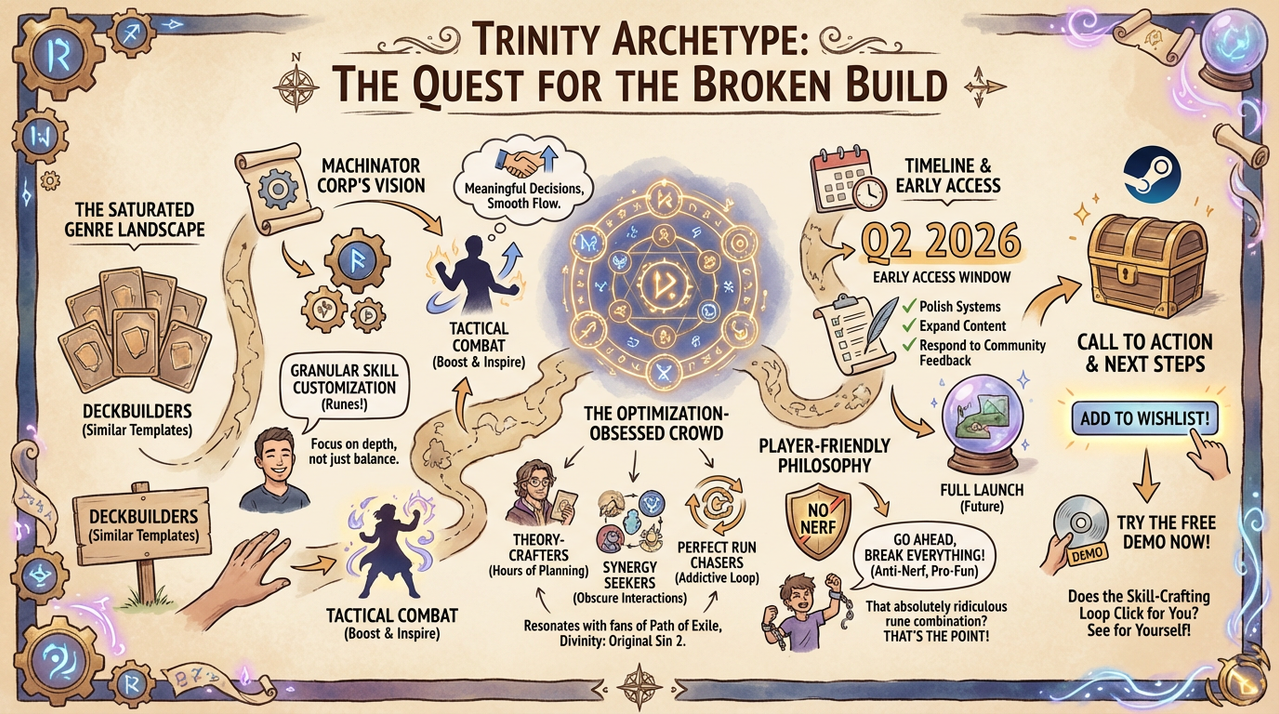
Trinity Archetype arrives at an interesting moment for roguelike RPGs. The genre feels saturated with deckbuilders all following similar templates, and players are hungry for fresh takes that maintain the addictive loop while introducing new wrinkles. Machinator Corp’s focus on granular skill customization through runes, combined with their explicit encouragement of broken builds, creates a distinct identity that could resonate with the optimization-obsessed crowd that made games like Path of Exile and Divinity: Original Sin 2 so successful. The Boost and Inspire mechanics add tactical depth without overwhelming complexity, creating moment-to-moment decisions that feel meaningful while keeping combat flowing smoothly. For a small studio’s ambitious project, the early demo feedback has been remarkably positive, with players praising the depth of customization and the satisfying feeling of discovering powerful synergies. The Q2 2026 Early Access window gives Machinator Corp time to polish systems, expand content, and respond to community feedback before the full launch. Whether Trinity Archetype becomes the next must-play roguelike or disappears into the crowded Steam marketplace depends on execution, but the foundation looks solid and the philosophy behind it feels refreshingly player-friendly. In a world where developers often nerf fun in service of balance, a game that says go ahead, break everything represents a welcome change. If you’re the type of player who spends hours theory-crafting builds, discovering obscure interactions, and chasing the perfect run, Trinity Archetype deserves a spot on your wishlist. The demo is free on Steam right now, so there’s no reason not to try it and see if the skill-crafting loop clicks for you. Just remember: when you find that absolutely ridiculous rune combination that trivializes encounters, that’s not a bug. That’s the whole point.