The Watch Dogs franchise appears to be officially over. Gaming insider Tom Henderson, known for his accurate leaks, has confirmed that Ubisoft’s hacker-themed open-world series is “completely dead” with no new installments planned. The revelation came during the latest Insider Gaming podcast, adding another casualty to Ubisoft’s ongoing corporate restructuring that has seen multiple games canceled and studios shut down.
What Tom Henderson Said
During the Insider Gaming podcast episode titled “The For Ubisoft Xbox Developer Reactions It’s Our One Year Anniversary,” Henderson addressed the future of Watch Dogs following Ubisoft’s announcement of massive cancellations. His statement was blunt and definitive: “As far as I’m aware at this moment in time, the Watch Dogs IP is completely dead.” Henderson explained that after Watch Dogs Legion launched in 2020, the development team moved to a different project that had been in the works for several years but was ultimately canceled. Critically, that canceled project was not Watch Dogs-related, signaling the franchise had already been shelved internally.
The timing of Henderson’s revelation is particularly significant because it follows Ubisoft’s January 21, 2026 announcement of a major corporate restructuring. During that announcement, the company canceled six games including the long-troubled Prince of Persia: The Sands of Time remake, shut down two studios, and delayed seven other projects. Ubisoft’s stock price plunged nearly 40 percent following the news, marking its sharpest single-day decline ever and dropping to levels not seen since 2011.
Why Watch Dogs Legion Failed
Watch Dogs Legion’s rocky reception appears to be the nail in the coffin for the franchise. The game launched in October 2020 with a unique premise: players could recruit any NPC in a dystopian London to join their resistance movement. In theory, this “play as anyone” mechanic should have revolutionized open-world games. In practice, it created a host of problems that never got fully resolved.
According to Henderson, developers working on Legion believed the game needed considerably more development time before release. The procedurally generated characters meant sacrificing deep storytelling and meaningful character development. Players ended up with a roster of forgettable operatives instead of memorable protagonists like Aiden Pearce from the first game or Marcus Holloway from Watch Dogs 2. The writing was criticized as extremely poor across the board, made worse by stilted voice performances that broke immersion.

Development Troubles Behind the Scenes
Community analysis suggests that Ubisoft lost confidence in Legion’s original vision midway through development, possibly spooked by the failure of Ghost Recon Breakpoint. The company allegedly scrambled to course correct, cutting RPG elements that had been planned. Individual operative progression was scrapped in favor of a shared tech menu. Unique stat-based traits for every NPC were reduced to just a handful of operative types like hitmen and construction workers. The last-minute changes resulted in countless bugs and glitches at launch, delayed online modes, and cut content including entire story missions.
The multiplayer component launched months after the base game and was met with profound disappointment. Public matchmaking sessions descended into chaotic shootouts with zero coordination, undermining the tactical stealth gameplay that made earlier Watch Dogs games compelling. The creative tools that could have made co-op interesting, like hijacking combat drones or planting turrets on cars, were locked behind a grindy progression system that turned off casual players.
From Promising Start to Franchise Graveyard
The death of Watch Dogs is particularly tragic when you consider how promising the franchise once seemed. When the first Watch Dogs launched in 2014, Ubisoft CEO Yves Guillemot boldly claimed it was “perfectly positioned to become the industry’s most successful new IP in history.” The game was the most preordered new IP in Ubisoft’s history and the second-highest preordered Ubisoft game of all time. It seemed poised to become a flagship franchise alongside Assassin’s Creed and Far Cry.
Watch Dogs 2, released in 2016, refined the formula with better hacking mechanics, a more likable protagonist, and a vibrant San Francisco setting that felt alive. Many fans consider it the high point of the series. But the commercial performance didn’t match the critical improvements, and Ubisoft clearly felt pressure to reinvent the wheel for the third installment rather than iterate on what worked.
What Happens Next
While the game franchise appears dead, Ubisoft hasn’t completely abandoned the Watch Dogs IP. A Watch Dogs movie directed by Mathieu Turi and starring Tom Blyth and Sophie Wilde started shooting in summer 2024, more than a decade after it was first announced. There’s also an official Watch Dogs interactive audio experience on Audible. These projects suggest Ubisoft still sees potential value in the brand, even if they’re not willing to invest in another game.
Henderson’s sources indicate there are currently no ideas or desire within Ubisoft to make new Watch Dogs titles. The franchise could be put on hold indefinitely, joining a graveyard of Ubisoft IPs that showed promise but couldn’t sustain momentum. This includes Pioneer, the sci-fi space exploration game teased in Watch Dogs 2 that was quietly canceled in 2019, and countless other projects that never saw the light of day.
The Bigger Picture at Ubisoft
The Watch Dogs cancellation is just one piece of a much larger crisis at Ubisoft. The company is undergoing a fundamental restructuring of its development processes and reevaluating all its major franchises. CEO Yves Guillemot stated the strategy aims to “establish the conditions for a return to sustainable growth,” which appears to mean fewer franchises developed simultaneously and a stronger focus on established moneymakers like Assassin’s Creed.
Ubisoft Halifax and Ubisoft Stockholm were shut down entirely during the restructuring, while other studios faced smaller impacts. The company is accelerating investments in generative AI while pulling back from riskier creative projects. For a company that once prided itself on launching new IPs and taking creative chances, the shift represents a dramatic change in philosophy driven by financial pressure and investor demands.
| Watch Dogs Game | Release Year | Setting | Reception |
|---|---|---|---|
| Watch Dogs | 2014 | Chicago | Mixed – downgraded graphics controversy but strong sales |
| Watch Dogs 2 | 2016 | San Francisco | Positive – improved mechanics but lower sales |
| Watch Dogs Legion | 2020 | London | Mixed – ambitious concept undermined by execution issues |
Fan Reactions
The gaming community’s reaction to Henderson’s announcement has been a mixture of disappointment and resignation. On Reddit, fans noted that Watch Dogs was never able to truly take off despite massive hype after its initial reveal trailer. The franchise struggled to find its identity, caught between wanting to be a serious cyberpunk thriller and a playground for chaotic hacking pranks. Neither approach was fully realized across three games.
Some fans are comparing Watch Dogs to Sleeping Dogs, another hacking-adjacent open-world franchise that was also canceled despite having a passionate fanbase. Both series showed flashes of brilliance but couldn’t sustain the commercial success needed to justify continued investment. In the current gaming landscape where publishers increasingly focus on live service games and established franchises, mid-tier series like Watch Dogs struggle to survive.
FAQs
Is Watch Dogs 4 officially canceled?
While Ubisoft hasn’t made an official announcement, insider Tom Henderson reports that the Watch Dogs IP is “completely dead” with no games currently in development. The franchise appears to be shelved indefinitely following the disappointing reception of Watch Dogs Legion.
Who is Tom Henderson and is he reliable?
Tom Henderson is a well-known gaming insider and journalist who runs Insider Gaming. He has a strong track record of accurate leaks and is considered a Tier 1 Very Reliable source by the gaming community. His reports are generally treated as credible within the industry.
What happened to the Watch Dogs Legion development team?
According to Henderson, after Watch Dogs Legion launched in 2020, the team moved to a different project that was not Watch Dogs-related. That project was in development for several years but was ultimately canceled during Ubisoft’s recent restructuring.
Why did Watch Dogs Legion fail?
Legion struggled with multiple issues including poor writing, stilted voice acting, a lack of memorable characters due to its “play as anyone” system, development troubles, and a rushed release. The game reportedly needed more development time but was pushed out to meet deadlines, resulting in bugs and cut content.
Will there be any more Watch Dogs content?
While no new games are planned, a Watch Dogs movie starring Tom Blyth and Sophie Wilde began shooting in 2024. There’s also an official Watch Dogs interactive audio experience on Audible. The IP isn’t completely abandoned but appears unlikely to get another game.
When did Ubisoft announce their major restructuring?
Ubisoft announced a major corporate restructuring on January 21, 2026, which included canceling six games, shutting down two studios, and delaying seven other projects. The company’s stock dropped 40 percent following the announcement.
What was the original vision for Watch Dogs?
When Watch Dogs launched in 2014, Ubisoft positioned it as a potential flagship franchise that could become “the industry’s most successful new IP in history.” It was the most preordered new IP in Ubisoft’s history at the time and showed strong initial sales.
Which Watch Dogs game was the best received?
Watch Dogs 2 is generally considered the high point of the series by fans and critics. It refined the hacking mechanics, featured a more likable protagonist in Marcus Holloway, and offered a vibrant open-world San Francisco setting, though it sold less than the original.
Conclusion
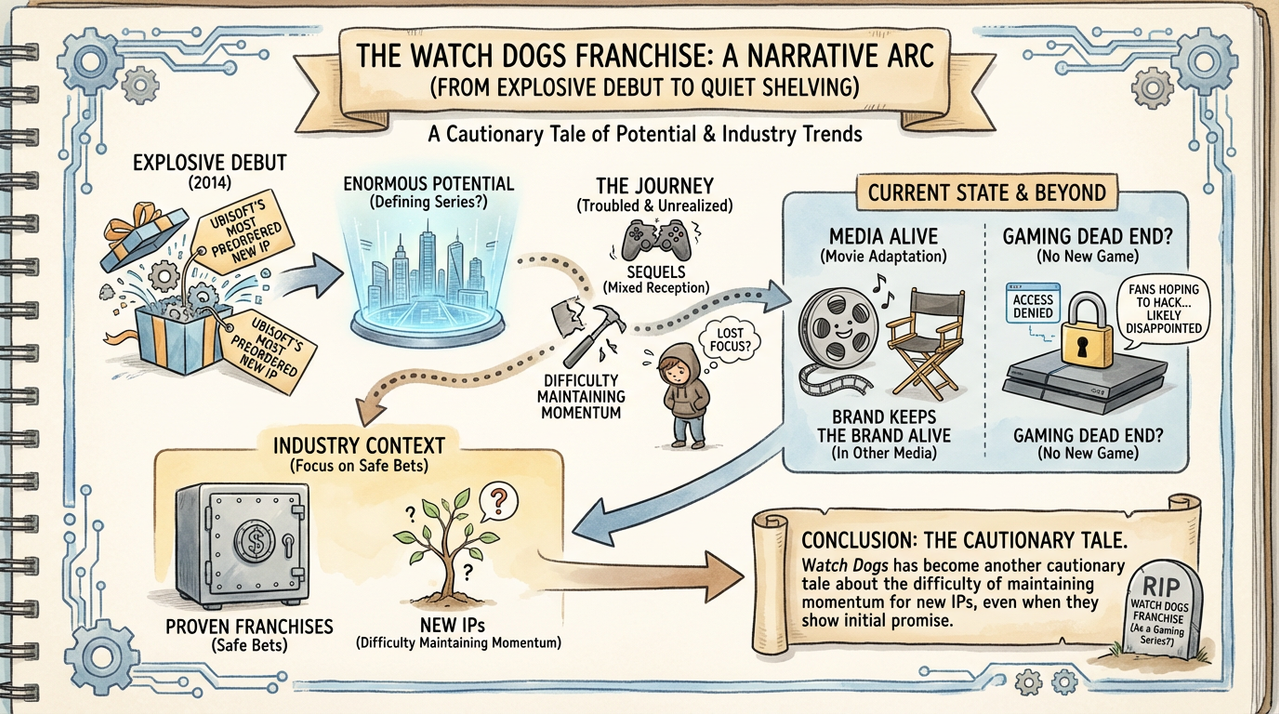
The apparent death of the Watch Dogs franchise marks the end of what could have been one of gaming’s defining series. From its explosive debut as Ubisoft’s most preordered new IP to its quiet shelving after Legion’s troubled launch, the franchise never quite lived up to its enormous potential. While a movie adaptation keeps the brand alive in other media, fans hoping to hack their way through another open world as a new protagonist will likely be disappointed. In an industry increasingly focused on safe bets and proven franchises, Watch Dogs has become another cautionary tale about the difficulty of maintaining momentum for new IPs even when they show initial promise.