Video game development involves countless hours of testing to ensure everything works properly before launch. But behind every polished release lies a collection of bizarre, hilarious, and sometimes downright absurd testing methods that developers rarely discuss publicly. A recent article from IGN compiled stories from industry veterans revealing their strangest quality assurance techniques, from banana castles built to stress test physics engines to entire islands covered in croaking frogs that needed extermination tickets.
These anecdotes pull back the curtain on game development, showing that creating immersive worlds often requires building ridiculous test environments that players never see. Whether it’s Mortal Kombat’s infamous Carwash where T-posed characters get dismembered by every damage type imaginable, or Overwatch’s custom testing hero with 10x movement speed, developers get genuinely creative when solving technical problems. The stories are equal parts fascinating and funny, highlighting the unglamorous reality behind gaming’s most polished experiences.
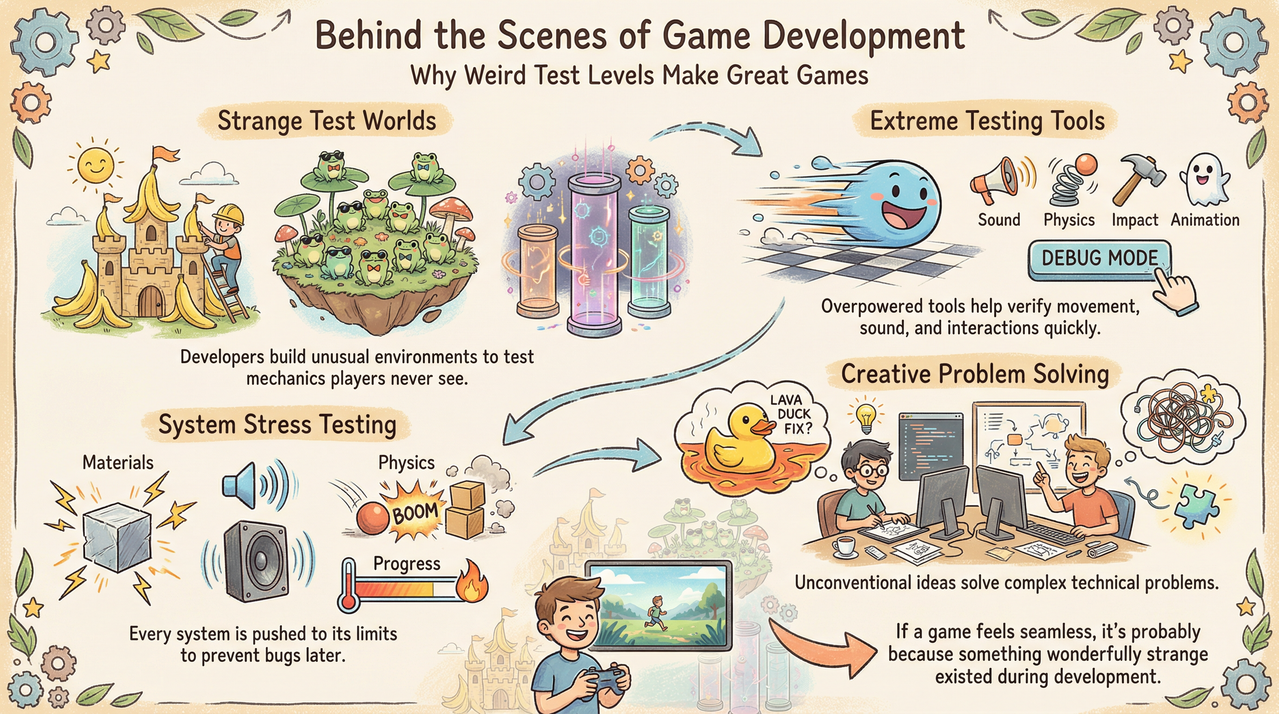
The Banana Castle Physics Experiment
Grant Mark, technical director at Moonshot working on the upcoming game Wildgate, revealed one of the most delightfully absurd testing projects in recent memory. Back in 2022, well before Wildgate’s official announcement, the team needed to identify performance bottlenecks in their physics simulation. The problem was they couldn’t reveal what they were actually working on to external vendors who would help with optimization.
The solution? Build a castle made entirely of bananas. Using stock Unreal Engine assets, Mark’s team glued banana models together to create elaborate structures that would stress test their physics system without revealing any proprietary game content. The nickname “Banana Castle” stuck internally as developers sent these ridiculous test projects to vendors, who probably had many questions about why they were optimizing the structural integrity of fruit-based architecture.
This approach perfectly captures game development’s practical creativity. When you need to test complex systems but maintain secrecy around unreleased projects, sometimes the answer is constructing architecturally unsound buildings from produce. The banana castle served its purpose, helping identify performance issues that were later fixed in the actual game, proving that sometimes the silliest solutions are the most effective.
Frog Island Must Die
Shayna Moon, a senior technical producer who worked on God of War, shared perhaps the most environmentally catastrophic testing story. During audio implementation, the team added a simple frog croaking sound to frog assets scattered throughout the game world. One level designer, apparently deciding that one frog wasn’t enough, took that asset and absolutely covered an entire island with frogs. Hundreds, possibly thousands of amphibians, all croaking simultaneously.
The result was audio chaos. Moon had to create a JIRA ticket with what might be the greatest description in game development history: kill Frog Island. The mental image of a producer desperately trying to convince their team that yes, the frog genocide is necessary for the game’s audio mix is pure comedy. But it illustrates an important testing principle: edge cases matter, and sometimes edge cases involve level designers going absolutely feral with asset placement.

Skinballs and Lighting Tests
Elizabeth Zelle, who worked on Saints Row, introduced the gaming world to Skinballs, possibly the most unsettling debug character ever created. Skinballs wasn’t a carefully modeled test dummy or a simple cube. It was literally four spheres wrapped in different shades of skin texture, designed specifically to test lighting on different skin tones during development.
The existence of Skinballs highlights an often-overlooked aspect of game development: ensuring visual elements work across diverse character appearances. Different skin tones react differently to various lighting conditions, and proper testing requires intentional planning. Most teams don’t plan for this kind of inclusive testing, but the Saints Row developers built it directly into their workflow with their delightfully named spherical friend.
While Skinballs might look disturbing in screenshots, the character served a crucial technical purpose. Developers could quickly load Skinballs into any lighting environment and immediately see how different skin tones would render under those conditions. It’s ugly, practical, and exactly the kind of behind-the-scenes solution that makes polished games possible.
The Mortal Kombat Carwash
Daanish Syed, a former Netherrealm Studios artist, revealed one of the most metal testing methods in gaming history: The Carwash. Used during development of Mortal Kombat X or 11, this test involved a T-posed character model slowly moving through a series of particle emitters, each one causing a specific type of damage including cuts, stabs, burns, gashes, and ice damage.
The Carwash allowed artists to test damage models on characters systematically, ensuring that every injury type displayed correctly across all fighters. Instead of manually triggering each damage state during actual gameplay, they could send a character through this automated torture chamber and watch as their model accumulated every possible wound. It’s efficient, horrifying, and perfectly on-brand for a franchise built on creative violence.
Imagine being a new employee at Netherrealm and walking past someone’s monitor showing a T-posed Sub-Zero slowly gliding through burning embers, ice shards, and stabbing effects while their colleague takes notes. Just another day at the office for fighting game developers.

Overwatch’s Super Tester Hero
Andrew Buczacki, who worked on Overwatch, faced a tedious but important challenge: ensuring every surface in every map made the correct sound when shot. Wood needed to sound like wood, metal like metal, and with dozens of materials across multiple large maps, manually testing everything would take forever. His solution was creating a custom testing hero that never appeared in the actual game.
This Franken-hero combined Widowmaker’s hookshot with a reduced one-second cooldown, Hanzo’s wall-climb ability, expanded magazine size, 10x movement speed, and the ability to toggle bullet sounds on and off. Essentially, Buczacki built a material-testing superhero who could zip around maps at ridiculous speeds, shooting everything in sight to verify audio implementation. When he left the team, colleagues told him they still used his custom hero for testing, which apparently made his day.
This story exemplifies smart problem-solving in game development. Instead of spending weeks manually testing materials, Buczacki invested time creating tools that made the job efficient and even somewhat fun. Give developers the right tools, and they’ll find creative ways to solve annoying problems.
World of Warcraft’s Testing Circus
Andrew Buczacki also shared multiple World of Warcraft testing anecdotes that border on the surreal. During testing for the Icecrown raid’s final boss in Wrath of the Lich King, a bug caused the Lich King’s sword Frostmourne to disappear in cinematics on specific hardware configurations. The solution? Mobilize the entire WoW QA floor to test every permutation of graphics settings and resolutions.
By the end of that testing day, dozens of QA testers had watched the cinematic so many times they’d memorized the dialogue. For months afterward, people would randomly shout “Bolvar!” around the office, a testament to the repetitive nature of quality assurance work. Another tester shared that verifying an achievement for winning loot rolls with a natural 100 required spawning approximately 100 raid bosses simultaneously in Onyxia’s Lair, activating god mode, and using cheat spells to murder everything before the tedious process of looting corpses.
WoW testing also involved creating automated galleries of character models wearing different equipment, taking screenshots from fixed angles on each new build to ensure shoulder pads didn’t mysteriously shrink. This happened to male Orcs over several patches before the automated system caught it, proving that even established live service games need constant vigilance against regression bugs.
The Tower of Physical Materials
Josh Ledford, a QA analyst at Obsidian working on The Outer Worlds 2, built a test level that sounds like a sensory nightmare: a tower where each room was made entirely of a different physical material. Some rooms had walls, ceilings, and floors made completely of hair. Others were constructed entirely from skin.
This horrifying architecture served an important purpose. The Outer Worlds 2 features different physical materials that affect both combat and movement, with unique responses to being shot and distinct footstep sounds. Instead of loading into various game levels to test specific materials, Ledford could teleport directly to the hair room, the skin room, or any other material chamber and quickly verify that effects worked correctly.
The mental image of a character walking around a room where every surface is skin, shooting skin walls to hear the impact sounds while taking notes, perfectly captures the deeply weird reality of game development. Players experience polished final products, but creating those products involves building rooms made of human tissue and documenting how bullets sound when they hit.
FAQs About Game Testing Methods
What was the Banana Castle in game development?
The Banana Castle was a test project created by Moonshot’s Wildgate team in 2022. Using stock Unreal Engine assets, developers built structures entirely from banana models to stress test their physics simulation system without revealing their actual game to external optimization vendors.
Why did God of War developers need to kill Frog Island?
A level designer covered an entire island with frog assets that each had croaking sounds attached. The resulting audio chaos from hundreds or thousands of frogs croaking simultaneously required senior technical producer Shayna Moon to create a JIRA ticket specifically to remove the excessive frogs.
What is Skinballs in video game testing?
Skinballs was a debug character used during Saints Row development consisting of four spheres wrapped in different shades of skin texture. It was specifically designed to test how lighting affected different skin tones, ensuring the game’s lighting worked properly across diverse character appearances.
How did Mortal Kombat developers test damage models?
Netherrealm Studios used “The Carwash,” where T-posed character models slowly moved through a series of particle emitters causing specific damage types like cuts, stabs, burns, gashes, and ice damage. This allowed systematic testing of all injury visualizations on every character.
What was the custom Overwatch testing hero?
Developer Andrew Buczacki created a custom hero combining Widowmaker’s hookshot with one-second cooldown, Hanzo’s wall-climb, expanded magazine size, 10x movement speed, and toggleable bullet sounds. This allowed efficient testing of material surface sounds across all maps by shooting every surface type.
Why do game developers create weird test environments?
Developers create unusual test environments to efficiently verify specific systems work correctly without loading full game levels or revealing proprietary content to external vendors. These environments isolate specific features like physics, audio, lighting, or material properties for focused testing.
What is the Tower of Physical Materials in The Outer Worlds 2?
QA analyst Josh Ledford built a test level where each room consisted entirely of different physical materials including hair and skin. This allowed quick testing of material-specific features like bullet impact effects and footstep sounds without navigating through actual game levels.
How repetitive is video game quality assurance testing?
Extremely repetitive. World of Warcraft QA testers memorized entire cinematic dialogues after watching them hundreds of times to test hardware-specific bugs. Testing can involve spawning 100 bosses simultaneously or spending days dropping nuclear weapons at different angles for rating board submissions.
Conclusion
The stories of Banana Castles, Frog Island, Skinballs, and The Carwash reveal a fundamental truth about game development: creating polished, immersive experiences requires building absolutely ridiculous test environments that players never see. Behind every smooth gameplay experience are developers shooting skin walls in nightmare towers, exterminating islands full of croaking amphibians, and watching T-posed characters get systematically dismembered by every damage type imaginable. These testing methods might sound absurd, but they represent practical solutions to complex technical problems. When you need to verify that hundreds of materials make correct sounds when shot, building a superhero with 10x movement speed makes perfect sense. When physics optimization requires secrecy, constructing castles from bananas becomes a legitimate strategy. The creativity and problem-solving behind these testing methods highlight the technical artistry that goes into game development. The next time you play a AAA title and everything just works, remember that somewhere in that game’s development history, someone probably built something absolutely insane to make that polish possible. Whether it was a frog-covered island, a banana castle, or spheres made of skin, the weird testing methods are what separate broken messes from playable masterpieces. Game development is beautiful, technical, artistic, and occasionally involves creating rooms made entirely of human hair.