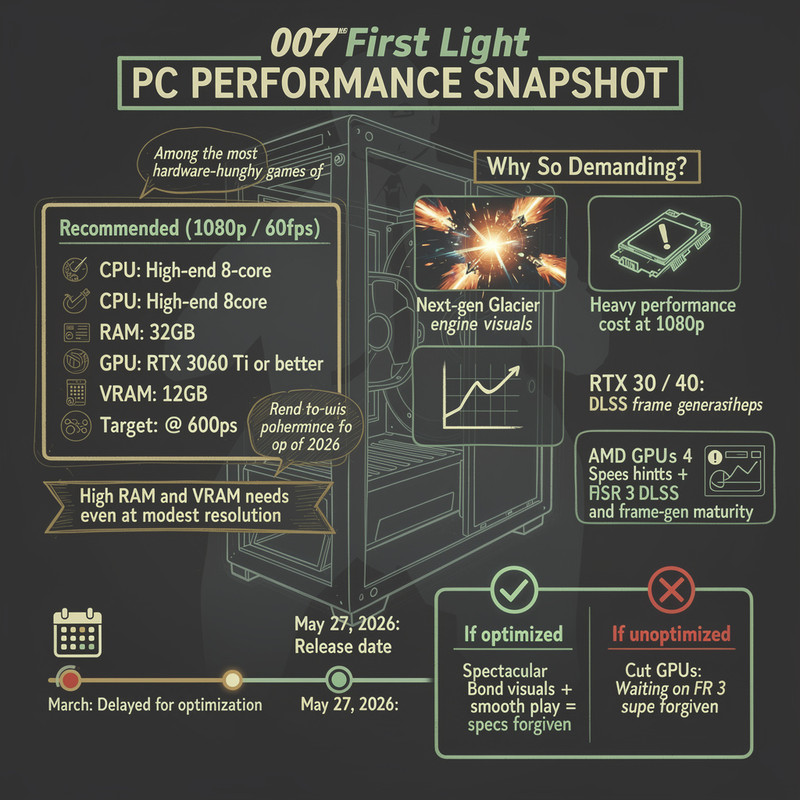
IO Interactive revealed the PC system requirements for 007 First Light on January 5, 2026, and the specs raise serious questions about optimization. The recommended configuration targets just 1080p at 60fps yet demands 32GB of RAM and 12GB of VRAM, specifications typically associated with 4K gaming rather than basic full HD performance. Even more confusing, IO lists the RTX 3060 Ti as a recommended GPU despite that card only having 8GB of VRAM, creating a contradiction between stated requirements and actual hardware compatibility. The studio hasn’t provided specs for 1440p or 4K, suggesting the game will rely heavily on NVIDIA’s DLSS 4 with multi-frame generation to reach playable frame rates at higher resolutions.
The May 27, 2026 release date gives IO Interactive four more months of optimization time after delaying from the original March 27 launch window. The Glacier engine powering 007 First Light has “significantly advanced” according to IO’s announcement, with next-generation smoke, cloud, and particle effects requiring substantial GPU resources. PC Gamer’s coverage notes that while the minimum specs seem forgiving, the recommended requirements feel worryingly high for 1080p/60fps gameplay, especially the 32GB RAM demand that exceeds most modern AAA titles targeting the same resolution and frame rate.
The Full System Requirements Breakdown
For minimum specifications targeting 1080p at 30fps, IO Interactive recommends an Intel Core i5 9500K or AMD Ryzen 5 3500 processor paired with an NVIDIA GTX 1660, AMD RX 5700, or Intel discrete GPU equivalent. You’ll need 16GB of RAM, 8GB of VRAM, 80GB of storage space, and Windows 10 or 11 64-bit. These requirements actually seem reasonable for an entry-level experience, with the GTX 1660 representing budget-friendly hardware from 2019 that remains capable for 1080p gaming.
The recommended specs targeting 1080p at 60fps jump dramatically to an Intel Core i5 13500 or AMD Ryzen 5 7600, paired with an NVIDIA RTX 3060 Ti, AMD RX 6700 XT, or Intel discrete GPU equivalent. Here’s where things get weird: IO demands 32GB of RAM, 12GB of VRAM, and still requires 80GB of storage with Windows 10/11 64-bit. That 32GB RAM requirement places 007 First Light among the most demanding modern games despite only targeting 1080p resolution.
DSO Gaming points out the obvious issue: “I’m pretty sure that the RAM requirements are not that accurate, especially if you don’t run other programs in the background. The devs probably used 32GB just so they can be safe.” This makes sense given most players don’t exclusively run games without browsers, Discord, or other background applications consuming resources. However, the 12GB VRAM recommendation contradicts listing the RTX 3060 Ti with only 8GB VRAM as a compatible GPU, suggesting IO either made an error or expects players to rely heavily on DLSS upscaling.
The RTX 3060 Ti Problem
Play Rated Games noticed the contradiction: “While 007 First Light recommended PC specs mention 12GB of VRAM, the team has listed NVIDIA RTX 3060 Ti with only 8GB VRAM as one of the compatible GPUs. There seems to be a mistake, and we can only hope that the studio rectifies the same before the release.” This error reveals either sloppy communication or reliance on assumptions about DLSS performance allowing 8GB cards to punch above their weight through aggressive upscaling and frame generation.
The RTX 3060 Ti launched in December 2020 as NVIDIA’s mainstream offering with 8GB of GDDR6 memory, intentionally positioned below the 3070’s 8GB and 3080’s 10GB configurations. For IO to recommend this specific GPU while simultaneously stating 12GB VRAM is required creates confusion about whether the game actually needs 12GB or if that figure accounts for future-proofing and higher settings not covered by the 1080p/60fps target.

NVIDIA DLSS 4 Partnership
IO Interactive announced a close collaboration with NVIDIA to implement DLSS 4 with multi-frame generation in 007 First Light. According to GameSpot’s coverage, IO says DLSS 4 “enables us to deliver a PC experience that matches the level of quality we believe the Bond franchise deserves,” allowing for “an even deeper sense of immersion and improved performance.” This partnership appears crucial for the game reaching acceptable performance levels, especially at resolutions beyond 1080p.
DLSS 4 represents NVIDIA’s latest AI-powered rendering technology featuring transformer-based super resolution and 4X multi-frame generation for RTX 50 series cards. The technology generates three additional frames for every one traditionally rendered frame, dramatically multiplying frame rates while maintaining image quality. For RTX 40 series owners, DLSS Frame Generation provides similar benefits generating one additional frame, while all RTX GPU owners can leverage DLSS Super Resolution for upscaling performance.
NVIDIA’s official announcement states that 007 First Light will feature DLSS 4 with multi-frame generation on PC, “which will increase detail and multiply frame rates with DLSS Multi Frame Generation.” The company showcased gameplay at CES 2026 running on RTX 50 series hardware, demonstrating how the technology enables higher frame rates than native rendering would allow. IO Interactive’s Chief Technical Officer Ulas Karademir, Principal Engineer Henrik Schlichter, and Franchise Art Director Rasmus Poulsen discussed the implementation in interviews with NVIDIA.
PC Gamer’s analysis suggests 007 First Light will “lean heavily on upscaling (and possibly frame generation) to run well because those effects are heavily affected by resolution, which upscaling reduces.” The publication notes IO has “significantly advanced” the Glacier engine with next-gen smoke, cloud, and particle effects, but those visual improvements come at substantial performance costs. Without DLSS 4, reaching 60fps at 1440p or 4K likely requires hardware well beyond what most enthusiasts own.
The Missing 1440p and 4K Specs
IO Interactive’s decision to only publish 1080p specifications raises eyebrows in 2026 when 1440p represents the sweet spot for PC gaming and 4K displays have become increasingly common among enthusiasts. Game Informer notes “there’s no word on what kind of PC you’ll need to play the game at, say, 1440p or 4K or even an FPS rate higher than 60.” This omission suggests IO either hasn’t finalized higher-resolution performance or expects players to figure it out themselves using DLSS upscaling.
GameSpot observes that the revealed specs “may be lower than many PC enthusiasts may want. There is no word on what a higher-end experience could require.” For comparison, most major AAA releases in 2025-2026 include Ultra or Extreme preset specifications targeting 1440p/60fps and 4K/60fps, often with separate ray tracing configurations. IO’s silence on these configurations implies the Glacier engine struggles to provide acceptable performance without aggressive DLSS usage.
PC Gamer speculates that “while IO Interactive said it has ‘significantly advanced’ the Glacier engine, that engine has never been the best for delivering performance in the Hitman games.” The publication notes that despite visual improvements, “it’s likely 007 First Light players will have to rely on those technologies to run at frame rates higher than 60, especially at resolutions beyond 1080p.” This dependency on NVIDIA’s upscaling and frame generation explains why the partnership announcement emphasizes DLSS 4 so heavily.
The Glacier Engine History
The Glacier engine powering 007 First Light traces back to IO Interactive’s Hitman series, where it delivered impressive visual fidelity but inconsistent performance across hardware configurations. Hitman (2016), Hitman 2 (2018), and Hitman 3 (2021) all featured large sandbox environments with detailed crowds, complex lighting, and reactive systems that stressed CPUs and GPUs differently depending on scenarios. While the engine excelled at creating believable living worlds, optimization remained a persistent complaint among PC players.
IO’s announcement emphasizes the “significantly advanced” Glacier engine features next-generation smoke, cloud, and particle effects leveraging modern GPU capabilities. These volumetric effects notoriously tank performance because they scale exponentially with resolution. Rendering realistic clouds at 4K native resolution requires processing dramatically more data than at 1080p, explaining why IO focuses specs on lower resolutions and leans on DLSS to handle higher settings.
The 80GB storage requirement suggests extensive high-resolution textures, audio files, and potentially pre-computed lighting data consuming disk space. Interestingly, IO doesn’t require an SSD for minimum specs, though recommended configurations almost certainly benefit from solid-state storage reducing load times and texture streaming hitches. Modern engines increasingly demand SSDs for acceptable performance, making IO’s decision to list HDDs as compatible somewhat surprising for a 2026 release.
How This Compares to Recent AAA Releases
Looking at other major 2025-2026 releases provides context for 007 First Light’s demanding requirements. Cyberpunk 2077 with path tracing enabled requires similar high-end hardware but explicitly targets 4K resolution with DLSS 4 achieving 240fps on RTX 50 series cards according to IGN’s coverage. Indiana Jones and the Great Circle recommends 16GB RAM and 8GB VRAM for 1440p/60fps Ultra settings, half the memory 007 First Light demands for lower resolution.
Doom: The Dark Ages targets 4K with DLSS 4 multiplying frame rates by 4x on RTX 50 series hardware, while FBC: Firebreak leverages the full RTX technology suite developed for Alan Wake 2 to achieve path-traced lighting at playable frame rates. These games demonstrate how DLSS 4 enables previously impossible performance levels, but they target higher resolutions than 007 First Light’s published specs suggest IO can achieve with the Glacier engine.
Reddit discussions about the specs show skepticism from the PC gaming community. One user noted that requiring 32GB RAM and 12GB VRAM for 1080p/60fps seems excessive compared to other demanding titles like Resident Evil Village, which runs beautifully at higher resolutions with less memory. Another pointed out that IO’s history with Hitman performance issues makes these aggressive requirements less surprising but no less disappointing for players hoping to max out settings without DLSS assistance.

GeForce NOW Streaming Option
NVIDIA’s announcement reveals that 007 First Light will be available on GeForce NOW at launch, allowing players without high-end local hardware to stream the game using cloud-based RTX 5080-class performance. Ultimate membership subscribers get access to DLSS 4, providing ultra-smooth gaming across devices including low-powered laptops, tablets, and even smartphones. This cloud streaming option partially addresses concerns about demanding PC requirements by offering an alternative path for players who can’t afford or don’t want to upgrade their hardware.
GeForce NOW Ultimate costs $19.99 monthly and includes priority access to NVIDIA’s servers with GeForce RTX 5080-equivalent performance, 4K resolution support, and extended gaming sessions. For players with solid internet connections meeting NVIDIA’s recommended 50 Mbps download speed, streaming 007 First Light through GeForce NOW provides a legitimate alternative to purchasing expensive GPU upgrades specifically for this game.
What This Means for Players
If you’re planning to play 007 First Light at 1080p/60fps, you’ll probably need an RTX 3060 Ti or RX 6700 XT with 16GB of RAM minimum despite IO’s 32GB recommendation. The developers likely inflated RAM requirements to account for background applications and ensure smooth performance in worst-case scenarios. However, the 12GB VRAM requirement suggests aggressive texture streaming and potentially unoptimized asset management that could cause stuttering on 8GB cards without DLSS upscaling assistance.
For 1440p and 4K gaming, expect to need RTX 4070 Ti or better hardware with DLSS 4 or DLSS 3 frame generation enabled to maintain 60fps. Native rendering at these resolutions without upscaling assistance will likely demand RTX 4090 or RTX 5080 class hardware based on how demanding the recommended 1080p specs already are. AMD GPU owners may struggle without equivalent frame generation technology unless IO optimizes FSR 3 implementation as well as DLSS 4.
The May 27 launch date provides IO Interactive four additional months of optimization time following the delay from March 27. Hopefully, this extra development window allows the team to improve performance enough that the demanding specs become less critical. Historical precedent with other delayed games suggests optimization polish in final months can dramatically improve frame rates, though fundamental engine limitations rarely get completely resolved through last-minute patches.
FAQs About 007 First Light PC Requirements
When does 007 First Light release?
007 First Light launches on May 27, 2026, for PlayStation 5, Xbox Series X|S, PC, and Nintendo Switch 2. The game was originally scheduled for March 27, 2026, but IO Interactive delayed it by two months for additional development time.
What are the minimum PC specs for 007 First Light?
Minimum specs target 1080p at 30fps and require an Intel Core i5 9500K or AMD Ryzen 5 3500, NVIDIA GTX 1660 or AMD RX 5700, 16GB RAM, 8GB VRAM, 80GB storage, and Windows 10/11 64-bit.
What are the recommended PC specs for 007 First Light?
Recommended specs target 1080p at 60fps and require an Intel Core i5 13500 or AMD Ryzen 5 7600, NVIDIA RTX 3060 Ti or AMD RX 6700 XT, 32GB RAM, 12GB VRAM, 80GB storage, and Windows 10/11 64-bit.
Why does 007 First Light require 32GB RAM for 1080p?
IO Interactive likely inflated RAM recommendations to account for background applications and ensure smooth performance. Most players will probably run the game acceptably with 16GB RAM, though 32GB provides headroom for browser tabs, Discord, and other typical applications running alongside the game.
Does 007 First Light support NVIDIA DLSS 4?
Yes, IO Interactive partnered with NVIDIA to implement DLSS 4 with multi-frame generation on PC. The technology generates three additional frames per rendered frame on RTX 50 series GPUs, dramatically multiplying frame rates while maintaining image quality.
What resolution and frame rate specs has IO revealed?
IO Interactive has only revealed specifications for 1080p at 30fps (minimum) and 1080p at 60fps (recommended). No 1440p or 4K specifications have been announced, suggesting players will need to rely on DLSS upscaling for higher resolutions.
Can I play 007 First Light without a high-end PC?
Yes, NVIDIA announced 007 First Light will be available on GeForce NOW cloud streaming service at launch. Ultimate membership subscribers get RTX 5080-class performance with DLSS 4 support, allowing play on low-powered devices with solid internet connections.
Why does the RTX 3060 Ti recommendation contradict 12GB VRAM requirement?
This appears to be an error in IO’s specifications. The RTX 3060 Ti only has 8GB VRAM despite the studio stating 12GB is required. Either IO made a mistake or expects players to use DLSS upscaling to compensate for the VRAM shortfall.
Conclusion
007 First Light’s PC system requirements reveal a game that pushes the Glacier engine to its limits with next-generation visual effects that come at substantial performance costs. Demanding 32GB RAM and 12GB VRAM just to hit 1080p at 60fps places IO Interactive’s James Bond debut among the most hardware-hungry releases of 2026 despite targeting relatively modest resolution and frame rate combinations. The contradiction between recommending the RTX 3060 Ti while stating 12GB VRAM is required suggests either specification errors or heavy reliance on DLSS upscaling to bridge the gap. IO’s partnership with NVIDIA for DLSS 4 implementation appears crucial for making the game playable at 1440p and 4K, with multi-frame generation providing the performance multipliers needed to compensate for engine limitations. The absence of higher resolution specifications implies IO either hasn’t optimized beyond 1080p yet or expects players to figure out their own settings using DLSS as a crutch. For players with RTX 30 or 40 series hardware, DLSS frame generation provides a path to higher frame rates without upgrading to RTX 50 series cards. AMD GPU owners face uncertainty without equivalent frame generation maturity, though FSR 3 support remains possible. The May 27 release date gives IO four more months of optimization time following the March delay, hopefully allowing performance improvements that make these demanding specs less critical. Whether 007 First Light justifies its hardware hunger depends on how well IO leverages the Glacier engine’s visual advances to deliver a Bond experience worthy of the franchise legacy. If the game looks spectacular and plays smoothly with DLSS enabled, most players won’t care about aggressive system requirements. But if performance issues plague the launch despite these high specs, IO will face justified criticism for shipping an unoptimized mess requiring cutting-edge hardware for basic 1080p gameplay.