Xbox released some genuinely excellent games in 2025. Doom: The Dark Ages was spectacular, Avowed proved Obsidian can’t miss, and South of Midnight delivered something visually unique. Unfortunately, nobody’s talking about any of that because Microsoft spent the entire year lighting the Xbox brand on fire. Between studio closures, thousands of layoffs, canceled projects, Game Pass price hikes that felt like a betrayal, and the effective end of Xbox exclusives, 2025 might go down as the worst year in the platform’s 24-year history.
The Studio Bloodbath
Microsoft shut down multiple studios in 2025, and each closure felt more bewildering than the last. Arkane Austin, the team behind Prey and the troubled Redfall, got axed despite having talented developers who could have been reassigned. Tango Gameworks, fresh off the critical and commercial success of Hi-Fi Rush, was shuttered in a move that shocked the entire industry. The Initiative, Microsoft’s supposed AAAA studio built from scratch to create groundbreaking experiences, was completely dissolved after Perfect Dark was canceled following years of troubled development.
ZeniMax Online Studios saw massive layoffs when their unannounced Project Blackbird got the axe. Everwild, the mysterious project from Rare that had been in development for years, was quietly canceled. The body count kept rising throughout the year, and each announcement was met with the same corporate doublespeak about tough decisions and sustainable growth. Microsoft reportedly pushed Xbox studios to deliver a 30 percent profit margin, a demand that’s borderline impossible for creative teams working on long-term projects.
Game Pass Becomes a Luxury Product
Remember when Game Pass was the best deal in gaming? Microsoft certainly does, and they decided you should pay a lot more for it. Game Pass Ultimate jumped to $29.99 per month, a price hike that turned what was once an incredible value proposition into something that costs more than most streaming services. The kicker is that the fundamental promise of Game Pass – every new Xbox game day one – is no longer guaranteed.

Call of Duty Black Ops 6, one of Microsoft’s biggest releases after the Activision acquisition, didn’t follow the traditional Game Pass model. The company tested an $80 price point for The Outer Worlds 2 before fan backlash forced them back to $70. These moves signal that Microsoft sees Game Pass subscribers as a revenue problem to solve rather than a community to nurture. When you combine higher subscription costs with fewer guaranteed day-one releases, the value equation collapses.
The End of Xbox Exclusives
For years, Xbox executives insisted their exclusives would stay exclusive. Then 2025 happened. Forza Horizon 5 hit PlayStation. Gears of War: E-Day was announced as multiplatform. Microsoft committed to bringing Halo: The Master Chief Collection to PS5 in 2026. Indiana Jones and the Great Circle launched on PlayStation just months after Xbox. The floodgates opened, and suddenly owning an Xbox console felt pointless.
| Issue | Impact |
|---|---|
| Studio Closures | Arkane Austin, Tango Gameworks, The Initiative shut down |
| Mass Layoffs | Thousands of developers lost jobs across ZeniMax, 343, other studios |
| Game Pass Price | Ultimate jumped to $29.99/month with fewer day-one guarantees |
| Console Sales | Dropped 70% year-over-year |
| Exclusives | Major franchises like Halo, Gears, Forza going multiplatform |
| Console Price | Xbox Series X and S prices increased mid-generation |
Microsoft’s justification is that they’re a platform, not a console company. They want you to play Xbox games anywhere – on PlayStation, Switch, PC, phones, smart TVs. The problem is that this strategy eliminates the primary reason to buy Xbox hardware. Why would anyone purchase a Series X when they can play the same games on their existing PlayStation 5 or gaming PC? Xbox console sales cratered by 70 percent in 2025, and it’s not hard to see why.
The Messaging Disaster
Phil Spencer and Sarah Bond, Xbox’s public faces, spent 2025 delivering tone-deaf messaging that made everything worse. Spencer justified layoffs and closures by saying tough decisions are necessary for profitability, seemingly oblivious to how that sounds when Microsoft is a multi-trillion-dollar company investing heavily in AI. Bond repeatedly told fans to “wait until next year” for things to improve, a line that’s worn thin after years of the same promises.

The Xbox Games Showcase in June tried to generate hype with reveals of Clockwork Revolution and announcements about Final Fantasy games coming to Xbox. But the goodwill evaporated when studio closures and layoffs continued immediately after. It became clear that Microsoft’s leadership is completely disconnected from both the developers creating their games and the players buying them.
Sony’s Mediocre Year Still Beat Xbox
The most damning thing about Xbox’s 2025 is that Sony had a relatively quiet year, and Xbox still couldn’t capitalize. PlayStation had fewer major exclusives than usual, and their first-party output was modest compared to previous years. This should have been Xbox’s moment to gain ground. Instead, they helped Sony by releasing their biggest games on PS5, essentially plugging the gaps in Sony’s release calendar with Microsoft-funded titles.
Even more embarrassingly, Xbox console sales were outpaced by devices targeted at children. The brand that once competed head-to-head with PlayStation is now struggling to outsell niche hardware. PlayStation 5 is on track to surpass PS4 lifetime sales, partially thanks to Xbox imploding and creating a vacuum that Sony effortlessly filled.
The Human Cost
Behind every statistic about layoffs and studio closures are real people whose lives got upended. John and Brenda Romero, gaming legends responsible for foundational franchises like Doom and Quake, had to lay off most of their staff and scramble for a new publisher after Microsoft pulled funding for their FPS project. The game was reportedly far along in development, meaning years of work vanished because Microsoft decided it didn’t fit their 30 percent margin requirement.
Developers who survived the cuts are working in an environment of constant fear, never knowing if their project will be the next one canceled or their studio will be the next one closed. This creates a negative feedback loop where Game Pass has fewer new releases to keep subscribers engaged, which leads to slower growth, which leads to more layoffs and closures.
What About the Games?
The tragedy is that Microsoft’s game publishing arm had one of its best years in a long time. Doom: The Dark Ages delivered exactly what fans wanted – brutal, fast-paced action with modern polish. Avowed showed that Obsidian remains one of the most consistently excellent RPG developers in the industry. South of Midnight presented a fresh aesthetic inspired by Southern Gothic folklore. These are legitimately good games that deserved to be celebrated.
But all that quality gets buried under the avalanche of bad decisions surrounding it. When you shut down the studio that made Hi-Fi Rush, one of your most creative successes, what message does that send? When you charge $30 a month for Game Pass while simultaneously laying off thousands of developers, how do you expect customers to react? When you port all your exclusives to competing platforms, why would anyone invest in your ecosystem?
FAQs
Why did Xbox have such a bad year in 2025?
Microsoft shut down multiple studios, laid off thousands of developers, increased Game Pass prices to $29.99/month, raised console prices, ended Xbox exclusives by bringing games to PlayStation, and canceled several projects including Perfect Dark – all while delivering tone-deaf messaging from leadership.
How much did Xbox console sales drop in 2025?
Xbox console sales dropped approximately 70 percent year-over-year in 2025, with hardware being outsold even by children’s gaming devices.
Which Xbox studios were shut down in 2025?
Arkane Austin, Tango Gameworks, and The Initiative were all shut down in 2025. ZeniMax Online Studios also saw massive layoffs when Project Blackbird was canceled.
How much does Xbox Game Pass Ultimate cost now?
Xbox Game Pass Ultimate increased to $29.99 per month in 2025, up from previous pricing, with Microsoft also removing guarantees that all new Xbox games will be available day one.
Are Xbox exclusives still exclusive?
No. In 2025, Microsoft brought major franchises like Forza Horizon, Gears of War, and announced Halo would come to PlayStation in 2026. The company has embraced a multiplatform strategy.
Did Xbox release any good games in 2025?
Yes, Xbox had strong releases including Doom: The Dark Ages, Avowed, and South of Midnight. However, these successes were overshadowed by studio closures, layoffs, and controversial business decisions.
Why is Microsoft making these changes to Xbox?
Microsoft reportedly pushed for 30 percent profit margins from Xbox studios and is prioritizing short-term gains to fund AI investments and justify the Activision Blizzard acquisition. The console market has also shown slowing growth.
What is Xbox’s Play Anywhere strategy?
Play Anywhere aims to let players access Xbox games on any device – consoles, PC, smartphones, smart TVs – through Game Pass, cloud gaming, and the Xbox Store. Microsoft is positioning Xbox as a platform rather than just a console.
Conclusion
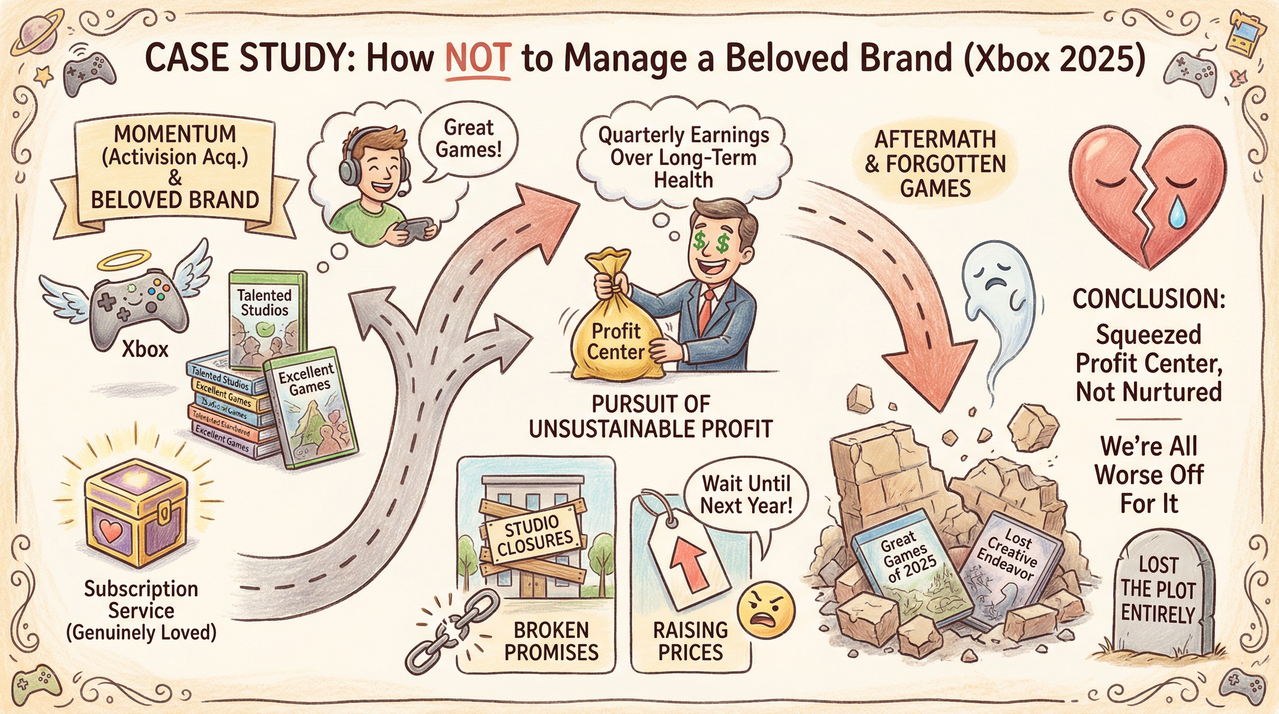
Xbox’s 2025 will be studied in business schools as a case study in how not to manage a beloved brand. Microsoft had momentum coming out of the Activision acquisition. They had talented studios creating excellent games. They had a subscription service that consumers genuinely loved. And they systematically destroyed all of it in pursuit of unsustainable profit margins that prioritize quarterly earnings over long-term brand health. The saddest part is that the great games Xbox published this year will be forgotten, buried under the rubble of closed studios and broken promises. When your executives are telling fans to wait until next year while firing developers and raising prices, you’ve lost the plot entirely. 2025 proved that Microsoft views Xbox as a profit center to be squeezed rather than a creative endeavor worth nurturing, and we’re all worse off for it.