In an extensive interview with Game Informer published January 5, 2026, Katsura Hashino dropped a statement that’s going to spark endless debates in JRPG communities: Atlus has reached a turning point where their signature formula needs to evolve. The director behind Persona 3, 4, 5, and Metaphor: ReFantazio stated that while the studio wants to retain narrative strengths that define their games, they feel pressure to create titles that are “more accessible for a wider audience.” Translation: Persona 6 and future Atlus RPGs might look significantly different from what longtime fans expect.
- The Core Quote That Changes Everything
- The JRPG 3.0 Vision
- What Metaphor: ReFantazio Taught Them
- The Accessibility Debate
- The Runtime Problem
- What This Means For Persona 6
- The Fanbase Will Absolutely Freak Out
- The Metaphor Factor
- What We Actually Know vs What We’re Speculating
- FAQs About Atlus and Persona’s Future
- Conclusion
The Core Quote That Changes Everything
Hashino’s key statement from the Game Informer interview (which requires a subscription to read in full) directly addresses Atlus’ future direction. “For us, it’s coming to a turning point where we want to really take it to the next level in terms of how our JRPGs are,” he explains. “Of course, we want to retain our strengths, whether that be our narrative or elements that make us JRPGs.”
But here’s where it gets controversial: “With these changing times, we do feel the need to update our format and create games that would be more widely playable, not just within the JRPG realm, but something that would be easier, more accessible for a wider audience. We’re hoping to update our format with that in mind.”
That word “accessible” is doing heavy lifting. Does it mean simplifying complex systems? Reducing the 80-100 hour runtime that Persona games demand? Adding difficulty options beyond the existing presets? Streamlining the calendar system that forces time management decisions? Nobody knows yet, but the mere acknowledgment that changes are coming will make hardcore fans nervous.
The JRPG 3.0 Vision
This interview connects to comments Hashino made at the G-Star 2025 gaming conference in South Korea back in November. During a talk titled “When experience becomes memory – designing lasting impressions through art and structure,” he outlined three eras of JRPGs according to a report by 4Gamer that GamesRadar translated.
JRPG 1.0 encompasses the “true classics” from NES through at least PlayStation 2. JRPG 2.0 represents the modern era from roughly Persona 4 through Metaphor: ReFantazio, defined by higher quality and greater responsiveness to players. Then there’s JRPG 3.0, the next generation that hasn’t been fully defined yet.
“There will be a greater dimension to these games and they’ll change the genre’s structure and presentation at a fundamental level,” Hashino said according to the translation. That’s ambitious language suggesting more than incremental improvements. He’s talking about reimagining what JRPGs can be at their core.

What Metaphor: ReFantazio Taught Them
Part of what’s driving this philosophical shift is Atlus’ experience developing Metaphor: ReFantazio, which launched in October 2024 to critical acclaim and commercial success. The game represented the first time in years that Hashino’s team built a new IP from the ground up rather than iterating on Persona’s established framework.
“This opportunity with Metaphor posed as a chance for the team to go back to our basics of building something new,” Hashino told Game Informer. “This helped us assess which elements we excelled at that we wanted to carry over into Metaphor, and which elements we really didn’t need to. That helped us view the things that we built previously from a new lens.”
That self-reflection process apparently revealed both strengths worth preserving and weaknesses worth addressing. Hashino believes the experience “will really help us for future titles and projects we have coming up,” suggesting lessons learned from Metaphor will directly influence Persona 6 and whatever else Studio Zero tackles next.
The Accessibility Debate
When game directors talk about making their titles “more accessible,” passionate fans immediately fear dumbing down. The term triggers memories of beloved franchises getting streamlined into blandness chasing mainstream audiences. Final Fantasy went from turn-based strategy to action combat. Dragon Age evolved from tactical RPG to action-adventure. Mass Effect removed RPG complexity between entries.
But accessibility doesn’t automatically mean simplification. It can mean better tutorialization that doesn’t overwhelm new players. Clearer UI that communicates information efficiently. Difficulty options that let players customize challenge rather than forcing everyone through the same experience. Quality-of-life improvements that respect player time without compromising depth.
Persona games specifically have legitimate accessibility issues beyond difficulty. The calendar system creates permanent consequences for time management decisions, meaning you can miss social links or fail to max stats if you don’t optimize perfectly. Some players find that pressure stressful rather than engaging. Others love it because consequences matter and choices have weight.

The Runtime Problem
Another potential accessibility issue is sheer length. Persona 5 Royal takes 100+ hours to complete thoroughly. Metaphor: ReFantazio runs 70-80 hours for the main story. That’s an enormous time commitment that excludes busy adults with jobs, families, and limited gaming hours. Younger players with infinite free time can sink entire summers into these games. Working professionals often can’t.
Does Atlus consider this an accessibility problem worth addressing? Would they make shorter games with tighter pacing? That seems unlikely given their design philosophy emphasizes slow-burn relationship building across in-game months. But perhaps they could implement better chapter select options for replays or create condensed story modes that hit major beats without grinding through every dungeon.
What This Means For Persona 6
Persona 6 remains unannounced despite Atlus celebrating the franchise’s 30th anniversary throughout 2026 with a special website promising multiple updates. The first update arrives January 8, and fans are speculating whether it’ll finally reveal the long-awaited sequel or just announce merchandise and concert tours.
Whenever Persona 6 does get announced, Hashino’s comments suggest it might diverge more significantly from Persona 5’s template than previous sequels did from their predecessors. Persona 4 was essentially Persona 3 with a murder mystery instead of apocalypse themes. Persona 5 added stealth infiltration and a rebellion theme but kept the core calendar/social link structure intact.
Persona 6 could represent a genuine reinvention if Atlus follows through on these accessibility and evolution goals. Maybe that means radically different combat. Perhaps the calendar system gets overhauled or replaced entirely. The social links could function differently. Or maybe the changes are more subtle: better onboarding for newcomers, more generous time management, optional difficulty customization.

The Fanbase Will Absolutely Freak Out
No matter what Atlus actually does, announcing intentions to make games “more accessible for a wider audience” guarantees backlash from hardcore fans convinced their beloved franchise is about to get ruined chasing casuals. This happens every time established series discuss accessibility. Dark Souls fans panicked when Elden Ring added Ashes summons. Monster Hunter veterans complained about World’s quality-of-life improvements. Dragon’s Dogma 2 caught heat for fast travel changes.
In Atlus’ case, the anxiety is amplified because Persona has become their flagship franchise with a devoted cult following. People who’ve been playing since Persona 3 in 2006 feel ownership over these games and will resist changes that threaten what they love about the series. The fact that Metaphor: ReFantazio succeeded both critically and commercially while maintaining traditional JRPG complexity will embolden those arguing Atlus doesn’t need to change anything.
But Stagnation Is Also Dangerous
The counterargument is that relying on the same formula indefinitely risks irrelevance. Every Persona game since 3 has followed essentially identical structure: high school students awakening to supernatural powers, managing daily life through a calendar system, building relationships through social links, infiltrating dungeons themed around psychological trauma. That formula works brilliantly, but it’s also been iterated on for nearly 20 years.
Younger players discovering Persona for the first time through Persona 5 Royal or Metaphor: ReFantazio might not stick around if Persona 6 feels like more of the same. The gaming landscape has changed dramatically since Persona 3 launched. Live service games dominate, attention spans have shifted, and competition for player time intensifies constantly. Atlus can’t assume the formula that worked in 2006 will work in 2026 or beyond.
The Metaphor Factor
Metaphor: ReFantazio’s success complicates this discussion because it proved Atlus can create new IPs using the Persona formula and still find massive audiences. The game sold over 1 million copies in its first day and earned universal praise for its mature political themes and refined mechanics. If the Persona structure still works when applied to fantasy settings, why fix what isn’t broken?
But Hashino’s comments suggest Metaphor also revealed limitations. Building something new from scratch forced the team to question assumptions and identify elements worth preserving versus elements dragging down the experience. That process of elimination and refinement will inform how they approach established franchises moving forward.

What We Actually Know vs What We’re Speculating
It’s important to separate confirmed information from speculation and anxiety. What we know for certain: Katsura Hashino believes Atlus has reached a turning point where their JRPG formula needs to evolve. He wants to make games more accessible while retaining narrative strengths. Metaphor: ReFantazio’s development taught valuable lessons about what works and what doesn’t. Future titles will reflect this new perspective.
What we don’t know: specific changes being implemented, whether this affects Persona 6 or only future original IPs, what “accessible” actually means in practice, how fans will react to whatever gets revealed, and whether these changes will be positive or negative. Everything beyond Hashino’s direct quotes is speculation based on interpreting deliberately vague language.
FAQs About Atlus and Persona’s Future
What did Katsura Hashino say about Atlus’ future?
Hashino stated that Atlus has reached a “turning point” where they need to evolve their JRPG formula while retaining narrative strengths. He specifically mentioned making games “more accessible for a wider audience” beyond the JRPG realm.
Does this mean Persona 6 will be easier or simpler?
Unknown. “Accessible” can mean many things including better tutorialization, clearer UI, difficulty options, or quality-of-life improvements. It doesn’t necessarily mean simplification, though that’s one possibility.
When does Persona 6 release?
Persona 6 hasn’t been officially announced yet. Atlus is celebrating Persona’s 30th anniversary throughout 2026 with website updates starting January 8, but whether they’ll reveal the sequel remains speculation.
What is JRPG 3.0?
According to Hashino’s G-Star 2025 conference talk, JRPG 3.0 represents the next generation of games that will “change the genre’s structure and presentation at a fundamental level.” Specifics remain undefined.
How did Metaphor: ReFantazio influence this thinking?
Developing Metaphor from scratch helped Atlus assess which elements they excel at versus elements they don’t need. That self-reflection process will inform future titles including potentially Persona 6.
Will Persona keep the calendar and social link systems?
Unknown, though Hashino emphasized retaining “our strengths” including narrative elements. The calendar/social link systems are core to Persona’s identity, making radical changes risky.
Are hardcore fans upset about this?
Many fans are nervous about changes to beloved formulas, especially when developers mention “accessibility.” Others argue evolution is necessary to avoid stagnation. Debate is intense across gaming communities.
What does Atlus announce on January 8, 2026?
Atlus’ Persona 30th anniversary website promises the first of multiple updates on January 8. Whether it’s Persona 6, merchandise, concerts, or something else remains unknown.
Conclusion
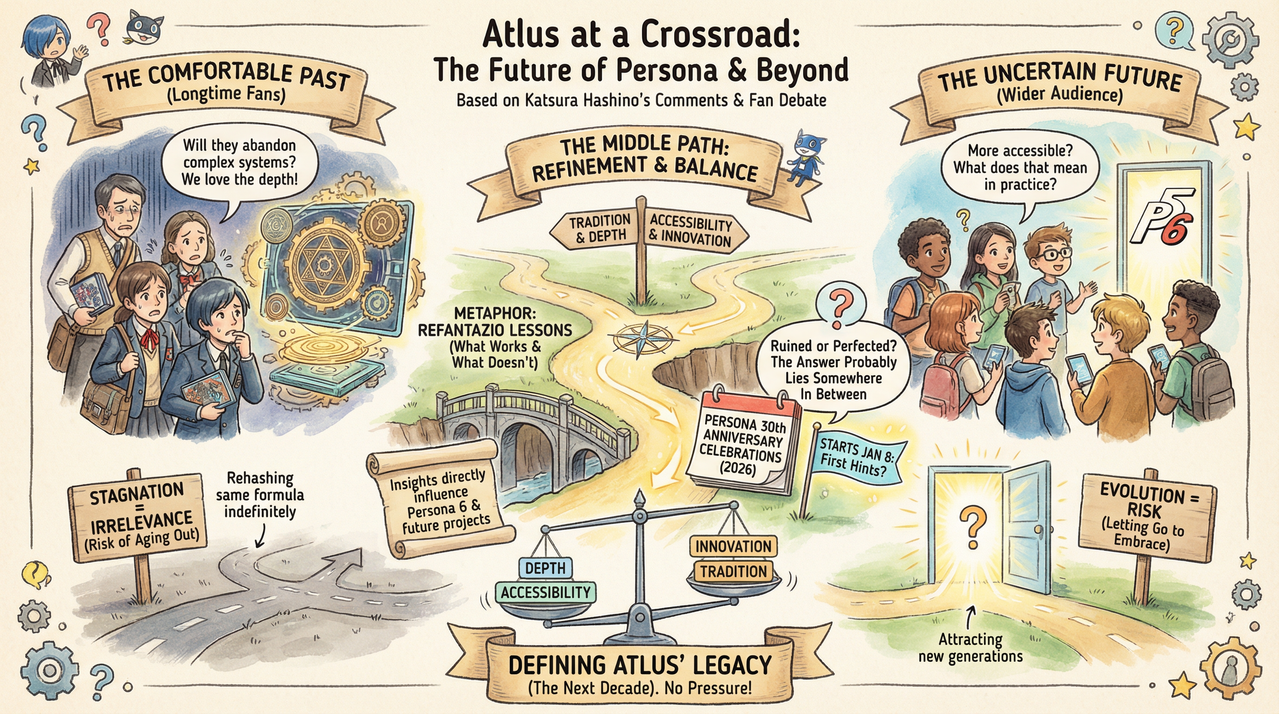
Katsura Hashino’s comments about Atlus reaching a turning point have ignited exactly the kind of debate you’d expect when a beloved developer announces intentions to change successful formulas. Longtime fans are understandably nervous about what “more accessible for a wider audience” actually means in practice. Will Persona 6 abandon complex systems that made the series special? Or will Atlus find ways to refine and improve without sacrificing depth? The answer probably lies somewhere in the middle, which is simultaneously reassuring and terrifying depending on your perspective. What’s clear is that Hashino and his team don’t plan to simply rehash the same formula indefinitely. Metaphor: ReFantazio’s development taught them valuable lessons about what works and what doesn’t, and those insights will directly influence how they approach Persona 6 and future projects. Whether those changes prove positive or negative won’t be known until we actually see what they’ve built. The Persona 30th anniversary celebrations throughout 2026 might provide hints about the franchise’s direction, starting with whatever gets announced January 8. Until then, fans will continue speculating, arguing, and worrying about whether their beloved series is about to get ruined or perfected. That’s the risk of evolution: it requires letting go of the comfortable past to embrace an uncertain future. Sometimes that gamble pays off spectacularly. Sometimes it doesn’t. But stagnation guarantees irrelevance, so Atlus really doesn’t have a choice. They have to evolve or risk watching their audience age out without attracting new generations to replace them. How they balance accessibility with depth, innovation with tradition, and new audiences with existing fans will define Atlus’ legacy over the next decade. No pressure or anything.