Terra Invicta, the absurdly ambitious grand strategy game that blends global geopolitics with hard sci-fi space colonization and realistic orbital combat, officially left Early Access on January 5, 2026 with its version 1.0 release. Developed by Pavonis Interactive (formerly Pavonis Studios, the team behind XCOM’s legendary Long War mod) and published by Hooded Horse, this is the game that asks: what if humanity detected alien probes at the edge of the solar system and immediately fractured into seven ideological factions fighting over how to respond? The answer involves managing Earth’s nations, colonizing 300+ celestial bodies, and designing space warships using realistic physics. It’s overwhelming, brilliant, and now finally feature-complete.
Three Years of Early Access Refinement
Terra Invicta launched into Early Access on September 26, 2022, which means it spent over three years in development post-launch. That’s a long time, but for a game this complex, it makes sense. IGN’s early access review praised the ambition but noted the game was “full of ambitious ideas” that forced players to “drill through opaque and confusing mechanics in order to enjoy them.” That criticism wasn’t wrong. Terra Invicta at launch was brutally complicated with minimal tutorialization.
The 1.0 version addresses those concerns with a revised interface, improved tutorials, and better onboarding. They also added a new “2070” quick-start scenario for players who want to skip decades of buildup and jump straight into the space expansion and fleet combat. The original “2026” scenario remains for players who want the full experience starting from present-day Earth with current geopolitical situations accurately modeled.
Language support expanded significantly with version 1.0 adding Italian, Russian, Korean, Czech, and Ukrainian to the existing English, German, French, Spanish, Polish, Brazilian Portuguese, Simplified Chinese, Traditional Chinese, and Japanese options. That’s 14 languages total, which is impressive for a niche strategy game from an independent studio.
Seven Factions, Seven Visions
Terra Invicta’s central hook is that humanity doesn’t unite against the alien threat. Instead, seven ideological factions emerge, each with completely different goals and strategies. The Resistance wants to fight the aliens directly and preserve human independence. The Humanity First faction takes xenophobia to extremes, seeking to destroy the aliens entirely. The Academy prioritizes scientific understanding and wants to communicate with the aliens peacefully.
Then things get darker. The Initiative represents transnational elites who see the alien arrival as an opportunity for profit and power consolidation. The Servants want to surrender and collaborate with the aliens, believing resistance is futile. Project Exodus plans to abandon Earth entirely, fleeing to the stars. And The Protectorate seeks to negotiate with the aliens for some form of managed coexistence where humanity survives but loses sovereignty.
Each faction plays dramatically differently because their victory conditions are unique. The Resistance wins by defeating the alien threat. Exodus wins by building colony ships and escaping the solar system. The Servants win by facilitating alien takeover. You’re not just managing the same mechanics with different flavor text; you’re playing fundamentally different strategic games depending on faction choice.

The Earth Layer: Geopolitical Chess
On Earth, Terra Invicta plays like a hyper-detailed simulation of 21st century geopolitics. You deploy council members (agents with specialized skills) to control points in nations, influence governments, destabilize rivals, assassinate enemy agents, or orchestrate coups. The game starts in 2022 with accurate details like Russian forces occupying Eastern Ukraine and Crimea, then projects forward as players reshape global politics.
Every nation has economy, military, popular support, and other stats you can manipulate. Controlling nations gives you access to their GDP, research output, military forces, and space programs. But control isn’t binary. Multiple factions can have influence in the same nation, leading to shadow wars where you’re sabotaging rivals while protecting your own interests from their agents.
The council member system creates fascinating strategic depth. You have limited slots and counselors can only undertake two missions per month. Do you send your spy to investigate suspected enemy activity or destabilize an opponent’s control region? Every action has opportunity costs, forcing constant prioritization of short-term needs versus long-term strategy.
The Space Layer: Hard Sci-Fi Colonization
Then there’s space, which is essentially an entirely separate game. Over 300 celestial bodies across the solar system can be colonized and exploited for resources. This isn’t simplified abstraction; Terra Invicta models realistic orbital mechanics, delta-v requirements, transfer windows, and resource chains. Mining asteroids for water, metals, and volatiles becomes essential for sustaining space expansion.
Building space infrastructure requires enormous investment. Stations and habitats cost massive resources and take years to construct. But controlling strategic locations like Mars, Europa, or the asteroid belt provides economic and military advantages that can swing the entire game. The faction that dominates space usually dominates Earth, and vice versa.
Space combat uses pausable real-time tactical battles where physics matters. Ships have thrust, rotation, heat management, and weapon ranges affected by realistic constraints. Laser batteries have line-of-sight requirements. Kinetic projectiles follow ballistic trajectories. Nuclear missiles can be intercepted. Fleet design and engagement tactics require understanding how newtonian physics applies to combat.

The Tech Tree From Hell
Terra Invicta features one of gaming’s most sprawling tech trees, split between public research that all humanity shares and private research specific to your faction. Public research follows a semi-realistic progression of near-future and science fiction technologies. Private research unlocks faction-specific bonuses, ship components, and strategic options.
Contributing the most to public research projects lets you choose humanity’s next research direction, giving you an edge in unlocking private spinoff technologies. This creates competition where factions race to dominate research paths that benefit their strategies. The Academy faction excels here because scientific advancement aligns with their victory conditions.
The tech tree is massive and initially overwhelming. New players often struggle to understand what they should prioritize because so many options exist. Version 1.0’s improved tutorials help, but Terra Invicta remains a game that demands significant learning investment before it clicks.
What Changed in Version 1.0
Beyond the improved tutorials and revised interface, version 1.0 adds substantial new content. New ship classes expand fleet composition options. Additional habitat modules allow more varied station designs. Exofighters give Earth nations air superiority capabilities. The expanded tech tree includes more specialization paths for different strategic approaches.
The 2070 quick-start scenario is particularly significant for accessibility. Starting decades into the game with space infrastructure already established lets players experience the full space colonization and combat systems without grinding through the early game setup. It’s basically Terra Invicta’s version of a mid-game save file for testing and learning.
The updated 2026 starting scenario reflects current geopolitical situations as of 2026, which means it’s modeling a world slightly different from when the game originally launched in 2022. This attention to detail demonstrates Pavonis Interactive’s commitment to realistic simulation even as real-world events continue evolving.

Day One PC Game Pass
Terra Invicta 1.0 launched simultaneously on Steam, GOG, Epic Games Store, Microsoft Store, and PC Game Pass. That PC Game Pass day-one availability is noteworthy because it gives subscribers immediate access without the $39.99 purchase price. For a niche grand strategy game with steep learning curves, lowering barriers to entry through subscription services could significantly expand the player base.
The timing also positions Terra Invicta alongside other grand strategy titles on Game Pass like Crusader Kings III, creating a library of deep strategy games that appeal to the same hardcore audience. Whether this translates to commercial success for Pavonis Interactive depends on how Xbox compensates developers for Game Pass inclusion, but the exposure certainly doesn’t hurt.
The Long War Connection
Pavonis Interactive’s credibility stems largely from The Long War, one of PC gaming’s most legendary mods. The original Long War for XCOM: Enemy Unknown transformed the game into a brutally difficult, mechanically deep experience that extended campaigns from 20 hours to 100+ hours. It became so popular that Firaxis acknowledged it when designing XCOM 2.
Terra Invicta carries that Long War DNA: extreme complexity, unforgiving difficulty, and systems-driven gameplay that rewards understanding intricate mechanics. This isn’t a game that holds your hand or makes things easy. It’s designed for players who want to master complicated systems and feel genuine accomplishment when strategies finally work.
That design philosophy limits appeal but creates intensely loyal fanbases. People who love Terra Invicta will evangelize it endlessly. People who bounce off the complexity will warn others away. There’s no middle ground with games this uncompromising.

Who Should Play Terra Invicta
Terra Invicta is absolutely not for everyone. If you struggled with Crusader Kings III’s complexity or found Hearts of Iron IV overwhelming, this will destroy you. The game demands patience, experimentation, and willingness to fail repeatedly while learning systems. Early campaigns will likely end in disaster as you figure out what you’re doing.
But if you’re the kind of person who spends hours planning optimal builds in strategy games, enjoys reading wikis to understand mechanics, and gets satisfaction from mastering complicated systems, Terra Invicta might be your new obsession. It’s the hardest of hard sci-fi strategy games, treating space colonization and combat with almost sim-level realism while wrapping it in grand strategy geopolitics.
The best comparison point is probably Dwarf Fortress before it got a Steam release with improved UI. Terra Invicta is that level of complex simulation, though with more accessible graphics and (after 1.0) significantly better tutorials than Dwarf Fortress ever had in its ASCII days.
FAQs About Terra Invicta 1.0
When did Terra Invicta leave Early Access?
Terra Invicta officially launched version 1.0 on January 5, 2026, after spending over three years in Early Access since its September 26, 2022 initial launch.
What platforms is Terra Invicta available on?
Version 1.0 is available on PC via Steam, GOG, Epic Games Store, Microsoft Store, and PC Game Pass. There are currently no console versions announced.
How much does Terra Invicta cost?
The game is priced at $39.99 / €39.99 / £34.99 / ¥4,980. PC Game Pass subscribers get day-one access without additional purchase.
Who developed Terra Invicta?
Pavonis Interactive (formerly Pavonis Studios) developed the game. They’re best known for creating The Long War mod for XCOM: Enemy Unknown. Hooded Horse publishes the game.
What are the seven factions in Terra Invicta?
The Resistance (fight aliens), Humanity First (destroy aliens), The Academy (study aliens), The Initiative (exploit aliens for profit), The Servants (surrender to aliens), Project Exodus (flee Earth), and The Protectorate (negotiate coexistence).
Is Terra Invicta hard to learn?
Yes, extremely. The game features multiple complex systems including geopolitical simulation, space colonization with realistic orbital mechanics, and tactical fleet combat. Version 1.0 improved tutorials but it remains challenging.
How long does a Terra Invicta campaign take?
Campaigns can easily exceed 100 hours depending on faction choice and strategy. The 2026 scenario starts from present day and progresses through decades. The 2070 quick-start scenario offers a shorter experience.
Does Terra Invicta have multiplayer?
No, Terra Invicta is single-player only. The complexity of simultaneous systems and pausable real-time space combat makes multiplayer implementation impractical.
Conclusion
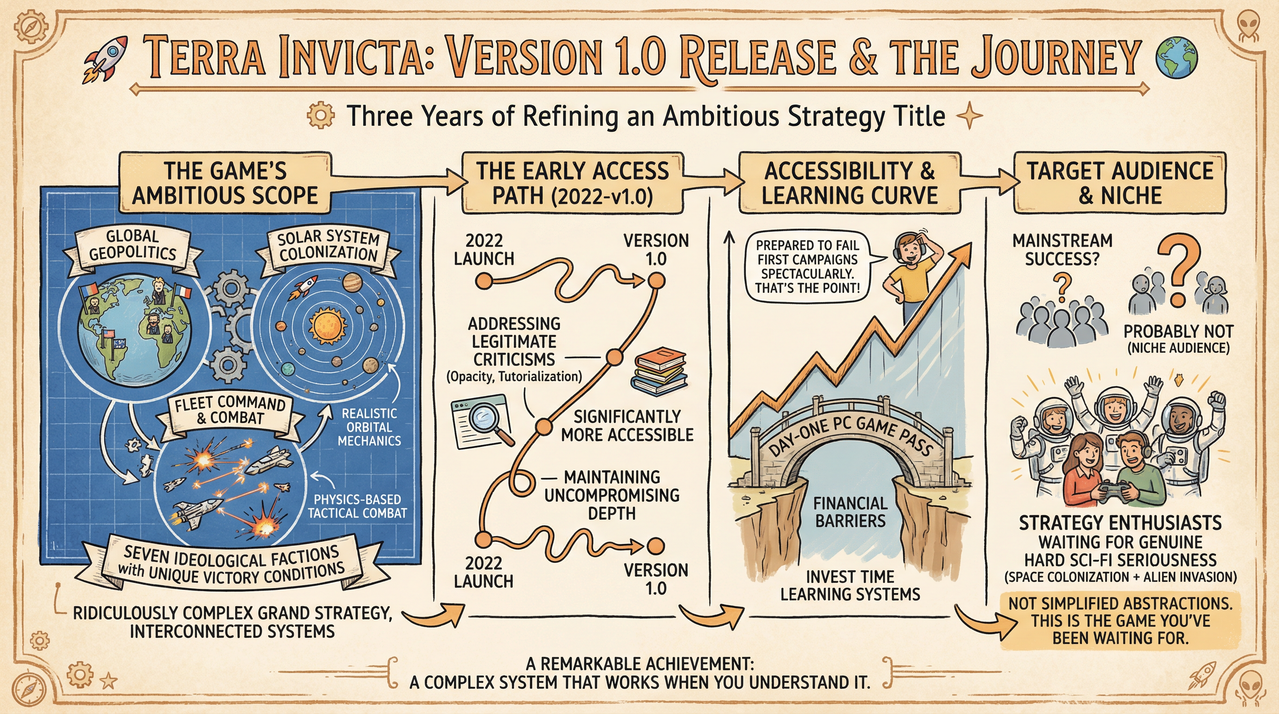
Terra Invicta’s version 1.0 release represents the culmination of over three years refining one of PC gaming’s most ambitious strategy titles. What Pavonis Interactive built is genuinely remarkable: a game that seamlessly transitions between managing global geopolitics, colonizing the solar system using realistic orbital mechanics, and commanding fleets in physics-based tactical combat, all while seven ideological factions pursue completely different victory conditions. It’s the kind of ridiculously complex grand strategy that should collapse under its own weight but somehow works when you finally understand how all the systems interconnect. The Early Access period allowed Pavonis to address legitimate criticisms about opacity and tutorialization. Version 1.0 is significantly more accessible than the 2022 launch while maintaining the uncompromising depth that defines the experience. Day-one PC Game Pass availability removes financial barriers for curious players willing to invest time learning the systems. Will Terra Invicta find mainstream success? Probably not. Games this complex and unforgiving naturally appeal to niche audiences. But for strategy enthusiasts who’ve been waiting for something that treats space colonization and alien invasion scenarios with genuine hard sci-fi seriousness rather than simplified abstractions, this is the game you’ve been waiting for. Just be prepared to fail your first few campaigns spectacularly while you figure out what you’re actually supposed to be doing. That’s not a bug, it’s the entire point.