The gaming world started 2026 with heartbreaking news. Albert Penello, a beloved Xbox veteran who spent nearly two decades at Microsoft shaping the platform across three console generations, passed away from cancer on December 31, 2025. He was 12 years old when his daughter was born, leaving behind a wife, Dara, and their daughter, Lily. The tributes flooding social media from industry legends speak to how deeply Penello impacted not just Xbox, but everyone who worked with him.
The Voice Xbox Needed
Albert Penello joined Microsoft in 2000, right at the beginning of the original Xbox project. Over 18 years, he held multiple leadership roles, eventually becoming senior director responsible for strategic marketing and planning for all Xbox devices worldwide. But titles don’t capture what made him special. Penello was the rare executive who genuinely engaged with fans online, defending Xbox’s vision during controversial moments while remaining approachable and human.
That approachability was tested during the Xbox One’s disastrous 2013 reveal. Microsoft bungled the messaging around always-online requirements, used game restrictions, and the mandatory Kinect. The backlash was severe, and Penello found himself on the frontlines defending decisions that even he later admitted were poorly communicated. He took abuse from angry gamers across forums and social media, but never stopped engaging, explaining, and listening.
Former Microsoft Director of Product Planning Albert Penello told Ars Technica at the time that the messaging was horrible. But rather than hide behind corporate statements, he showed up in Reddit threads, NeoGAF forums, and Twitter replies, treating frustrated fans with respect even when they weren’t extending the same courtesy. That willingness to be accountable, to be present during the tough moments, earned respect even from those who disagreed with Xbox’s direction.

Backward Compatibility Champion
One of Penello’s most lasting contributions was his work on backward compatibility. When Xbox One launched in 2013, it couldn’t play Xbox 360 or original Xbox games. Penello initially explored cloud streaming solutions but found them problematic due to varying internet connection quality. The team eventually landed on building a virtual Xbox 360 entirely in software, an emulator that could run classic games on new hardware.
The announcement at E3 2015 that Xbox 360 games would run on Xbox One at no additional cost shocked the industry. Sony had abandoned backward compatibility, forcing PlayStation fans to rebuy games or subscribe to streaming services. Microsoft went the opposite direction, letting players insert their old discs or download digital versions they already owned. It was consumer-friendly in a way that felt almost old-fashioned.
When Xbox One X launched in 2017, Penello and his team pushed backward compatibility even further. Original Xbox games running at 480p were upscaled to 1920p, a 16x resolution boost. Xbox 360 titles jumped from 720p to full 4K. Games like Red Dead Redemption and Fallout 3 looked better on Xbox One X than they ever did on their original hardware, all through software emulation and the Heutchy Method developed by Microsoft engineers.
The Technical Vision
What made this possible was forward thinking that happened as early as 2011 during Xbox One’s R&D phase. Penello and the hardware team baked backward compatibility support into the console’s silicon before anyone knew if it would actually work. That bet paid off years later when the emulation software came together, proving sometimes the best features require planning for possibilities rather than guaranteed returns.
Penello frequently discussed these technical achievements in interviews and podcasts. He appeared on Major Nelson’s show explaining how Xbox One X came to be, sharing the development origins and challenges. When skeptics questioned whether 4K gaming was real or just marketing, Penello provided detailed technical explanations about rendering pipelines, resolution scaling, and GPU performance. He never talked down to fans, instead treating technical discussions as opportunities to educate and excite people about what was possible.

Beyond Xbox
Penello left Microsoft in 2018 after nearly two decades, joining Amazon to work on Luna, the company’s cloud gaming service. As senior product manager, he led product and feature definition for the Luna Controller, applying his extensive hardware experience to a completely new platform. He co-authored Amazon’s Luna Cloud Gaming strategy document and presented it to Jeff Bezos and Amazon leadership, bringing the same strategic vision that defined his Xbox years to a new challenge.
His career started even earlier at Electronic Arts from 1994 to 2000, where he managed key properties including Need for Speed, James Bond, and Jane’s Combat Simulations. Before Xbox existed, Penello was already shaping how games were marketed and positioned for consumers. That two-decade-plus span across EA, Microsoft, and Amazon represented a career touching every aspect of the gaming industry.
According to sources at Windows Central, Penello had been contributing to plans for the next generation of Xbox as a consultant in recent months. Even while battling cancer, he remained engaged with the platform he helped build, offering his expertise and insight for whatever comes after Xbox Series X and S. That dedication speaks to how much Xbox meant to him personally.
Tributes From Gaming Legends
The outpouring of grief from gaming industry figures highlights how universally respected Penello was. Larry Hryb, better known as Major Nelson, shared his devastation at losing a close friend. He described Penello as a pillar of gaming at Microsoft and Amazon, a brilliant trusted voice, and most importantly a husband and father profoundly loved by his family.
Mike Ybarra, former Blizzard president who worked with Penello at Microsoft, revealed he spoke with Albert about a month before he passed. Despite his condition, Penello’s spirits were high and his attitude remarkable. Ybarra remembered him as a kind person with incredible passion for gaming, whose energy and commitment to keeping players first was second to none.
Peter Moore, former head of Xbox who worked alongside Penello during the Xbox 360 era, called him a true legend. Moore highlighted Penello’s ultimate optimism and willingness to take on any project, even joking about the ill-fated HD-DVD addon for Xbox 360. He said Penello leaves a big hole in the heart of the extended Xbox family.
The Human Side
What emerges from these tributes is a portrait of someone who balanced professional excellence with genuine kindness. Penello had strong opinions about gaming technology and wasn’t afraid to defend them publicly, but he treated people with respect even during heated debates. He understood that behind every angry forum post was a passionate gamer who cared deeply about their hobby.
His LinkedIn profile described him simply as someone who loved his job as Dad most of all. Despite managing massive product launches like Kinect, Xbox 360 S, and Xbox One X that represented hundreds of millions in investment, what mattered most was his family. That perspective, that understanding that games exist to bring joy and connection, informed how he approached his work.
Industry peers consistently describe Penello as friendly, approachable, and generous with his time. He didn’t act like an executive too important to engage with fans or junior colleagues. He showed up, participated, explained his thinking, and listened to feedback. In an industry often criticized for corporate distance and tone-deaf communication, Penello represented a different approach.
Frequently Asked Questions
Who was Albert Penello?
Albert Penello was a longtime Xbox executive who worked at Microsoft from 2000 to 2018, serving in various leadership roles including senior director of product management and marketing across the original Xbox, Xbox 360, and Xbox One generations. He later worked at Amazon on the Luna cloud gaming service.
When did Albert Penello pass away?
Albert Penello passed away on December 31, 2025, after a battle with cancer. The news was confirmed on January 2, 2026, by former colleagues including Mike Ybarra and Larry Hryb.
What was Albert Penello known for?
Penello was known for his work on Xbox backward compatibility, his role in launching Xbox One X, and his willingness to engage directly with gaming communities during controversial moments. He was respected for combining technical expertise with genuine passion for gaming and player-first thinking.
Did Albert Penello work on Xbox backward compatibility?
Yes, Penello was instrumental in Xbox’s backward compatibility program. He explored various technical solutions and was part of the team that developed the software emulation allowing Xbox 360 and original Xbox games to run on Xbox One and Xbox One X, often with significant graphical improvements.
What did Albert Penello do after leaving Microsoft?
After leaving Microsoft in 2018, Penello joined Amazon Web Services as a senior product manager. He led development of the Luna Controller for Amazon’s cloud gaming service and co-authored the company’s cloud gaming strategy, presenting it to Jeff Bezos and Amazon leadership.
How old was Albert Penello when he died?
Penello’s exact age has not been publicly reported. He is survived by his wife Dara and their 12-year-old daughter Lily. His career in gaming spanned over 25 years, starting at Electronic Arts in 1994.
How can people support Albert Penello’s family?
Those wishing to show support to Penello’s family can do so by emailing PenelloFamily@gmail.com, as mentioned in several tributes. The gaming community has been encouraged to share memories and condolences through this channel.
What games did Albert Penello work on at EA?
During his time at Electronic Arts from 1994 to 2000, Penello managed marketing for several key franchises including Need for Speed, STRIKE series, Jane’s Combat Simulations, Xena, and James Bond games. He directed strategy and execution for all aspects of product marketing for these titles.
A Legacy That Endures
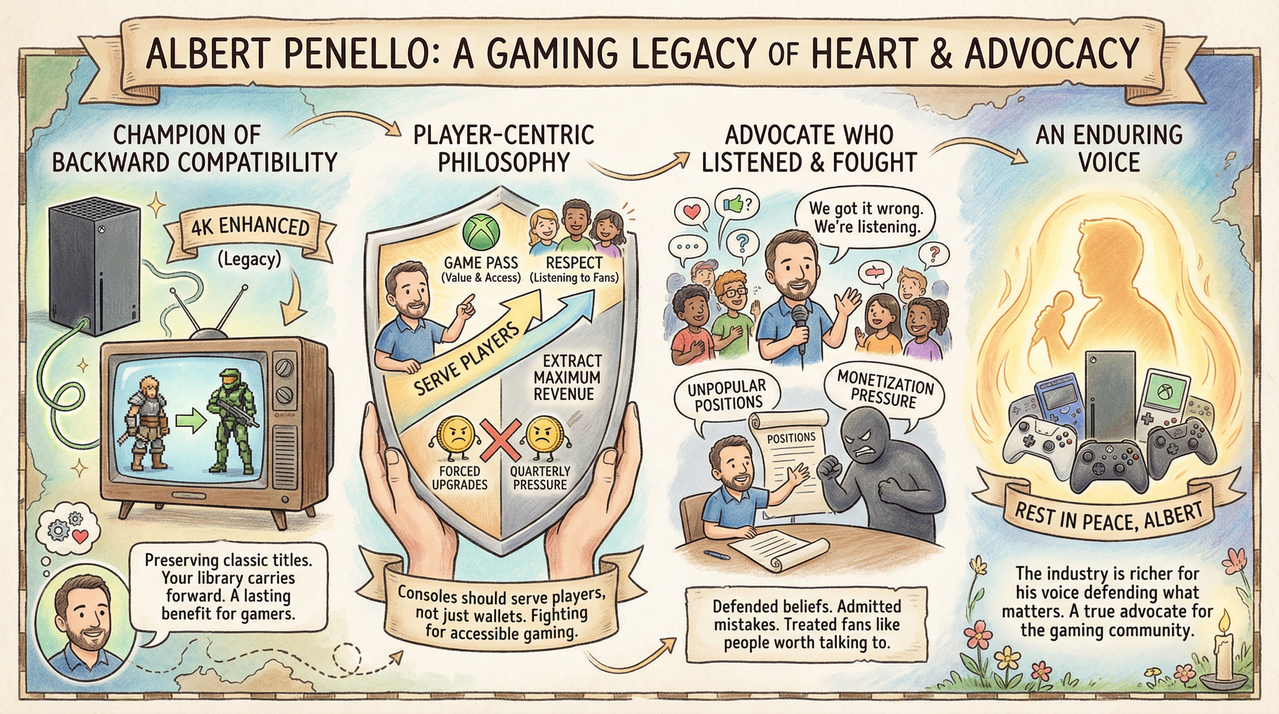
The gaming industry loses veterans regularly, but Albert Penello’s passing feels different. He wasn’t just an executive who approved budgets and attended meetings. He was someone who genuinely cared about games, who understood why preserving classic titles mattered, who believed consoles should serve players rather than extract maximum revenue from them. That philosophy shaped decisions that still benefit gamers today.
Every time someone boots up an Xbox 360 game on their Series X and sees it running in 4K, that’s Penello’s legacy. Every time Microsoft emphasizes player value through Game Pass or backward compatibility instead of forced hardware upgrades, that reflects thinking he championed. The idea that gaming should be accessible, that your library should carry forward, that companies should respect customers, those weren’t revolutionary concepts, but they required people in leadership positions willing to fight for them.
Penello fought those fights. He defended unpopular positions when he believed in them. He admitted mistakes when the company got it wrong. He treated fans like people worth talking to rather than wallets to extract money from. In an industry increasingly dominated by live-service monetization, battle passes, and quarter-over-quarter growth pressures, his approach feels almost quaint. But it’s what gaming needs more of, not less.
The tributes pouring in aren’t just professional courtesy. They’re genuine grief from people who knew Albert Penello made gaming better, both through his work and how he treated those around him. His family lost a husband and father. The gaming community lost an advocate who actually listened. Xbox lost someone who helped define what the platform could be at its best. Rest in peace, Albert. The industry is poorer without you, but richer for the time we had your voice defending what matters.