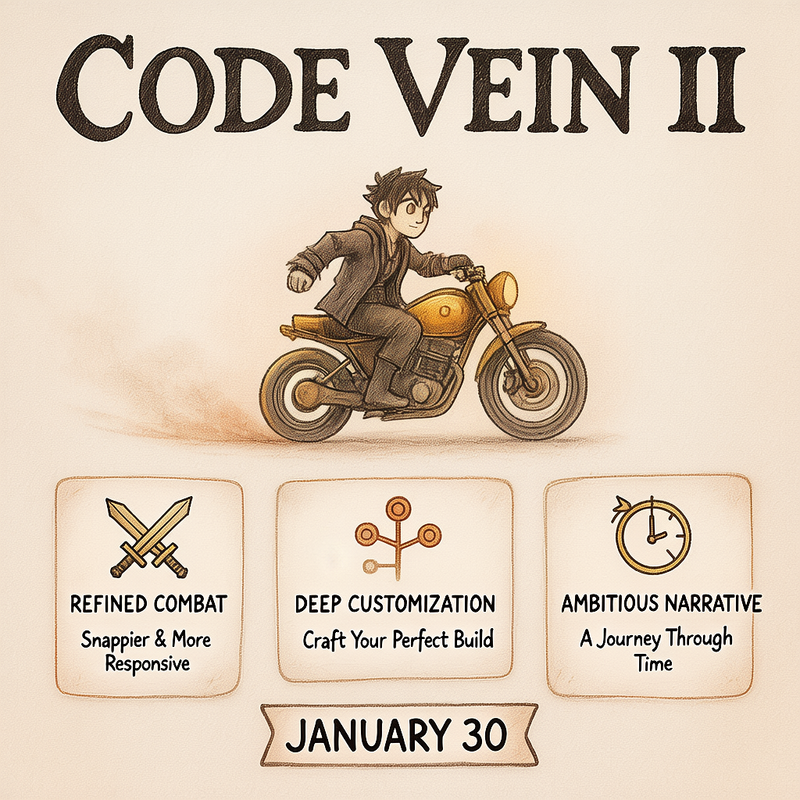
Code Vein II drops on January 30, 2026, and after spending several hours with preview builds, one thing is crystal clear: Bandai Namco wants this sequel to be bigger, bolder, and way more ambitious than the 2019 original. The vampire anime soulslike is back with a standalone story about time travel, corrupted heroes, and saving the world from collapse. But more importantly, it adds enough combat customization options to make Dark Souls look minimalist by comparison.
- What Makes This Game Different
- The Combat Gets Complicated (In a Good Way)
- Blood Codes Return, Better Than Before
- Partner System Gets Smarter
- Environments and Exploration
- Boss Fights Are Brutal
- Character Creator Demo Coming Soon
- Does It Feel Like a Proper Sequel
- Performance and Polish
- FAQs About Code Vein II
- Conclusion
What Makes This Game Different
Code Vein II doesn’t continue directly from the first game’s story. Instead, it introduces an entirely new cast of Revenants (the game’s vampire-like beings) in a world facing annihilation from something called the Luna Rapacis and an event known as the Resurgence. You play as a Revenant Hunter with access to time travel abilities, allowing you to visit the past and influence events that shape the present and future.
The time travel premise emerged from Bandai Namco’s desire to give players greater agency over the narrative. According to the development team, you’ll meet legendary heroes from 100 years ago who tried and failed to seal away the Resurgence, help them with their personal quests in the past, then return to the present where those same heroes have been corrupted into monstrous Fallen Heroes that you must defeat. It’s an ambitious narrative structure for a genre that typically relies on environmental storytelling and obscure item descriptions.
The Combat Gets Complicated (In a Good Way)
At its foundation, Code Vein II follows standard soulslike conventions. Square button for light attacks, Triangle for heavy hits, Circle to dodge, and L1 to block or parry if you time it perfectly. But that’s where the simplicity ends. The game layers system after system on top of that foundation until you’re juggling more mechanics than seems reasonable.
First, there are seven weapon types ranging from dual blades (new to the sequel) to halberds, bayonets, hammers, and more. Each weapon has its own moveset and feel. Then you’ve got Formae, which are essentially special abilities you equip to your face buttons. Hold R1 and press Square, Triangle, Circle, or X to activate whichever Forma you’ve assigned to that slot. Formae come in three categories: Combat for powerful attacks, Magic for projectiles and area effects, and Support for buffs, shields, and defensive maneuvers.

The Ichor System and Drain Attacks
Formae aren’t free. They consume a resource called Ichor, which you generate by landing special Drain Attacks on enemies. Your equipped Jail (the sequel’s version of the original’s Blood Veil) transforms your arm into a beast-like claw that siphons Ichor from enemies when you successfully execute these attacks. This creates a risk-reward loop where you need to stay aggressive, get in close, and land Drains to keep your special abilities flowing.
If you hammer enemies hard enough with regular attacks and Formae, you’ll build up bleeds that eventually stagger them. Once staggered, you can perform Special Drain Attacks that do massive damage while refilling your Ichor reserves. Bosses have enormous health pools, so learning this rhythm of attack, drain, Formae, stagger, and Special Drain becomes essential for survival.
Blood Codes Return, Better Than Before
The Blood Code system from the original game makes a comeback, though Bandai Namco says it’s been reworked. Blood Codes function like hot-swappable classes that rescale your stats on the fly. Want to switch from a tanky build with high defense to a fast, magic-focused setup? Just swap your Blood Code without needing to respec your entire character. Each Blood Code has six attributes affecting things like base defense, maximum Ichor capacity, and other stats.
This flexibility extends to Formae assignment as well. You can mix and match abilities from different playstyles, creating hybrid builds that suit your exact preferences. One preview mentioned equipping Ivy (which makes spikes emerge from the ground), Bat (growing wings and sending out a swarm), and Reaper (a scythe attack with area-of-effect properties) all on the same loadout. The customization depth is genuinely staggering.
Partner System Gets Smarter
One of Code Vein’s defining features was always the companion system, letting NPC partners fight alongside you. Director Hiroshi Yoshimura stated that traversing difficult dungeons with your partner and overcoming challenges together defines the series’ identity, so Code Vein II doubles down on that concept.
Here’s the clever twist: you can now choose whether your partner follows you as an AI co-op teammate or gets assimilated into you, providing specific buffs without the benefit of an extra body dealing damage and distracting enemies. This gives solo players who enjoy tackling challenges alone a viable option without feeling punished, while maintaining the companion element for those who prefer having backup. Partners can also perform Restorative Offerings to revive fallen players with recovered health, though a cooldown period leaves them temporarily incapacitated afterward.
Environments and Exploration
Preview builds showcased multiple distinct areas including the flooded ruins of the Sunken City, the Undead Forest, and MagMell Island (which serves as the game’s central hub). One level featured a ruined, flooded mall called the Sunken Pylon that’s now overrun by Horrors, the corrupted former humans and Revenants created by the Resurgence.
True to soulslike design, levels feature branching paths with optional tough fights and hidden rewards. You’ll unlock shortcuts and elevators that loop back to earlier checkpoints in classic fashion. And yes, there’s a golden motorcycle that serves as your vehicle for traversing between areas, which was easily one of the most eye-catching reveals when the game was first announced at Summer Game Fest.
Boss Fights Are Brutal
The Metagen Remnant boss showcased in preview sessions demonstrated just how punishing Code Vein II’s encounters can be. This colossal creature required getting in close to dodge its enormous burly arms, then striking its face during brief openings without over-committing and getting pummeled. Even after learning its patterns, the fight remained arduous due to the massive health pool and variety of deadly attacks bosses possess.
Successfully staggering bosses through sustained aggression allows for those critical Special Drain Attacks that chunk their health bars. But reaching that point demands pattern recognition, resource management, and precise execution. If you thought the original Code Vein had tough bosses, the sequel appears ready to test your patience even more.

Character Creator Demo Coming Soon
On January 23, 2026, a week before full launch, Bandai Namco will release a Character Creator Demo on PlayStation Store, Xbox, and Steam. This demo lets you explore MagMell Island (the central hub), mess with the deep character customization options, and create up to 64 different character saves. Your creations will transfer to the full game when it launches on January 30.
Character customization has always been a huge draw for Code Vein fans. The original game offered absurd levels of detail in facial features, hairstyles, accessories, and outfits. Based on preview impressions, the sequel maintains that commitment to letting players create exactly the anime vampire protagonist they envision.
Does It Feel Like a Proper Sequel
Multiple preview outlets emphasized that Code Vein II feels more like a standalone action RPG than a direct sequel, which seems intentional. The disconnected story allows newcomers to jump in without prior knowledge, while the refined combat systems and expanded customization give veterans plenty of new mechanics to master.
One previewer noted that what surprised them most was how confident the sequel feels in its identity. It’s still very much a soulslike with tough combat and punishing encounters, but it places massive emphasis on storytelling and character development through direct narrative delivery rather than environmental storytelling. That focus on explicit story in a genre that usually keeps things obscure could be Code Vein II’s biggest strength or its most divisive element depending on player preferences.
Performance and Polish
Preview sessions ran on base PlayStation 5 hardware, and impressions suggest the game runs smoothly despite the visual upgrades and increased enemy counts. The animations have been refined from the original, enemy designs look more detailed, and the overall presentation feels like a step up. Composer Go Shiina returns to provide the score, which was consistently praised as one of the original game’s highlights.
FAQs About Code Vein II
When does Code Vein II release?
Code Vein II launches on January 30, 2026 for PlayStation 5, Xbox Series X|S, and PC via Steam. A Character Creator Demo releases January 23, 2026.
Do I need to play the first Code Vein?
No, Code Vein II features a standalone story with new characters and locations largely disconnected from the original game’s events. Newcomers can jump in without prior knowledge.
What is the time travel mechanic?
Players can travel to the past to meet legendary heroes from 100 years ago, help them with personal quests, then return to the present where those heroes have been corrupted and must be defeated as bosses.
How does the combat differ from the first game?
Combat now features seven weapon types, revamped Formae abilities (replacing the old Gift system), the Ichor resource management, assimilated partner options, and refined animations for faster, more combo-heavy gameplay.
Can you play solo without AI companions?
Yes, you can choose to have partners assimilate into you for buffs rather than fighting alongside you, giving solo players a viable option without severe penalties.
What are Formae?
Formae are special abilities equipped to your face buttons that cost Ichor to use. They come in Combat, Magic, and Support categories and offer powerful attacks, projectiles, buffs, and defensive options.
How do you generate Ichor?
Ichor is generated by landing Drain Attacks on enemies using your Jail equipment, which transforms your arm into a beast-like claw. Regular attacks and staggering enemies also help build Ichor reserves.
Will character creations transfer from the demo?
Yes, the Character Creator Demo launching January 23 allows you to create up to 64 character saves that will transfer to the full game on January 30.
Conclusion
Code Vein II is shaping up to be exactly what a sequel should be: bigger in scope, deeper in mechanics, and more confident in its unique identity. Bandai Namco clearly listened to feedback from the original, refining the combat to feel snappier and more responsive while adding enough customization to satisfy build crafters who love tweaking every stat and ability. The time travel narrative premise is ambitious for a soulslike, and whether it pays off will depend on the execution when the full game drops. But based on several hours of hands-on time across multiple preview outlets, the foundation is solid. If you loved the first Code Vein’s combination of challenging combat, anime aesthetics, and companion-focused gameplay, the sequel delivers more of everything that worked while smoothing out rough edges. And if you bounced off the original due to clunky combat or confusing systems, the refined mechanics might be worth a second look. Either way, January 30 can’t come fast enough for vampire soulslike fans ready to ride that golden motorcycle into battle.