Square Enix dropped the complete opening movie for Dragon Quest VII Reimagined on January 5, 2026, and it’s a visual showcase for what might be the most aesthetically unique remake in the franchise’s 38-year history. The two-minute cinematic takes full advantage of the game’s distinctive diorama-style presentation, where characters modeled after physical dolls adventure through lovingly detailed miniature environments. But the bigger news buried at the end of that video? A free playable demo launches tomorrow, January 7, across PlayStation 5, Xbox Series X|S, Nintendo Switch, Switch 2, and PC with full progress transfer to the February 5 release.
The Opening Movie That Sells The Vision
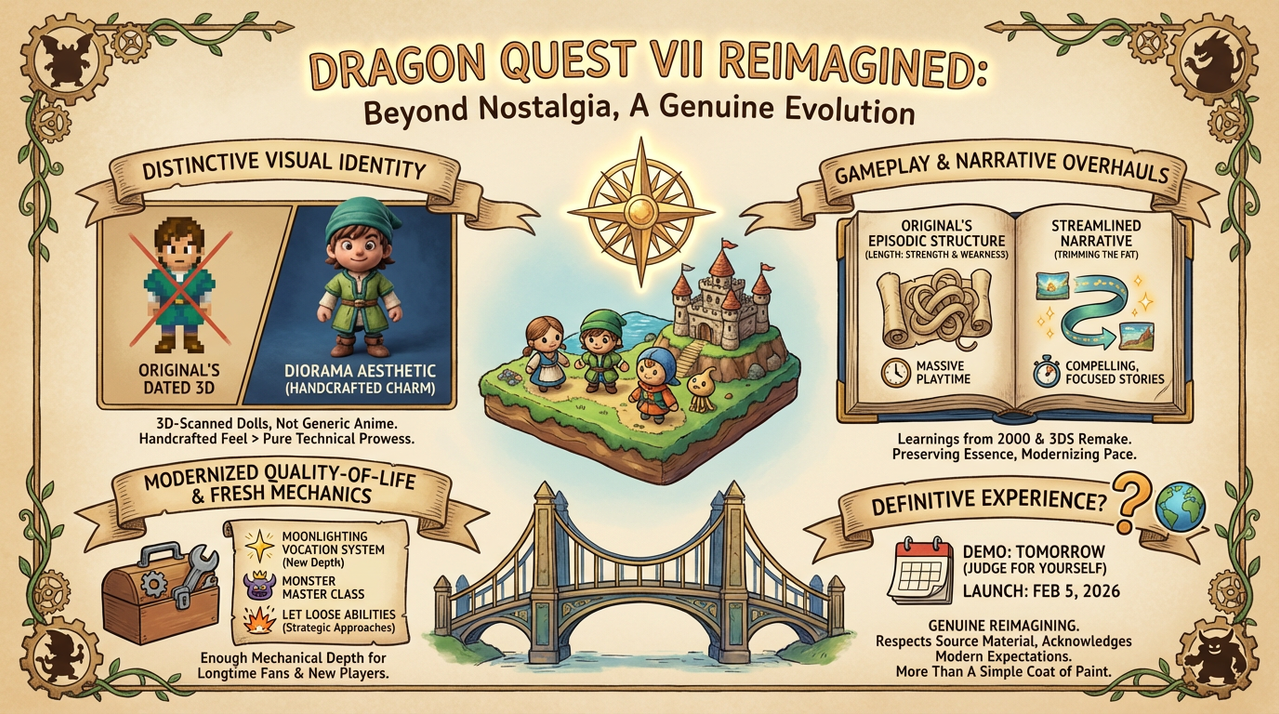
The opening cinematic demonstrates exactly what Square Enix means by “hand-crafted aesthetic” and “diorama-style visuals.” Characters move through the world with a distinctive toy-like quality because they’re literally based on physical dolls that the development team created and 3D scanned. The environments surrounding them resemble elaborate miniature sets you’d see in stop-motion animation, complete with exaggerated depth-of-field effects that make everything feel tangible and craft-focused.
Combat sequences show the party battling iconic Dragon Quest monsters like Slimes and Drackys with spell effects and abilities rendered in vibrant, chunky visual styles. The whole presentation evokes the feeling of playing with action figures on a lovingly constructed playset, which sounds potentially off-putting but actually looks charming as hell when executed with this level of production value and art direction.
It’s a bold departure from both the original PlayStation version’s primitive 3D graphics and the 3DS remake’s more traditional anime-inspired look. This reimagined aesthetic takes inspiration from the HD-2D style Square Enix developed for Octopath Traveler and Triangle Strategy while pushing it in a distinctly different direction that feels uniquely Dragon Quest.
Demo Details And The Day Off Dress
The demo launches January 7, 2026 simultaneously across all platforms where the full game will release: PlayStation 5, Xbox Series X|S, Nintendo Switch, Switch 2, and PC via Steam (with the Steam version technically releasing February 6, one day after console versions due to time zones). Progress from the demo carries over completely to the full game, meaning you can effectively start your adventure a month early without losing anything.
As an additional incentive, players who complete the demo will receive the “Day Off Dress,” an exclusive costume for party member Maribel that presumably changes her appearance without affecting stats. These kinds of cosmetic bonuses for trying demos have become standard practice for Square Enix, rewarding early engagement while giving completionists one more item to check off their lists.
The demo presumably covers the game’s opening hours on Estard Island, introducing protagonist and his childhood friends before they discover the Shrine of Mysteries and get swept into time-traveling adventures. How much content the demo includes hasn’t been specified, but Square Enix demos typically offer 2-4 hours of gameplay.

What Makes This A Reimagining Not Just A Remake
The “Reimagined” subtitle isn’t marketing fluff. Square Enix producer Takeshi Ichikawa has been explicit that this isn’t a straight remake like the 3DS version released in 2013. Instead, the team is fundamentally reworking Dragon Quest VII’s most controversial elements while preserving what made it special. That means significant cuts to the story’s length and substantial gameplay overhauls.
Dragon Quest VII originally launched in 2000 on PlayStation in Japan and 2001 in North America. It was notorious for having one of the longest, most tedious openings in JRPG history, taking hours before the first actual battle. The 3DS remake in 2016 improved pacing but still featured a sprawling 100+ hour adventure that many modern players found too bloated. Ichikawa personally admitted he quit the original game because the opening dragged too much.
For Reimagined, the team is streamlining the narrative by removing or converting to optional side quests any story segments that “had little or no direct connection to the main storyline.” That’s a controversial decision because Dragon Quest VII’s episodic structure visiting different islands trapped in time is core to its identity. But if the result is a tighter 40-60 hour experience versus the original’s 100+ hour marathon, many players will appreciate the respect for their time.
The Combat And Vocation Overhauls
Combat receives equally substantial changes beyond just visual upgrades. The most significant quality-of-life improvement is that weak monsters can now be defeated directly in the overworld without entering turn-based battles. If you encounter a low-level Slime and your party vastly outlevels it, you can strike it during exploration for an instant victory. This eliminates the tedious random encounters that plague older JRPGs.
For battles that do trigger traditional turn-based combat, Square Enix added options to speed things up through preset command queues and even full auto-battle where AI handles everything. These features respect that not every player wants to manually input commands for trivial fights against trash mobs, though boss battles and challenging encounters presumably still demand strategic thinking.
The vocation (job class) system gets expanded with a “Moonlighting” mechanic that lets characters equip two vocations simultaneously instead of just one. Your primary vocation determines your main stats and abilities, while your secondary vocation provides additional skills and passive bonuses. This creates significantly more build variety and customization compared to the original’s simpler single-job system.
The Let Loose And Monster Master Additions
A new “Let Loose” mechanic triggers when characters become sufficiently “worked up” during battle, allowing them to unleash powerful unique abilities. The system seems similar to Limit Breaks from Final Fantasy or Pep Powers from Dragon Quest XI, providing burst damage options and dramatic turn-arounds when battles get desperate.
The new Monster Master vocation introduces a “Positive Reinforcement” ability that summons monsters to assist during battles. This appears to function like a summoner or pet class, giving players access to creatures they’ve presumably encountered and befriended throughout their adventure. Whether this replaces the monster recruitment system from Dragon Quest V or supplements it remains unclear.
Why Dragon Quest VII Matters
For Western audiences, Dragon Quest VII occupies a weird space in franchise history. It’s the best-selling entry in Japan with over 4 million copies sold on PlayStation alone, making it more successful there than even Dragon Quest VIII or XI. But it was Dragon Quest’s first appearance on a non-Nintendo console in the West, and the 2001 North American release arrived when the PlayStation was already obsolete with PS2 dominating.
The result was that most Western players skipped it entirely, making Dragon Quest VII one of those games everyone knows about but few have actually played. The 3DS remake in 2016 gave it a second chance, but the handheld’s install base limitations and the game’s massive length meant it remained niche. Reimagined represents a third opportunity for Dragon Quest VII to find its audience, this time with modern platforms, streamlined pacing, and genuinely distinctive visuals.
The episodic structure where you visit islands trapped in different time periods solving localized problems before restoring them to the present creates a uniquely satisfying gameplay loop. Each island essentially functions as a self-contained story arc with its own cast, conflicts, and resolution before moving to the next. It’s brilliant for players who struggle with 100-hour commitments because you can treat each island as a stopping point.
The Switch 2 Connection
Dragon Quest VII Reimagined is one of the few third-party titles officially confirmed for Nintendo Switch 2 at launch. The game supports both Switch and Switch 2 natively, with presumably better performance and visuals on the upgraded hardware. Save data transfers seamlessly between the two platforms, meaning early adopters who play the demo or buy the game on original Switch can upgrade without losing progress.
This positioning makes Reimagined part of Switch 2’s launch lineup alongside first-party titles and other early releases. For Nintendo, having a major Square Enix JRPG available day one demonstrates third-party support. For Square Enix, it guarantees their game launches into a hardware cycle where millions of players are actively looking for new content to justify their console purchase.
The February 5 Release Blitz
Dragon Quest VII Reimagined launches February 5, 2026 across PlayStation 5, Xbox Series X|S, Nintendo Switch, and Switch 2, with PC via Steam following February 6. The simultaneous multi-platform launch represents a major shift for Dragon Quest, which historically staggered releases between Japan and the West or between different platforms.
Pre-orders are available now with early purchase bonuses including a costume for the Hero along with helpful starter items. The Standard Edition is priced at $59.99 / €59.99 / £49.99, which is standard for full-price JRPGs on current-generation hardware. No Deluxe or Collector’s Editions have been announced yet, though Square Enix frequently reveals those closer to launch.
February 5 puts Reimagined in an interesting release window. It arrives before the typically crowded March release period but after most of January’s big launches. The timing gives it breathing room to find an audience without competing directly against huge blockbusters, which is smart positioning for a JRPG remake of a game most Western players never experienced.

FAQs About Dragon Quest VII Reimagined
When does the Dragon Quest VII Reimagined demo release?
The free demo launches January 7, 2026 across PlayStation 5, Xbox Series X|S, Nintendo Switch, Switch 2, and PC. Save data transfers to the full game releasing February 5.
What platforms is Dragon Quest VII Reimagined available on?
The game releases February 5, 2026 for PlayStation 5, Xbox Series X|S, Nintendo Switch, and Nintendo Switch 2, with PC via Steam following February 6 due to time zone differences.
How long is Dragon Quest VII Reimagined?
The original game took 100+ hours to complete. The Reimagined version streamlines the story significantly by removing or making optional content not directly connected to the main narrative, though exact length hasn’t been confirmed.
What’s different about the Reimagined version?
Major changes include diorama-style visuals using 3D-scanned doll models, streamlined story removing padding, instant-defeat for weak overworld monsters, Moonlighting system for dual vocations, Let Loose burst abilities, and the new Monster Master vocation.
Do I need to play previous Dragon Quest games first?
No, Dragon Quest games are largely standalone. Dragon Quest VII tells a complete story with no connection to other entries beyond sharing thematic elements and recurring monsters.
What is the Day Off Dress?
It’s an exclusive costume for party member Maribel that players receive for completing the January 7 demo. The costume carries over to the full game when it launches February 5.
Will Dragon Quest VIII get similar treatment?
Not announced, but fan demand for a Dragon Quest VIII Reimagined remake following the same visual style is extremely high in community discussions. Square Enix hasn’t confirmed plans.
How much does Dragon Quest VII Reimagined cost?
Standard Edition is priced at $59.99 / €59.99 / £49.99. Pre-orders include a Hero costume and starter items. No Deluxe or Collector’s Editions have been announced yet.
Conclusion
The Dragon Quest VII Reimagined opening movie showcases exactly why this remake deserves attention beyond just being another nostalgic cash-grab. Square Enix and HexaDrive committed to a genuinely distinctive visual identity that stands apart from both the original’s dated 3D graphics and the generic anime style that dominates modern JRPGs. The diorama aesthetic using 3D-scanned dolls as character models creates something that looks handcrafted and charming in ways that pure technical prowess can’t replicate. But visuals alone wouldn’t justify calling this Reimagined rather than Remastered. The substantial gameplay overhauls, streamlined narrative, and modernized quality-of-life improvements suggest Square Enix learned from both the original’s 2000 launch and the 3DS remake’s 2016 reception. Dragon Quest VII’s episodic structure and massive length were simultaneously its greatest strength and biggest weakness. Trimming the fat while preserving what made each island’s story compelling could result in one of the best Dragon Quest experiences for players who bounced off previous versions. The demo launching tomorrow gives everyone a chance to judge for themselves before committing to the February 5 purchase. And for longtime fans who’ve already played Dragon Quest VII multiple times? The Moonlighting vocation system, Monster Master class, and Let Loose abilities provide enough mechanical depth that even familiar story beats should feel fresh through different party compositions and strategic approaches. Whether Dragon Quest VII Reimagined becomes the definitive version that finally brings Western audiences around to Japan’s favorite entry remains to be seen. But based on that opening movie and everything Square Enix has shown so far, this is way more than a simple coat of paint on a PlayStation classic. It’s a genuine reimagining that respects the source material while acknowledging that 2026 players have different expectations than audiences did in 2000. Sometimes that’s exactly what classic games need.