World in Conflict launched in 2007 and immediately became a cult classic among real-time tactics fans. Massive Entertainment created something special by removing base building and resource gathering, focusing purely on explosive tactical combat where you called in reinforcements and devastating off-map strikes. Then the studio moved on to other projects, leaving a genre-defining game with no true successor. Enter Joe Theis, a solo indie developer building InfiniWar, a spiritual successor that asks a fascinating question: what if World in Conflict had roguelike replayability and RPG-style progression? The answer is shaping up to be one of the most exciting indie strategy games coming in 2026.
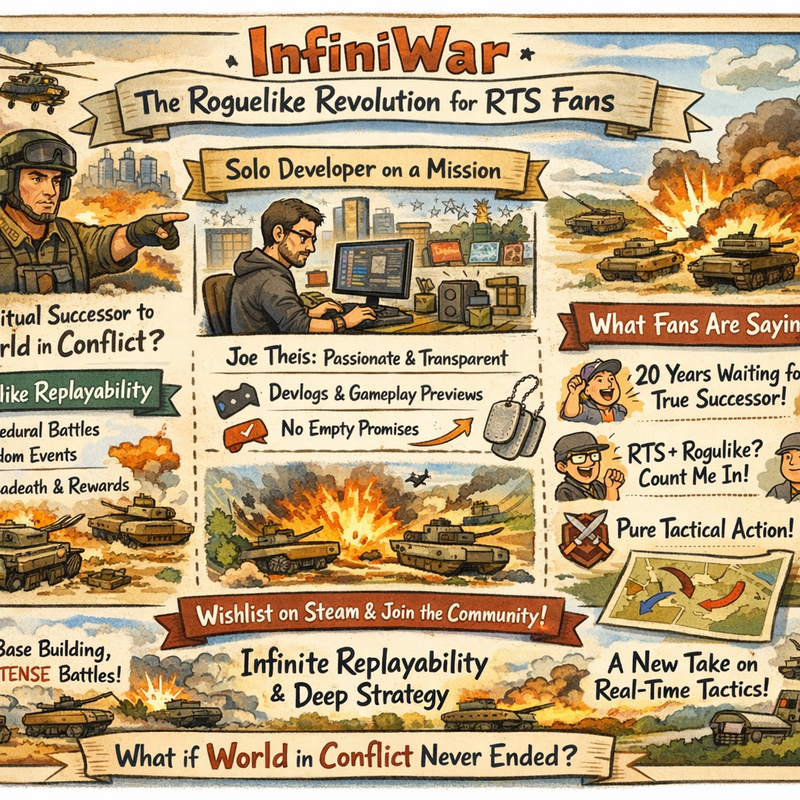
World in Conflict’s DNA
InfiniWar wears its inspiration proudly. Just like World in Conflict, the game eliminates traditional RTS busywork. No worker units gathering resources. No building construction queues. No tech trees that force every match to follow identical opening strategies. Instead, InfiniWar focuses entirely on tactical combat where your decisions about unit positioning, ability usage, and support strikes determine victory or defeat.
You command combined arms forces including land, sea, and air units across procedurally generated battlefields. Armor pushes through enemy lines while infantry secures objectives. Artillery rains death on fortified positions. Attack helicopters provide close air support. Fighter jets establish air superiority. Naval vessels bombard coastal targets. The combined arms puzzle rewards players who understand how different unit types complement each other rather than just massing the strongest units.
Off-map support abilities form the tactical backbone just like in World in Conflict. Call in precision airstrikes to obliterate hardened targets. Request artillery barrages to suppress enemy positions before your assault. Deploy tactical air defense to protect advancing forces from enemy aircraft. These abilities recharge over time or cost resources to use, creating meaningful decisions about when to commit your most powerful tools. Saving them for the perfect moment versus using them proactively defines skilled play.

Environmental Destruction That Matters
Buildings aren’t just decoration in InfiniWar. Heavy ordnance brings down entire structures, denying cover to enemies and opening new tactical approaches. Forest burns away under napalm strikes, exposing units that relied on concealment. Paths get cleared through dense terrain, allowing vehicles to flank from unexpected angles. This destructibility creates dynamic battlefields that evolve based on how the battle unfolds rather than remaining static maps.
Joe Theis has emphasized that environmental destruction isn’t just visual spectacle, it’s tactical depth. A well-placed artillery barrage doesn’t just damage enemies, it permanently alters the battlefield for the rest of the engagement. Buildings that provided defensive positions become rubble piles. Dense forests become scorched clearings. These changes affect both your forces and the enemy, rewarding players who think several moves ahead about how battlefield modification serves their strategy.
Where Roguelike Meets Real-Time Tactics
Here’s where InfiniWar diverges from its inspiration. Every battle takes place on a uniquely generated map with randomized objectives, win conditions, and environmental features. You’re never fighting the same battle twice. One mission might task you with defending key positions against waves of attackers. Another requires aggressive assaults to capture territory before time expires. A third could involve destroying specific high-value targets while surviving counterattacks.
These individual battles connect into broader operations within a roguelike-inspired campaign structure. Each operation presents branching paths with different rewards, challenges, and story developments. Lose all your forces in a battle and that operation ends, but you keep meta-progression that makes future attempts stronger. This structure creates the infinite replayability that traditional RTS campaigns lack while maintaining the tension that permadeath brings to roguelikes.
The non-binary outcomes system adds nuance most tactics games miss. Battles aren’t just win or lose. You might achieve your primary objective but take heavy casualties. Perhaps you secure a tactical withdrawal, preserving forces at the cost of surrendering territory. Maybe you win decisively, earning bonus rewards and unlocks. These graduated outcomes create more interesting strategic decisions where pyrrhic victories and costly defeats both have consequences beyond binary success or failure.

RPG Progression Meets Military Command
InfiniWar treats your military force like an RPG character build. Between battles, you visit a planning mode resembling a town or command center where you make strategic decisions about force composition. Unlock new unit types by completing objectives and earning rewards. Choose upgrades that enhance specific capabilities or provide new tactical options. Equip skills that grant powerful abilities with long cooldowns. Every decision shapes how you’ll approach future engagements.
This RPG-style progression creates build diversity rarely seen in tactics games. One player might specialize in armored warfare, fielding heavy tanks with enhanced protection and firepower. Another focuses on air power, unlocking advanced aircraft and reducing cooldowns on air support abilities. A third emphasizes artillery and indirect fire, transforming their force into a siege machine that pounds enemies from afar. These specializations emerge organically from player choices rather than being rigid class selections.
The system also introduces interesting trade-offs. Powerful units and abilities cost more to field, limiting how many you can deploy simultaneously. Specialized builds excel in certain scenarios but struggle in others. Balancing generalist flexibility against specialist power creates strategic depth that extends across entire operations rather than just individual battles. Your choices in mission three affect what strategies remain viable in mission seven.
Elite and Ace Enemies
Enemy forces aren’t mindless cannon fodder. InfiniWar introduces elite and ace units inspired by Diablo’s rare and unique monsters. These specialized enemies possess enhanced abilities, unique mechanics, and significantly increased threat levels. An elite tank might have reactive armor that reduces incoming damage. An ace helicopter could deploy countermeasures that jam your targeting systems. These encounters force tactical adaptation mid-battle rather than allowing you to autopilot through engagements.
The elite system creates emergent narratives where specific enemy commanders become recurring nemeses. Maybe that ace pilot keeps showing up in crucial battles, forcing you to adapt your strategy around countering their specific strengths. Perhaps an elite armored column represents the main threat, requiring you to focus fire and use your most powerful abilities to neutralize them before they overrun your positions. These individual threats add personality to what could otherwise feel like anonymous enemy forces.

Stylized Aesthetics Over Realism
Joe Theis made a deliberate choice to pursue stylized low-poly visuals rather than photorealistic graphics. This aesthetic direction serves multiple purposes. As a solo developer, creating realistic military assets would consume years of development time. The stylized approach allows faster iteration and more focus on gameplay systems. It also ensures the game ages gracefully, since artistic style outlasts technical fidelity.
The visuals still communicate clearly despite the abstraction. Different unit types are immediately distinguishable by silhouette and color. Environmental features like buildings, forests, and water bodies read clearly from the tactical camera angle. Explosions and destruction effects provide satisfying feedback without overwhelming the screen. The style proves you don’t need Battlefield-level graphics to create compelling military strategy experiences.
Procedural map generation creates diverse battlefields across multiple biomes. Fight across expansive deserts where visibility extends for miles but cover is scarce. Battle on vibrant tropical islands with dense jungles providing concealment. Engage in icy mountain passes where elevation and chokepoints dominate tactics. These biomes aren’t just visual variety, they fundamentally change how engagements play out by altering terrain characteristics and available cover.
What’s Not in InfiniWar
Understanding what Joe Theis deliberately excluded helps clarify InfiniWar’s vision. There’s no base building, no resource gathering, no fixed tech trees, no traditional narrative campaign with scripted missions. The game intentionally avoids these RTS staples to focus entirely on tactical combat and roguelike replayability. If you loved the economic management of StarCraft or the story campaigns of Company of Heroes, InfiniWar isn’t trying to replicate those experiences.
Similarly, there’s no multiplayer planned for the initial release. InfiniWar is designed as a single-player experience with friendly AI available for larger battles. While Joe mentions multiplayer might appear in a hypothetical InfiniWar 2, the current project remains focused on perfecting the single-player roguelike campaign. This scope limitation represents smart solo development, focusing resources on core systems rather than spreading thin across too many features.
The game also avoids deep 4X simulation layers with detailed world maps and complex logistics. You’re not managing supply lines or conducting grand strategy across theaters of war. Each battle is self-contained within the broader operation structure. This focused approach keeps gameplay tight and replayable rather than bogged down in micromanagement that could dilute the tactical combat emphasis.
The Solo Developer Journey
Joe Theis has been documenting InfiniWar’s development through YouTube devlogs and Reddit posts, providing transparency into the creative process. As a solo developer, he handles every aspect: programming, design, art, audio, marketing, and community management. This one-person approach creates challenges but also ensures cohesive vision without committee dilution or publisher interference.
The devlogs reveal thoughtful design decisions and willingness to iterate based on feedback. Joe discusses why he chose stylized graphics, how roguelike structure serves replayability, and what systems made the cut versus what got saved for potential sequels. This transparency builds trust with the community while setting realistic expectations about scope and timeline for a solo-developed tactics game.
Development milestones like adding the town/planning mode between battles show steady progress toward a playable demo. Joe has mentioned plans for a demo that will let players experience the core loop before committing to purchase. This demo-first approach demonstrates confidence in the gameplay while reducing risk for curious players unsure whether InfiniWar’s unique blend of genres appeals to them.
Filling the World in Conflict Void
The real-time tactics genre focusing purely on combat without base building has felt underserved since World in Conflict. Company of Heroes scratches a similar itch but emphasizes WWII settings and different tactical considerations. WARNO and its predecessors target hardcore military simulation fans rather than broader audiences. InfiniWar positions itself between arcade action and hardcore simulation, aiming for that accessible-yet-deep sweet spot that made World in Conflict so special.
The roguelike elements could be what finally gives the subgenre staying power beyond single campaigns. Traditional RTS campaigns end after 10-20 hours, then players either move to multiplayer or move on entirely. InfiniWar’s procedural operations and RPG progression create incentives for repeated play that don’t require competitive multiplayer. For players who love tactical combat but don’t want the stress or time commitment of ranked ladders, this represents the perfect solution.
Whether InfiniWar can capture World in Conflict’s magic while adding roguelike replayability depends on execution. The concept is sound. The inspiration is proven. The solo developer shows commitment and skill through transparent development updates. What remains is playtesting, iteration, and polishing those core systems until they feel as tight and satisfying as the 2007 classic that inspired this ambitious indie project.
Frequently Asked Questions
When does InfiniWar release?
No official release date has been announced yet. The game is currently in development with a demo planned. Check the Steam page and wishlist to receive updates.
What platforms will InfiniWar be available on?
InfiniWar is confirmed for PC via Steam. No console versions have been announced at this time.
Who is developing InfiniWar?
Joe Theis is the solo indie developer creating InfiniWar, handling all aspects of development independently.
Does InfiniWar have base building?
No. InfiniWar deliberately excludes base building, resource gathering, and traditional RTS economic management to focus purely on tactical combat.
Is there multiplayer?
No multiplayer is planned for the initial release. InfiniWar is designed as a single-player experience with friendly AI available for larger battles.
How is InfiniWar similar to World in Conflict?
Both games focus on tactical combat without base building, feature off-map support abilities, emphasize combined arms warfare, and create explosive battlefield action with environmental destruction.
What makes InfiniWar different from World in Conflict?
InfiniWar adds roguelike procedural campaigns with non-binary outcomes, RPG-style force customization and progression, elite enemy units, and infinite replayability through randomized battles and operations.
Will there be a demo?
Joe Theis has mentioned plans for a demo that will showcase the core gameplay loop. Follow development updates on Steam or through his devlog videos for announcement details.
What inspired InfiniWar?
World in Conflict is the primary inspiration for tactical combat, with roguelike games influencing the campaign structure and Diablo inspiring the elite/ace enemy system.
Why stylized graphics instead of realistic visuals?
As a solo developer, Joe Theis chose stylized low-poly graphics to allow faster development, easier iteration, and better performance while maintaining clear visual communication and timeless aesthetic appeal.
Final Thoughts
InfiniWar represents exactly the kind of creative risk-taking that makes indie development exciting. Rather than cloning World in Conflict wholesale or creating yet another traditional RTS, Joe Theis identified what made that 2007 classic special and asked how modern design trends could enhance those strengths. The answer, combining explosive tactical combat with roguelike replayability and RPG progression, sounds perfect on paper.
Execution will determine whether InfiniWar becomes the spiritual successor fans have wanted for nearly two decades. The challenges are real. Balancing procedural generation with handcrafted quality, ensuring elite enemies feel threatening without being frustrating, creating meaningful RPG progression that doesn’t become overwhelming, maintaining tactical depth across hundreds of randomized battles. These aren’t simple problems, and Joe is tackling them solo.
But the transparent development approach builds confidence. Joe isn’t promising features he can’t deliver or hiding behind marketing speak. He’s showing actual gameplay, discussing design decisions openly, and setting realistic scope for what one person can accomplish. The willingness to cut multiplayer and 4X elements to focus on perfecting the core tactical roguelike experience shows mature project management that increases the likelihood of actually finishing and polishing the game.
For World in Conflict fans who’ve been waiting nearly 20 years for something that captures that same magic, InfiniWar deserves attention. For roguelike enthusiasts curious about the genre expanding into real-time tactics, this represents uncharted territory worth exploring. For strategy gamers tired of the same base-building economic management loops, the pure combat focus offers refreshing simplicity.
Wishlist InfiniWar on Steam to follow development and receive notification when the demo launches. Watch Joe’s devlog videos for deeper dives into specific systems and design philosophies. Join the small but growing community discussing tactics, builds, and strategies before the game even releases. Sometimes the most exciting games come from solo developers with clear visions, deep passion for their inspirations, and the technical skills to execute ambitious ideas.
World in Conflict showed us that RTS games could thrive without base building if the tactical combat was engaging enough. InfiniWar is betting that same combat can sustain infinite replayability through roguelike structure and RPG progression. If Joe Theis succeeds, he won’t just create a spiritual successor to a beloved classic. He’ll establish a new subgenre that other developers will spend years trying to replicate. That’s worth watching, wishlisting, and eventually playing when the demo arrives and the game launches. The real-time tactics roguelike revolution might start with one solo developer who simply asked: what if World in Conflict never ended?