NVIDIA pulled the curtain back on DLSS 4.5 at CES 2026, and it’s bringing some genuinely eyebrow-raising features to the table. The headline grabber is Dynamic Multi Frame Generation with a 6x mode that can pump out five AI-generated frames for every single traditionally rendered frame. Whether that sounds amazing or terrifying probably depends on how you feel about AI in gaming.
What’s Actually New in DLSS 4.5
DLSS 4.5 splits into two main components. First is the second-generation transformer model for Super Resolution, which NVIDIA says fixes some of the visual artifacts that plagued earlier versions. The company claims it delivers better temporal stability, meaning less flickering on static surfaces, reduced ghosting behind fast-moving objects like weapons, and sharper anti-aliasing overall. This part works on every RTX GPU ever made, going all the way back to the 20 series cards.
The second component is where things get spicy. Dynamic Multi Frame Generation can now generate up to 6x frames instead of the previous 4x limit. NVIDIA showed Black Myth: Wukong running at 246 fps in 4K with full path tracing on an RTX 5090, which sounds impressive on paper. The dynamic aspect means the system automatically adjusts frame generation multipliers based on your monitor’s refresh rate, scaling up during demanding scenes and scaling down when your GPU can handle the load naturally.
The Training Behind the Tech
NVIDIA hasn’t been sitting idle between versions. The company runs a dedicated supercomputer with thousands of GPUs that trains DLSS models 24/7, 365 days a year. The second-generation transformer model uses five times more compute than the old convolutional neural network models that powered early DLSS versions, with improved contextual awareness and smarter pixel sampling baked in.
This expanded training helps address specific edge cases where DLSS would produce distracting artifacts. Static surfaces that used to shimmer or flicker should look more solid now. Ghostly trails that formed behind player weapons or objects close to the camera are also supposed to be dramatically reduced. NVIDIA demonstrated these improvements using The Elder Scrolls IV: Oblivion Remastered and Indiana Jones and the Great Circle, showing clearer motion and sharper edges compared to DLSS 4.

Who Actually Benefits Right Now
The Super Resolution improvements are available immediately through the NVIDIA App for all RTX GPU owners. Because NVIDIA built DLSS Override functionality into the app, over 400 games can take advantage of the upgraded image quality without developers needing to patch anything. That’s a massive library getting an instant boost, which is genuinely impressive.
However, Dynamic Multi Frame Generation and the 6x mode are exclusive to RTX 50 Series GPUs and won’t arrive until Spring 2026. If you’re rocking an RTX 3080 or 4090, you’ll get the image quality improvements but none of the dynamic frame generation features. NVIDIA says the new frame generation tech requires the AI Management Processor and enhanced Tensor Cores found only in Blackwell architecture cards.
The Frame Generation Debate
Here’s where opinions split. NVIDIA is promising 4K 240Hz path-traced gaming, which sounds like a dream scenario for anyone with a high-refresh monitor. The company demonstrated this with an RTX 5090 maintaining 53ms PC latency despite generating five frames for every one it actually renders. That’s achieved through NVIDIA Reflex technology working alongside the frame generation.
But not everyone is convinced. Frame generation has always been divisive, with some players swearing by it and others refusing to enable it under any circumstances. Cranking that up to 6x means 83% of what you’re seeing on screen is AI-generated rather than traditionally rendered. For competitive gamers or anyone sensitive to input lag, that’s a tough sell regardless of what the latency numbers say. Even casual players who enjoy frame gen at 2x or 3x might find 6x pushes things too far into uncanny valley territory.

Game Support and Future Plans
Over 250 games and apps already support DLSS 4 with Multi Frame Generation, making it NVIDIA’s fastest-adopted gaming technology. DLSS 4.5 extends that compatibility while adding several high-profile upcoming titles. 007 First Light, Phantom Blade Zero, and PRAGMATA will all launch with DLSS 4 support including ray tracing and path tracing features.
Resident Evil Requiem also got a shout-out with an exclusive path-traced trailer shown at CES. These AAA integrations show developers are willing to build their games around NVIDIA’s upscaling tech from day one, which should mean better implementation than retrofitted patches. The question is whether they’ll optimize specifically for 6x frame generation or stick with more conservative multipliers.
Performance Mode Gets Serious
One genuinely exciting development is how Performance and Ultra Performance modes have evolved. NVIDIA claims Performance Mode with DLSS 4.5 now matches or beats native resolution image quality, while Ultra Performance has become actually viable for 4K gaming. That’s a big deal because it means players with mid-range RTX cards can potentially play demanding games at 4K without the image looking like a blurry mess.
The improvements are most dramatic when rendering from fewer pixels, which is exactly when you’d want to use Performance or Ultra Performance modes anyway. If those claims hold up in real-world testing, it could significantly extend the useful life of older RTX cards as games get more demanding.
RTX Remix Logic and Other Announcements
DLSS 4.5 wasn’t the only gaming tech NVIDIA announced at CES. RTX Remix Logic will launch later this month, allowing modders to create dynamic effects that respond to real-time game events when remastering classic titles. The company also revealed upgraded G-SYNC Pulsar monitors claiming 4x the effective motion clarity are hitting stores this week.
GeForce NOW is expanding too, with native Linux support and Fire TV compatibility coming soon. NVIDIA ACE, the AI character engine, is being integrated into Total War: Pharaoh as an AI advisor, with a playtest program launching in 2026. The company is clearly pushing AI integration across its entire ecosystem, not just upscaling.
FAQs About NVIDIA DLSS 4.5
When is DLSS 4.5 available?
DLSS 4.5 Super Resolution is available now in beta through the NVIDIA App, with official release on January 13, 2026. Dynamic Multi Frame Generation and 6x mode arrive in Spring 2026 for RTX 50 Series GPUs only.
Which graphics cards support DLSS 4.5?
All GeForce RTX GPUs from the 20 Series onward support the Super Resolution improvements. However, Dynamic Multi Frame Generation and 6x mode require RTX 50 Series cards with Blackwell architecture.
How many games support DLSS 4.5?
Over 400 games and apps can use DLSS 4.5 Super Resolution immediately via DLSS Override in the NVIDIA App. More than 250 titles already support DLSS 4 with Multi Frame Generation, which will work with the dynamic features when they launch in Spring 2026.
What is Dynamic Multi Frame Generation?
It’s a feature that automatically adjusts frame generation multipliers in real-time based on your monitor’s refresh rate and GPU performance. Instead of fixed 2x or 4x modes, it can scale from 3x up to 6x dynamically to maintain smooth framerates.
Does 6x frame generation increase input lag?
NVIDIA says latency remains low thanks to Reflex technology, with demonstrations showing 53ms PC latency on an RTX 5090 running Black Myth: Wukong at 246 fps with 6x generation. However, real-world experience will vary by game and system configuration.
Can I use DLSS 4.5 in older games?
Yes, the DLSS Override feature in the NVIDIA App allows you to use the latest Super Resolution model in any game that supports DLSS, even if developers haven’t patched it. This gives instant upgrades to hundreds of titles.
Is Performance Mode really better than native now?
NVIDIA claims Performance Mode with DLSS 4.5 can match or exceed native image quality while rendering fewer pixels. This is most noticeable at 4K resolution, though independent testing will be needed to verify these claims across different games.
Do I need the NVIDIA App to use DLSS 4.5?
Yes, DLSS 4.5 is distributed through the NVIDIA App, which replaced GeForce Experience. The app includes DLSS Override functionality and other features like driver updates and game optimization.
Conclusion
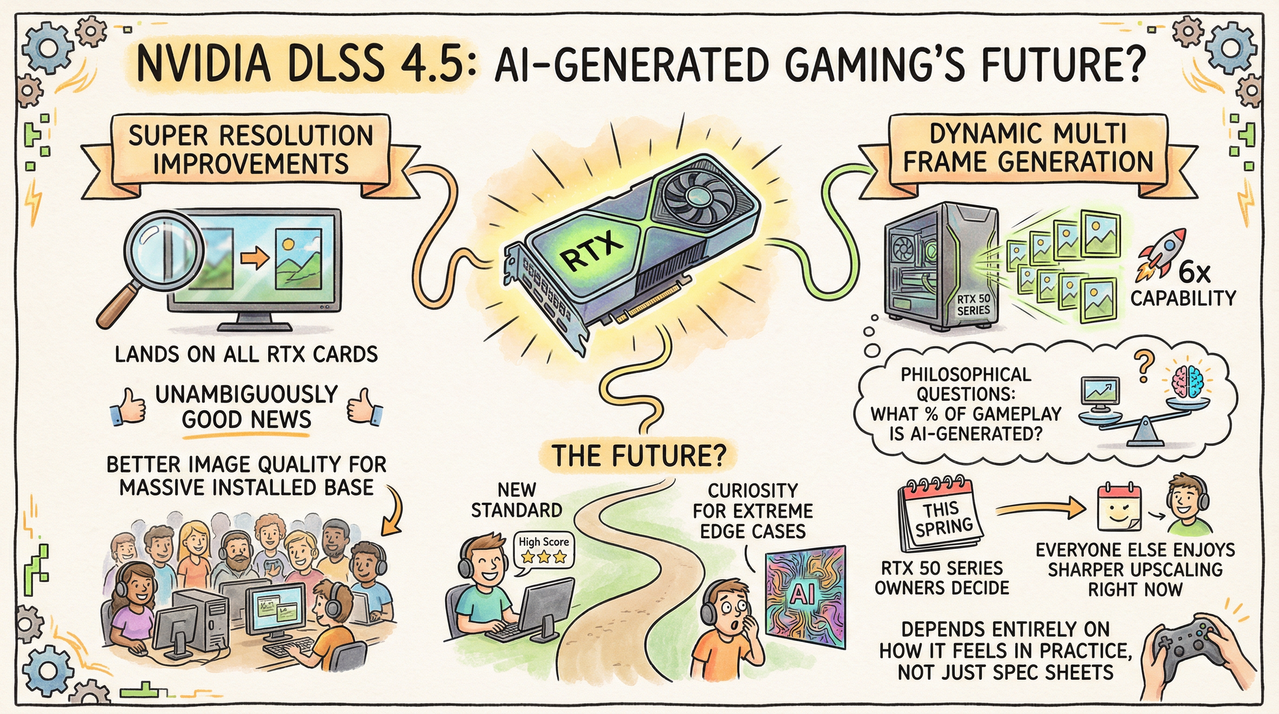
DLSS 4.5 represents NVIDIA doubling down on AI-generated frames as the future of gaming performance. The Super Resolution improvements landing on all RTX cards is unambiguously good news, bringing better image quality to a massive installed base. Dynamic Multi Frame Generation with 6x capability is where things get interesting, both in the potential performance gains and the philosophical questions about what percentage of your gameplay should be AI-generated versus traditionally rendered. RTX 50 Series owners will get to decide for themselves when the feature arrives this spring, while everyone else can enjoy sharper upscaling right now. Whether 6x frame generation becomes the new standard or remains a curiosity for extreme edge cases will depend entirely on how it feels in practice, not just what the spec sheets promise.