The gaming community went into panic mode this week after reports surfaced that Nvidia’s RTX 5070 Ti and RTX 5060 Ti 16GB graphics cards were being discontinued. Hardware Unboxed dropped a bombshell video claiming these mid-range GPUs had reached “end of life” status, with Asus unable to secure supply from Nvidia. But here’s the twist: both Asus and Nvidia quickly pushed back, saying the cards aren’t actually discontinued. So what’s really happening?
The Initial Report That Sparked Panic
According to Hardware Unboxed’s Tim Schiesser, sources at Asus confirmed during CES 2026 that the RTX 5070 Ti had essentially reached end of life, with the company unable to get supply to continue shipping the graphics card. The YouTube channel also reported that the RTX 5060 Ti 16GB was facing the same fate. Retailers across Australia and the US confirmed they could no longer purchase these cards from partners and distributors, with existing stock expected to be the last until further notice.
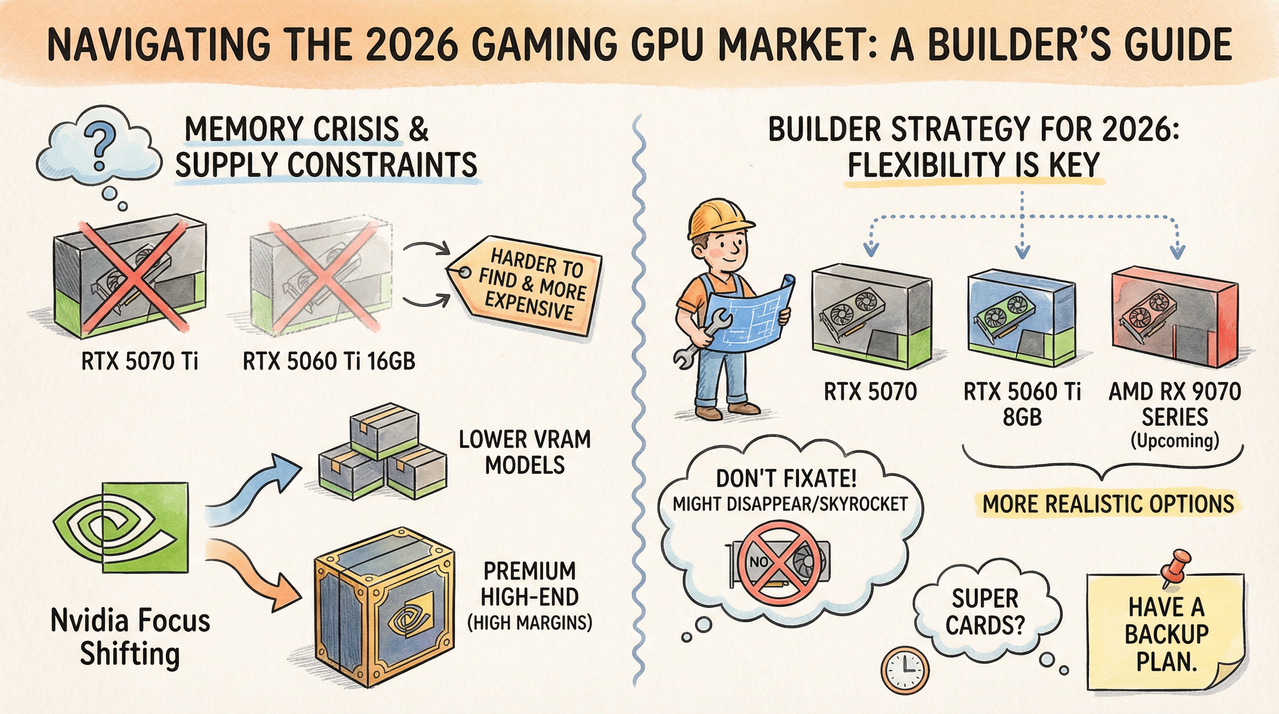
The culprit? The ongoing memory crisis. Both cards feature 16GB of VRAM, which has become increasingly expensive due to AI data centers consuming massive amounts of the world’s memory supply. RAM prices have reportedly surged by nearly 500%, making these mid-range cards with high memory configurations financially challenging for Nvidia to produce. With the more expensive RTX 5080 also sporting 16GB of VRAM, it made sense that Nvidia would prioritize production of its higher-margin products.
Asus and Nvidia Fire Back
Almost immediately after the story broke, both Asus and Nvidia issued statements denying the discontinuation claims. Asus released a press statement clarifying that neither the RTX 5070 Ti nor the RTX 5060 Ti 16GB had been designated as end-of-life products. The company stated that “current fluctuations in supply for both products are primarily due to memory supply constraints, which have temporarily affected production output and restocking cycles.”
Nvidia echoed this sentiment, confirming that they continue to ship all SKUs. The companies framed the issue as a temporary supply challenge rather than a permanent discontinuation. However, the carefully worded statements acknowledge that availability may appear limited in certain markets, which doesn’t exactly inspire confidence for gamers hoping to snag one of these cards at a reasonable price.
What This Means for Availability and Pricing
Regardless of whether these cards are officially “discontinued” or just severely supply-constrained, the practical impact for consumers is nearly identical. Prices have already started climbing. The RTX 5070 Ti has increased by $100 in the US (from $730 to $830) and AU$200 in Australia (from AU$1,200 to AU$1,400). Meanwhile, the RTX 5060 Ti 16GB is becoming increasingly difficult to find in stock.
The situation highlights a broader problem facing PC gaming in 2026. With memory manufacturers like Micron, Samsung, and SK Hynix prioritizing AI data centers, gaming hardware is taking a back seat. Industry analysts expect this memory shortage to extend into 2027 or even 2028. One analyst from Moor Insight and Strategy noted that unlike past memory cycles which were purely boom or bust, AI might create a structural change to how memory is consumed.
Nvidia appears to be shifting its strategy to focus on 8GB models like the RTX 5050, 5060, and the 8GB version of the 5060 Ti. The 12GB RTX 5070 is expected to stick around for now, positioned as the sweet spot for gamers who want decent VRAM without the premium pricing that 16GB models now command.
The Super Series Delay
Adding fuel to the fire, Hardware Unboxed confirmed that Nvidia’s planned RTX 50 Super series has been postponed indefinitely. These refreshed cards, traditionally released about a year after the initial launch, were expected to debut at CES 2026. However, Nvidia opted to delay them due to the ongoing memory crisis. There’s speculation that if RAM pricing doesn’t stabilize soon, the Super series launch could be cancelled altogether.
The Super cards were rumored to upgrade from 2GB GDDR7 modules to 3GB versions to enhance capacity, but sourcing these larger memory chips has proven challenging. This would have been a significant upgrade for gamers looking for more VRAM headroom, but the memory shortage has thrown a wrench into those plans.

Should You Buy Now or Wait?
| Card Model | VRAM | Current Status | Price Trend |
|---|---|---|---|
| RTX 5070 Ti | 16GB | Supply constrained | Rising ($730 to $830) |
| RTX 5060 Ti 16GB | 16GB | Supply constrained | Limited availability |
| RTX 5060 Ti 8GB | 8GB | Available | Stable |
| RTX 5070 | 12GB | Available | Stable near MSRP |
| RTX 5080 | 16GB | Limited, inflated prices | Well above MSRP |
If you’ve been eyeing the RTX 5070 Ti or RTX 5060 Ti 16GB, the decision gets tricky. While technically not discontinued, the writing is on the wall. Limited supply, rising prices, and Nvidia’s apparent shift away from 16GB mid-range cards suggest these models won’t be easy to find at reasonable prices moving forward. For most gamers, the RTX 5070 with 12GB of VRAM offers a better value proposition right now, sitting at its $549 MSRP with decent availability.
The RTX 5060 Ti 8GB and standard RTX 5060 remain viable options for budget-conscious builders, though the reduced VRAM might be a concern for future-proofing. With modern games increasingly demanding more video memory, 8GB is starting to feel tight for high settings at 1440p and beyond.
FAQs
Are the RTX 5070 Ti and RTX 5060 Ti 16GB officially discontinued?
No, both Asus and Nvidia have denied that these cards are discontinued. However, they are experiencing severe supply constraints due to memory shortages, which means availability is extremely limited and prices are rising.
Why are 16GB graphics cards being affected more than others?
The global memory shortage driven by AI data centers has made GDDR7 memory extremely expensive. Nvidia appears to be prioritizing 16GB modules for higher-margin products like the RTX 5080 and RTX 5090, leaving mid-range 16GB cards like the 5070 Ti with limited supply.
Will the RTX 50 Super series still be released?
The RTX 50 Super series has been postponed indefinitely according to recent reports. If memory prices don’t stabilize, there’s a possibility the entire Super lineup could be cancelled, though Nvidia hasn’t made an official announcement.
Should I buy an RTX 5070 Ti now before it disappears?
Unless you find one at or near MSRP, it’s probably not worth paying inflated prices. The RTX 5070 with 12GB offers better value at its current $549 price point, and the performance difference isn’t massive enough to justify paying $100-200 more for the Ti model.
How long will the memory shortage last?
Industry analysts expect the memory shortage to continue through 2027 or even 2028. Unlike previous memory cycles that were purely market-driven, the current shortage is structural due to AI’s massive and sustained demand for memory components.
What are the best alternatives to the RTX 5070 Ti right now?
The RTX 5070 (12GB) at $549 offers solid 1440p performance without the supply issues. AMD’s RX 9070 XT, launching in early March 2026 at $599, is also positioned as a competitor in this segment and might offer better availability.
Will prices come back down for these cards?
It’s unlikely in the near term. With memory supply allocated through 2026 and AI demand showing no signs of slowing, expect prices to remain elevated or continue climbing for cards with higher VRAM configurations.
The Bottom Line
Whether you call it a discontinuation or a supply constraint, the end result is the same for gamers: the RTX 5070 Ti and RTX 5060 Ti 16GB are becoming harder to find and more expensive to buy. The memory crisis isn’t going away anytime soon, and Nvidia’s focus is clearly shifting toward either lower VRAM models or premium high-end cards where margins justify the expensive memory.
For builders planning a new gaming PC in 2026, flexibility is key. Don’t fixate on specific models that might disappear or skyrocket in price. The RTX 5070, RTX 5060 Ti 8GB, and AMD’s upcoming RX 9070 series offer more realistic options in an increasingly challenging market. And if you’re holding out for those Super cards? You might want to have a backup plan.