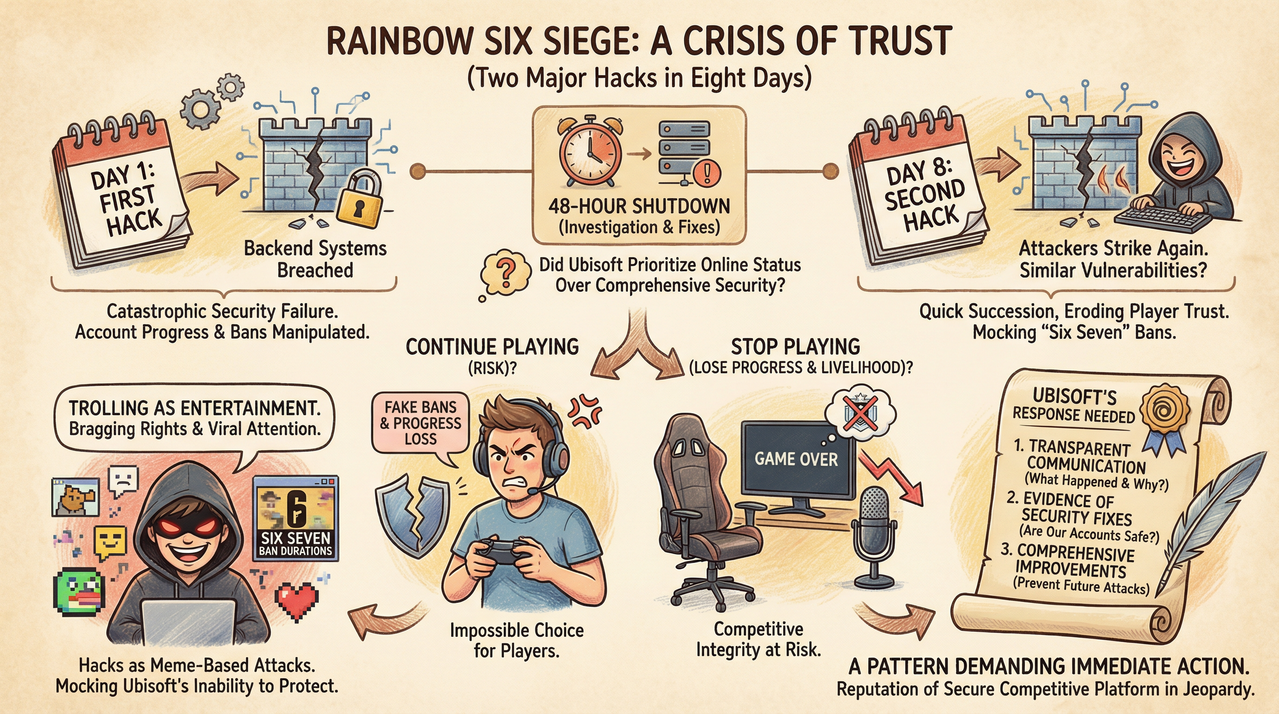
Rainbow Six Siege can’t catch a break. Ubisoft’s tactical shooter, which celebrated nearly a decade of competitive success, got hacked on December 27, 2025, with attackers flooding player accounts with billions in virtual currency and rare cosmetics. The publisher took servers offline, rolled back transactions, and restored service by December 29. Problem solved, right? Wrong. Just six days after coming back online, Rainbow Six Siege got hacked again on January 4, 2026. This time, hackers handed out 67-day bans to random players including popular streamers, with ban messages referencing the viral internet meme. The repeated breaches within eight days expose catastrophic security failures at Ubisoft that should terrify anyone playing their games.
The Christmas Currency Heist
The first hack hit Rainbow Six Siege on December 27, 2025, during the holiday weekend when many security teams operate with skeleton crews. Attackers exploited Ubisoft’s backend systems to manipulate player accounts on a massive scale. Within hours, players logged in to discover approximately 2 billion R6 Credits and Renown, the game’s premium and earned currencies, sitting in their accounts. To put that in perspective, R6 Credits normally cost real money, with the largest bundle offering 16,000 credits for $100. The hackers essentially gave every affected player currency worth hundreds of thousands of dollars.
The attack went beyond just currency. Hackers unlocked every cosmetic item in the game for affected players, including ultra-rare developer-only skins like the coveted Glacier weapon skins that normally can’t be obtained through any legitimate means. They also manipulated the ban system, randomly banning and unbanning players while hijacking the in-game ban ticker to display messages mocking Ubisoft’s security. Alpha Packs, the game’s loot boxes, appeared in inventories by the hundreds.
Ubisoft responded by completely shutting down Rainbow Six Siege and its marketplace. The game remained offline for nearly 48 hours while engineers investigated the breach and implemented fixes. On December 29, Ubisoft began cautiously restoring service, starting with limited testing before fully reopening servers. The publisher rolled back all transactions to 11:00 AM UTC on December 27, meaning every purchase made with the illicit currency disappeared. Players who received free items had them removed from their accounts. Ubisoft clarified that nobody would be banned for spending the hacker-provided credits since players weren’t responsible for receiving them.

The Database Vulnerability
Security researchers identified the likely attack vector as CVE-2025-14847, dubbed MongoBleed, a critical vulnerability in MongoDB database instances. The flaw allows unauthenticated remote attackers to leak memory from exposed MongoDB servers, exposing credentials, authentication keys, and other sensitive information. A public proof-of-concept exploit became available shortly before the attacks, giving bad actors a roadmap for exploitation.
What makes this particularly damaging is that multiple unrelated hacker groups apparently compromised Ubisoft simultaneously using different methods. According to security firm VX-Underground, at least two separate threat operations targeted Rainbow Six Siege. One group exploited game service APIs directly to manipulate currency and moderation systems without accessing user data. A second group allegedly used MongoBleed to pivot into Ubisoft’s internal Git repositories, claiming to steal decades of source code dating back to the 1990s.
The existence of multiple attack vectors suggests Ubisoft’s security posture was fundamentally weak rather than falling victim to one sophisticated zero-day exploit. When different hacker groups using different methods can simultaneously breach your systems, you have systemic problems, not bad luck.
Six Seven Meme Becomes Ban Message
The second hack on January 4, 2026, took a different, more disruptive approach. Instead of giving players free items, attackers focused on the game’s moderation and ban systems. Players across PC, PlayStation, and Xbox platforms suddenly received 67-day suspensions for alleged harassment violations. The bans hit randomly, affecting casual players and prominent content creators alike, including streamers Varsity Gaming and Jessica JessGOAT Bolden who broadcasted their confusion live.
The 67-day duration wasn’t random. It references the six seven meme that recently went viral across social media, where people repeatedly say the numbers six and seven in various comedic contexts. By choosing this specific ban length, the hackers made their intentions clear: this wasn’t accidental system failure, this was trolling at industrial scale. The ban messages themselves often listed vague or nonsensical reasons, making it obvious they weren’t legitimate enforcement actions.
What makes these bans particularly frustrating is their impact on ranked play and seasonal progression. A 67-day ban essentially locks players out of an entire competitive season. For streamers and content creators whose livelihoods depend on playing Rainbow Six Siege, the bans represented potential income loss. Even players who didn’t receive bans directly felt uncertainty about account safety and whether they might be next.
Ubisoft’s Slow Response
As of January 4, Ubisoft had not issued an official statement about the second breach. The company’s status page listed degraded connectivity, authentication failures, matchmaking issues, and in-game store disruptions, but made no explicit mention of another security incident. This communication failure mirrors problems from the first hack, where Ubisoft took hours to acknowledge the situation while players panicked about whether spending the mysterious credits would result in permanent bans.
The lack of transparency fuels speculation and misinformation. During both hacks, Reddit and social media filled with rumors about what was happening, who was responsible, and what consequences players might face. Clear, immediate communication from Ubisoft could have prevented much of this confusion, but the company’s crisis response seems focused on fixing technical issues rather than keeping players informed.
What This Means for Players
Two successful hacks within eight days against one of gaming’s biggest competitive shooters raises serious questions about account security and data protection. While Ubisoft claims no personal player data was compromised in either incident, the hackers’ ability to manipulate backend systems that control currencies, inventory, and moderation suggests they had extensive access to sensitive infrastructure.
If attackers can arbitrarily grant currency, unlock items, and issue bans, what else might they access? Player IP addresses, email addresses, purchase histories, and private messages all exist somewhere in Ubisoft’s systems. The fact that hackers demonstrated control over game systems doesn’t guarantee they couldn’t pivot to more sensitive data if motivated differently. Security firm VX-Underground reported that one hacker group claimed to access Ubisoft’s internal Git repositories containing decades of source code, suggesting the breach extended far beyond just Rainbow Six Siege game servers.
Trust in automated systems takes severe damage when mistakes like this happen repeatedly. Rainbow Six Siege relies on automated moderation and anti-cheat systems to maintain competitive integrity. When players see that external attackers can manipulate these systems to issue fake bans, confidence in legitimate bans erodes. Every future enforcement action will now face skepticism about whether it represents genuine rule violation or potential system compromise.
The Bigger Ubisoft Problem
Rainbow Six Siege isn’t Ubisoft’s first security failure. The publisher has faced multiple breaches over the years affecting various games and services. In June 2025, another Rainbow Six Siege exploit involving prepaid cards inflated in-game currency costs Ubisoft significant financial losses. These repeated incidents suggest systemic security problems rather than isolated bad luck.
The broader gaming industry faces increasing security challenges as games become more service-oriented with persistent online components, virtual economies, and stored player data. However, other major publishers like Valve, Riot Games, and Epic Games have managed to maintain relatively robust security despite operating massive live service titles. Ubisoft’s repeated failures stand out as particularly egregious given the company’s size and resources.
What’s especially concerning is that the MongoBleed vulnerability used in the attacks had a public proof-of-concept exploit available. This wasn’t an unknown zero-day that security teams couldn’t prepare for. It was a documented, exploitable flaw that should have been patched or mitigated. That multiple hacker groups were able to exploit it successfully suggests Ubisoft either wasn’t aware of the vulnerability or failed to prioritize fixing it before attackers struck.
Hacker Motivations
Based on the nature of both attacks, the hackers appear motivated more by chaos and reputation than financial gain. Giving players billions in virtual currency doesn’t directly profit the attackers. Neither does issuing meme-inspired 67-day bans. These actions serve primarily to embarrass Ubisoft, demonstrate technical capability, and generate viral attention across social media and gaming communities.
Some security analysts speculate the attacks represent protest against Ubisoft’s handling of persistent cheating and botting problems in Rainbow Six Siege. By demonstrating how easily backend systems can be manipulated, hackers may be trying to force Ubisoft to take security more seriously. The fact they’ve struck twice within eight days, with the second attack occurring so soon after servers returned from the first breach, suggests they’re deliberately trolling and proving that fundamental vulnerabilities remain unpatched.
The involvement of multiple separate hacker groups complicates attribution and response. These weren’t coordinated attacks working toward shared goals. They were opportunistic exploitations of the same vulnerabilities by different threat actors who recognized Ubisoft’s systems were vulnerable. This makes future attacks more likely since the security holes evidently remain known and exploitable within hacking communities.
Frequently Asked Questions
Will players keep the free currency from the December hack?
No. Ubisoft rolled back all transactions to December 27 at 11:00 AM UTC, removing all currency and items players received during the breach.
Will players be banned for spending the hacker-provided credits?
No. Ubisoft explicitly stated nobody would be banned for spending credits they received, since players weren’t responsible for the breach.
Are the 67-day bans from January 4 legitimate?
No. These bans appear to be the result of the second hack and reference the viral six seven meme. Affected players should contact Ubisoft support.
Was personal player data stolen?
Ubisoft claims no personal data was compromised. However, security researchers report hackers may have accessed internal source code repositories, raising concerns about the full extent of the breach.
What is the MongoBleed vulnerability?
CVE-2025-14847 is a critical MongoDB vulnerability that allows unauthenticated attackers to leak memory from exposed database instances, exposing credentials and authentication keys.
Has Ubisoft fixed the security holes?
Unknown. The fact that a second hack occurred just days after the first suggests fundamental vulnerabilities may remain unpatched. Ubisoft has not provided detailed information about security improvements.
Should I change my Ubisoft account password?
Yes, as a precaution. Enable two-factor authentication if you haven’t already, and use a unique password not shared with other accounts.
Will Rainbow Six Siege go offline again?
Possibly. If the January 4 breach proves as extensive as the December 27 incident, Ubisoft may need to shut down servers again to investigate and implement fixes.
Are other Ubisoft games at risk?
If the breaches exploited systemic vulnerabilities in Ubisoft’s infrastructure rather than Rainbow Six Siege-specific flaws, other games using similar backend systems could be vulnerable.
How did streamers get banned while not playing?
The hacks manipulated backend moderation systems directly, allowing bans to be issued without player actions. Some players reported being banned while offline.
Final Thoughts
Two major hacks within eight days against one of competitive gaming’s flagship titles represents a catastrophic security failure. Rainbow Six Siege has built a dedicated community over nearly a decade, weathering controversy and competition to remain one of the most-played tactical shooters. These repeated breaches threaten that legacy by eroding player trust in Ubisoft’s ability to protect accounts and maintain competitive integrity.
What’s particularly alarming is how the second hack came so quickly after the first. Ubisoft had 48 hours with servers offline to investigate vulnerabilities, implement fixes, and strengthen security. Yet within less than a week of restoration, attackers struck again using what appears to be similar access to backend systems. This suggests either Ubisoft didn’t fully understand the scope of the first breach, or they prioritized getting servers back online over comprehensively securing them.
For players, the situation creates impossible choices. Continue playing and hope your account doesn’t get hit with fake bans or have progress manipulated? Stop playing entirely until Ubisoft demonstrates they’ve actually fixed the problems? Either option punishes legitimate players for Ubisoft’s security failures. Competitive players grinding for seasonal ranks can’t afford to lose progress to rollbacks or illegitimate bans. Content creators can’t risk their livelihoods on unstable servers.
The meme-based nature of the attacks, particularly the six seven reference in ban durations, adds insult to injury. Hackers aren’t just breaching systems, they’re openly mocking Ubisoft while demonstrating technical superiority. The trolling aspect suggests attackers view this as entertainment rather than serious cybercrime, which makes future attacks more likely as they chase viral attention and bragging rights within hacking communities.
Ubisoft needs to provide transparent communication about what happened, what they’re doing to fix it, and what security improvements players can expect going forward. Vague status page updates about degraded connectivity don’t address the fundamental question: are our accounts safe? Until Ubisoft can confidently answer yes with evidence, Rainbow Six Siege’s reputation as a secure competitive platform remains in serious jeopardy. Two hacks in eight days isn’t bad luck. It’s a pattern that demands immediate, comprehensive response before attackers strike a third time.