Gaming preservation group Hidden Palace started 2026 with a bang by showcasing a February 2008 prototype build of Spore during their New Year’s Day livestream. This build, dated February 19, 2008, represents a crucial missing link in Spore’s development history, sitting six months before the game’s September 2008 release and containing substantial cut content that fans have been curious about for nearly 18 years.
The Missing Link Between Vision and Reality
This prototype serves as a fascinating snapshot of Spore during its final development push. The build sits chronologically between the 2008 Creature Creator demo that EA released to build hype and the polished final product that hit store shelves in September. What makes it particularly valuable is the presence of debugging tools and remnants of content dating back to the legendary GDC 2005 reveal, when Will Wright first unveiled his ambitious vision for a game that would simulate evolution from single cells to galactic civilizations.
The prototype includes evidence of features that were showcased in early promotional materials but never made it to the final game. Chief among these is content from the aquatic stage, an entire gameplay phase that was cut during development. The build also contains early creature designs, leftover assets from the never-implemented city stage, and various development tools that give insight into how Maxis was building this technically ambitious project.
That Infamous Aquatic Stage
The aquatic stage has become something of a legend in Spore’s development history. Originally intended to bridge the gap between the cell stage and creature stage, this phase would have players control fish, reptiles, and amphibians in underwater environments. The GDC 2005 demonstration showed macroscopic underwater plants and a fully realized aquatic ecosystem that looked genuinely compelling.
So why was it cut? According to community discussions and developer comments over the years, the aquatic stage suffered from technical problems with navigation and animation. Making three-dimensional underwater movement feel good while also being intuitive proved more challenging than the team anticipated. Rather than delay the entire game or ship with a subpar stage, Maxis made the tough call to remove it entirely, leaving only skeletal remnants in the code including underwater colony scripts and swim animations.
What Else Got Left Behind
The aquatic stage wasn’t the only casualty of Spore’s development process. The original vision presented at GDC 2005 included seven distinct stages: molecular, cell, aquatic, creature, tribal, city, terraforming, and space. The final game shipped with only five stages: cell, creature, tribal, civilization, and space. Beyond the aquatic stage, the molecular stage was cut for being too simple and potentially boring. At the molecular level, players would have assembled proteins and organelles to eventually form a cell, but testers found there wasn’t enough threat or interesting gameplay at that scale.
The city stage also underwent massive changes. Early footage showed a separate phase focused purely on urban development and city-building mechanics similar to SimCity. The final game instead merged city management into the broader civilization stage, simplifying the experience but losing some of the granular control shown in those early demos. The terraforming stage, which would have let players shape entire planets before moving to space exploration, was similarly absorbed into the space stage as a mechanic rather than standing alone.
Why This Prototype Matters
For game preservation advocates and Spore fans, this prototype represents an invaluable historical artifact. The build includes a .pdb file, which is a program database containing debugging information. This is huge for modders and reverse engineers because it provides symbol information that makes decompiling and understanding the game’s code significantly easier. Projects attempting to recreate or expand upon Spore could potentially use this information to better understand how Maxis implemented certain systems.
The prototype also gives us concrete evidence of development decisions rather than relying on fading memories and second-hand accounts. For 17 years, discussions about what Spore could have been relied heavily on scattered video clips from trade show demos and developer interviews. Now, preservationists and curious players can actually explore a build that contains these cut features in some form, even if they’re not fully functional.

Hidden Palace’s Preservation Mission
Hidden Palace has made a name for itself in the gaming community by tracking down and preserving prototype builds, cancelled games, and development materials that would otherwise be lost to time. Their work includes everything from nearly complete builds of cancelled titles to early prototypes of beloved classics. The group operates by accepting donations from anonymous sources and carefully verifying the authenticity of materials before making them publicly available.
This Spore prototype came from an anonymous donor described as a “secret Santa” in Hidden Palace’s announcement. The group mentioned that circumstances outside their control and falling down a preservation rabbit hole led them to take extra time with this particular release. They streamed the prototype on New Year’s Day, allowing the community to see the content before making it available for download and further study.
Spore’s Complicated Legacy
Spore remains one of gaming’s most fascinating what-if stories. The game generated massive hype following its 2005 reveal, with Will Wright’s reputation from The Sims and SimCity lending credibility to his incredibly ambitious vision. However, the final product received middling reviews from gaming press who found the gameplay unfocused, with each stage feeling shallow compared to games dedicated to that specific genre.
Scientific communities were particularly harsh, feeling misled by promotional materials that suggested the game would be built on actual evolutionary science. Instead, Spore’s evolution mechanics were simplified and gamified to the point where they barely resembled real biological processes. The DRM controversy surrounding the game’s release also overshadowed the actual content, with EA’s aggressive copy protection scheme generating significant backlash and becoming one of the most downvoted products on Amazon at the time.
Despite these issues, Spore found a dedicated fanbase that appreciated its creative tools and the sheer scope of what it attempted to accomplish. The creature creator became a cultural phenomenon, with players sharing increasingly absurd and hilarious designs online. Even today, there’s a community of modders and players keeping Spore alive, and multiple fan projects are attempting to create spiritual successors like Elysian Eclipse, Thrive, and Sporigins.
Frequently Asked Questions
What is Hidden Palace and why do they leak prototype games?
Hidden Palace is a gaming preservation group that acquires, verifies, and publicly releases prototype builds and development materials from unreleased or cancelled games. Their mission is to preserve gaming history that would otherwise be lost. They don’t “leak” in the traditional sense but rather legally preserve and share materials donated to them.
Can I play this prototype build of Spore?
Yes, Hidden Palace typically makes their preserved builds available for download after showcasing them. The February 2008 prototype should be accessible through their website. However, keep in mind this is an unfinished development build that may have bugs, missing features, and stability issues.
Why was the aquatic stage removed from Spore?
The aquatic stage was cut due to technical challenges with navigation and animation. Creating intuitive three-dimensional underwater movement that felt good to play proved more difficult than anticipated. Rather than delay the game or ship with a problematic stage, Maxis decided to remove it entirely.
What other stages were cut from Spore during development?
Besides the aquatic stage, Spore lost the molecular stage (too boring with limited gameplay), a dedicated city stage (merged into civilization stage), and the terraforming stage (incorporated into space stage as a mechanic rather than standalone phase).
Does this prototype contain fully playable versions of cut stages?
Not necessarily. The prototype contains remnants, debugging tools, and leftover assets from cut features rather than fully functional versions. The aquatic stage likely appears as leftover code, assets, and possibly non-functional implementations rather than a complete playable experience.
Will this prototype help modders improve the current version of Spore?
Potentially yes. The prototype includes a .pdb file with debugging information that makes understanding the game’s code structure much easier. This could help modders working on community projects or attempting to restore cut content to the final game.
Are there any Spore sequels or spiritual successors in development?
While EA has never developed an official Spore 2, several fan projects are attempting to create spiritual successors. These include Elysian Eclipse, Thrive (which recently completed its cell stage), Sporigins, Exogenesis, and Darwinian Dreams. However, most operate on extremely limited budgets and have slow development cycles.
A New Year’s Gift for Game History
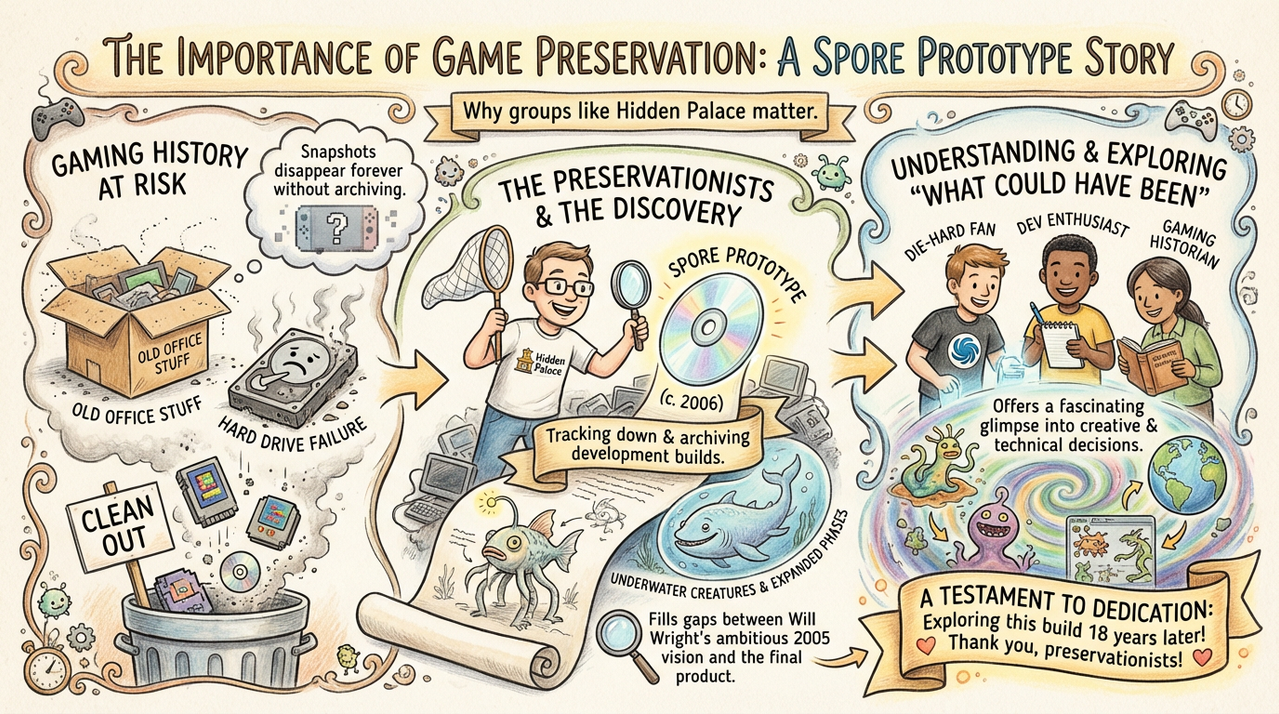
The preservation of this Spore prototype represents exactly why groups like Hidden Palace matter. Without dedicated preservationists tracking down and archiving development builds, these snapshots of gaming history would disappear forever when hard drives fail or offices get cleaned out. Every prototype that surfaces gives us better understanding of the creative and technical decisions that shape the games we eventually play. For Spore specifically, this build helps fill in the gaps between Will Wright’s ambitious 2005 vision and the more focused but arguably less exciting final product. It shows us the version of Spore that could have been, complete with underwater creatures and expanded gameplay phases that never made it to store shelves. Whether you’re a die-hard Spore fan, a game development enthusiast, or someone interested in gaming history, this prototype offers a fascinating glimpse into one of the most ambitious and ultimately controversial games of the 2000s. The fact that we can now explore this build 18 years after its creation is a testament to the dedication of gaming preservationists everywhere.