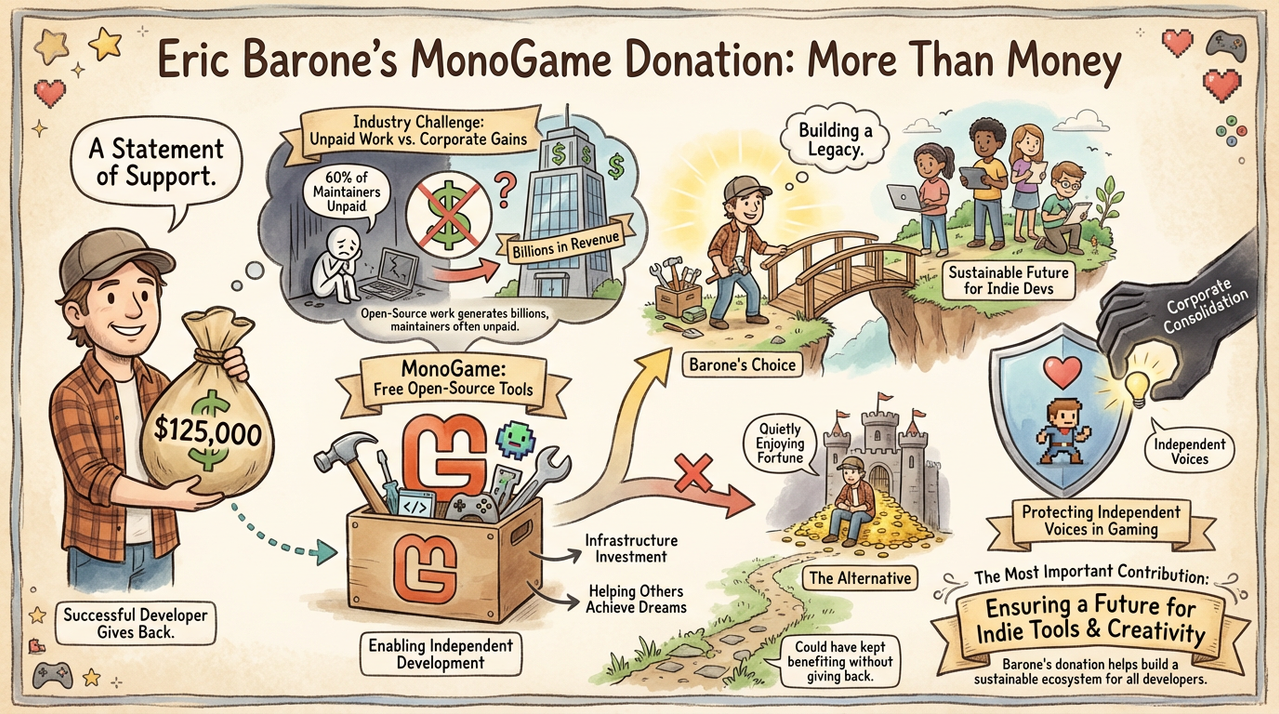
Eric Barone, the solo developer who created Stardew Valley and amassed an estimated $615 million fortune from it, just did something remarkable. On December 30, 2025, he donated $125,000 to MonoGame, the open-source C# framework that powers his beloved farming simulator, along with a commitment to provide ongoing monthly support. For context, that single donation equals about 57 months of MonoGame’s typical community funding.
- What Is MonoGame and Why Does This Matter?
- The Numbers Are Staggering
- Why Barone Did This
- The Open Source Funding Crisis
- This Isn’t Barone’s First Philanthropic Move
- The Terraria Precedent
- What Other Games Use MonoGame?
- How Much Money Has Barone Actually Made?
- Community Reactions
- What Happens Next?
- FAQs
- Conclusion
What Is MonoGame and Why Does This Matter?
MonoGame is an open-source C# game development framework that started as a community effort to extend Microsoft’s XNA Framework beyond Windows. When Microsoft discontinued XNA in 2013, MonoGame became the spiritual successor, maintained by volunteers and the nonprofit MonoGame Foundation. Think of it as the free, community-driven engine that lets developers build games without paying licensing fees or royalties.
The framework has powered some of gaming’s biggest indie success stories. Celeste, the critically acclaimed platformer that sold millions and won multiple awards, runs on MonoGame. So does Bastion, Supergiant Games’ breakout hit. Carrion, the reverse-horror game where you play as the monster, uses it. Tooth and Tail, the charming RTS about revolutionary rodents, was built with it. And of course, Stardew Valley itself migrated to MonoGame from XNA back in 2021.
The Numbers Are Staggering
Before Barone’s donation, MonoGame received approximately $2,200 per month from 238 GitHub sponsors, totaling around $26,000 annually. That’s the infrastructure funding for a framework that has generated hundreds of millions, possibly billions, in combined game revenue. Stardew Valley alone has sold over 41 million copies across all platforms, generating that estimated $615 million for Barone.
His $125,000 donation doesn’t just supplement the current funding model, it completely transforms it. Combined with his ongoing monthly commitment, Barone has effectively guaranteed MonoGame’s financial stability for years to come. The MonoGame Foundation called it an extraordinary show of support, which is putting it mildly. This is one of the largest individual contributions to an open-source game framework in history.
Why Barone Did This
While Stardew Valley wasn’t originally built using MonoGame, having switched from XNA in 2021, the framework has been crucial to maintaining and updating the game across multiple platforms. When you’re a solo developer managing a game that exists on PC, Mac, Linux, PlayStation, Xbox, Nintendo Switch, iOS, and Android, having reliable open-source tools matters immensely.
Barone has been working on his next game, Haunted Chocolatier, since announcing it in 2021. That project is being developed entirely solo without plans to change that approach. Having stable, well-maintained frameworks like MonoGame directly impacts his ability to develop and potentially port Haunted Chocolatier in the future. So yes, there’s a self-serving element to the donation, but that doesn’t diminish its significance.
The Open Source Funding Crisis
| Framework Funding Reality | Details |
|---|---|
| MonoGame Annual Budget (Before Donation) | ~$26,000 from 238 sponsors |
| Barone’s One-Time Donation | $125,000 (57 months of typical funding) |
| Ongoing Commitment | Undisclosed monthly amount |
| Games Revenue Generated on MonoGame | Hundreds of millions (estimated) |
| Stardew Valley Revenue Alone | ~$615 million (estimated) |
Barone’s donation highlights a massive problem in software development. According to the 2024 Tidelift State of the Open Source Maintainer Report, 60% of open-source maintainers remain unpaid. Critical infrastructure that serves billions of downloads monthly runs on volunteer labor, with maintainers shouldering enormous responsibility in their personal time without compensation.
MonoGame is a perfect example. The framework enabled indie developers to create games that collectively earned hundreds of millions of dollars, yet it operated on roughly $26,000 per year before Barone’s contribution. That’s less than many junior developer salaries. The funding gap between value extracted and infrastructure support is absurd.

This Isn’t Barone’s First Philanthropic Move
The MonoGame donation continues a pattern of Barone giving back to the gaming community. Earlier in 2025, he publicly mused about potentially saving Hytale, the Minecraft-inspired sandbox RPG that Riot Games cancelled. When original Hypixel Studios founder Simon Collins-Laflamme reached out about resurrecting the project, Barone expressed interest, saying he’d need to hear more about the plan and why it failed initially.
That deal ultimately didn’t happen, as Hytale was sold back to its original owners. But the willingness to even consider using his personal fortune to rescue another developer’s ambitious project speaks volumes about his character. Not many successful indie developers would publicly entertain the idea of bankrolling someone else’s risky game development.
The Terraria Precedent
Barone’s donation reminds many of a similar move by Andrew Spinks, the creator of Terraria. Back in 2021, Spinks was so frustrated with Unity’s policy changes that he donated $100,000 each to open-source game engines Godot and FNA. His message was clear: the industry needs viable alternatives to corporate-controlled engines that can change terms or pricing at will.
That’s exactly what MonoGame represents. It’s a completely free, community-maintained framework with no corporate overlord that can suddenly decide to charge runtime fees or alter licensing agreements. For independent developers, especially solo creators like Barone, that independence and stability is priceless. Having successful devs reinvest in these tools helps ensure they remain viable options for the next generation.

What Other Games Use MonoGame?
If you’ve enjoyed indie games over the past decade, you’ve almost certainly played something built with MonoGame. The framework’s versatility has enabled everything from pixel-art platformers to complex strategy games. Some notable titles include Axiom Verge, the Metroidvania that captured the essence of classic exploration games; TowerFall Ascension, the beloved local multiplayer arena combat game; and Bastion, the game that put Supergiant Games on the map.
MonoGame’s strength lies in giving developers low-level control over their games without forcing them into editor-heavy workflows. For programmers who prefer writing code directly rather than clicking through visual editors, it offers an appealing middle ground between building an engine from scratch and surrendering to commercial solutions like Unity or Unreal.
How Much Money Has Barone Actually Made?
Let’s do some rough math. Stardew Valley has sold over 41 million copies since its 2016 launch. The game typically sells for $15, though it occasionally goes on sale. Even accounting for platform cuts (typically 30% on digital storefronts), regional pricing variations, and sale discounts, conservative estimates put Barone’s total gross revenue somewhere around $615 million.
Since Stardew Valley was developed entirely by Barone as a solo project over four and a half years, and he only brought in temporary contract help for porting and translations later, the vast majority of that revenue flows directly to him after platform fees and taxes. Yes, he now has a small team helping with updates and ongoing support, but the core game that generated those millions of sales was solo work.
That context makes the $125,000 donation more impressive. While it’s a significant amount of money, it represents roughly 0.02% of his estimated total revenue from Stardew Valley. Barone could have donated ten times that amount and still barely dented his fortune. The fact that he’s also committing to ongoing monthly support suggests he understands the long-term importance of maintaining open-source infrastructure.
Community Reactions
Reddit lit up with praise when news of the donation broke. One highly upvoted comment called Barone “the most awesome person in gaming,” while another said he “just keeps on giving back.” Multiple commenters noted how impressive it is that despite achieving massive success and having every right to become arrogant about his accomplishments, Barone consistently demonstrates genuine humility and appreciation for the tools and community that supported him.
Some users pointed out the self-serving aspect of the donation, since his current game runs on MonoGame and his future projects will likely benefit from its continued development. But most agreed that even if there’s a business justification, the gesture still matters enormously for open-source sustainability. Plenty of successful developers benefit from free tools without ever giving back meaningfully.
What Happens Next?
The MonoGame Foundation hasn’t detailed exactly how they’ll use Barone’s donation, but the possibilities are substantial. With five years’ worth of typical funding arriving at once, the team could hire part-time or full-time developers to accelerate feature development, improve documentation, expand platform support, or strengthen security and performance.
More importantly, Barone’s public commitment might inspire other successful indie developers to support the open-source tools that enabled their success. If even a handful of other MonoGame-powered game creators followed suit with similar donations, the framework could achieve genuine financial sustainability without relying on the current model of small monthly contributions from hundreds of individuals.
FAQs
How much did Eric Barone donate to MonoGame?
Eric Barone donated $125,000 to MonoGame on December 30, 2025, along with an ongoing monthly commitment of an undisclosed amount. The single donation equals approximately 57 months of MonoGame’s typical community funding.
Why did the Stardew Valley creator donate to MonoGame?
Stardew Valley switched from Microsoft’s XNA Framework to MonoGame in 2021. The framework is crucial for maintaining and updating the game across multiple platforms. Barone is also working on Haunted Chocolatier solo and will likely benefit from continued MonoGame development.
What other games use MonoGame?
Notable games built with MonoGame include Celeste, Bastion, Carrion, TowerFall Ascension, Axiom Verge, and Tooth and Tail. Hundreds of indie games have been developed using the open-source framework since it succeeded Microsoft’s XNA in 2013.
How much money has Eric Barone made from Stardew Valley?
With over 41 million copies sold at approximately $15 each, conservative estimates put Stardew Valley’s total gross revenue around $615 million. After platform fees and taxes, Barone has likely earned hundreds of millions as the solo developer.
Is Eric Barone still working on Haunted Chocolatier?
Yes, Barone has been working on Haunted Chocolatier since announcing it in 2021, though he paused development to create Stardew Valley’s 1.6 update. He recently announced that version 1.7 is coming, which may further delay Haunted Chocolatier’s completion.
What is MonoGame?
MonoGame is a free, open-source C# game development framework that succeeded Microsoft’s XNA Framework when Microsoft discontinued it in 2013. It’s maintained by volunteers and the nonprofit MonoGame Foundation, with no licensing fees or royalties.
How much funding did MonoGame receive before this donation?
Before Barone’s donation, MonoGame received approximately $2,200 per month from 238 GitHub sponsors, totaling around $26,000 annually. This funded infrastructure that enabled hundreds of millions in game revenue.
Has Barone done other philanthropic things in gaming?
Yes, Barone expressed interest in potentially helping rescue Hytale, the cancelled Minecraft-inspired RPG, though that didn’t ultimately happen. He’s also been praised for consistently supporting the gaming community despite his massive personal success.
Is Stardew Valley still being updated?
Yes, despite saying he was done with Stardew Valley updates, Barone announced version 1.7 is coming. He now has a small team helping with updates while he works solo on Haunted Chocolatier, though the new update will likely slow down his next game’s development.
Conclusion
Eric Barone’s $125,000 donation to MonoGame represents more than just financial support for an open-source project. It’s a statement about the importance of maintaining the free tools that enable independent game development. In an industry where 60% of open-source maintainers go unpaid while their work generates billions in revenue, seeing a successful developer give back substantially matters. Barone didn’t have to do this. He could have quietly enjoyed his fortune while continuing to benefit from MonoGame’s free development. Instead, he chose to invest in infrastructure that will help other developers achieve their own dreams. Whether his next game, Haunted Chocolatier, becomes the next Stardew Valley or not, this donation ensures his legacy extends beyond just making great games. He’s helping build a sustainable future for the tools that make indie development possible. And in gaming, where corporate consolidation threatens to squeeze out independent voices, that might be the most important contribution of all.