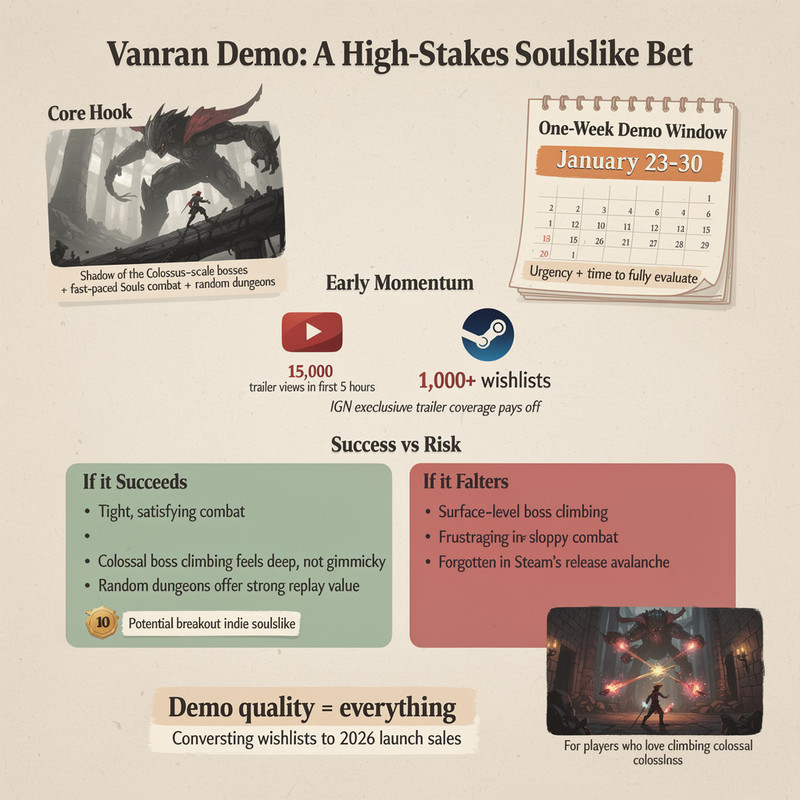
Vanran, the indie soulslike from Korean developer Becuzus, released its demo date announcement trailer on January 6, 2026, confirming a week-long playable demo on Steam from January 23-30. The game combines fast-paced Souls-style combat with Shadow of the Colossus-scale boss battles where you climb massive enemies to reach weak points, all set in a dark fantasy world where a fallen human slave wields a sealed blade to spark rebellion. IGN secured an exclusive trailer premiere that racked up 15,000 views in five hours and drove over 1,000 Steam wishlists according to the developer’s Reddit post, suggesting genuine excitement for this blend of familiar mechanics executed with fresh visual style.
The demo timing positions Vanran to capitalize on the post-holiday indie game discovery period when players hunt for interesting projects to wishlist before 2026’s major releases dominate attention. Running for exactly one week creates urgency without overstaying its welcome, encouraging players to try the demo during the limited window rather than adding it to an ever-growing backlog. IGN describes it as an “indie-developed, faster-paced-than-usual soulslike that features random dungeons” in a world of despair where survival demands mastering brutal combat against overwhelming odds.
Shadow of the Colossus Meets Dark Souls
Vanran’s core hook is fighting colossal enemies that require climbing and targeting specific weak points, directly evoking Team Ico’s masterpiece Shadow of the Colossus. The trailer showcases massive creatures several stories tall with the player character scaling their bodies mid-combat, hanging from ledges while dodging attacks, and striking glowing weak points that stagger these behemoths. Unlike Shadow of the Colossus’s deliberate, almost puzzle-like approach, Vanran accelerates the pace with faster traversal, aggressive combat, and Souls-style dodge rolls that create a more action-oriented interpretation of the climbing boss formula.
The Souls influence appears in the stamina-based combat, dodge-roll timing windows, deliberate attack animations with commitment frames, and challenging difficulty that punishes greedy mistakes. However, Becuzus describes Vanran as “faster-paced-than-usual” for the soulslike genre, suggesting more aggressive action closer to Bloodborne or Nioh rather than methodical Dark Souls pacing. This speed increase makes sense given the climbing mechanics; waiting around observing patterns works for ground-based Souls combat but creates tedious downtime when you need to scale massive enemies quickly before they shake you off.
The setting establishes a dark fantasy world where humans serve as slaves under mysterious oppressors. You play as a fallen slave who acquires a sealed blade that grants power to fight back, sparking rebellion against the established order. IGN quotes Becuzus describing the fantasy world as one where “a fallen human slave wields a sealed blade to spark rebellion. Players walk a brutal path toward freedom in a world of despair.” This narrative framework justifies increasingly powerful enemies as you climb the rebellion ladder, with each colossal boss representing another stepping stone toward freedom.
Random Dungeons and Roguelike Elements
IGN confirms Vanran features “random dungeons,” suggesting roguelike or roguelite elements that change level layouts between runs. Whether this means full procedural generation like Hades or shuffled room arrangements like Dead Cells remains unclear from available information. Random dungeons help replayability by preventing players from memorizing optimal paths, forcing adaptation to whatever layout the game generates. Combined with the challenging Souls-style combat, randomized dungeons create scenarios where knowledge from previous runs helps but doesn’t guarantee success since environmental advantages shift constantly.
This roguelike influence distinguishes Vanran from most soulslikes that feature handcrafted level design as a core pillar. Games like Dark Souls and Elden Ring meticulously design interconnected worlds where level layout itself tells environmental stories and guides player progression. Vanran trading that bespoke design for procedural variety suggests different priorities: replayability and varied challenge runs over environmental storytelling and exploration satisfaction. Whether this trade-off works depends on how much variety the random dungeon system provides and whether combat stays engaging across multiple runs through similar-looking but differently arranged rooms.
The IGN Exclusive Impact
Developer Becuzus took to Reddit’s gamedev community six hours after the trailer premiered to share results from their IGN exclusive deal. “About 5 hours ago, our gameplay trailer for VANRAN went live as an exclusive on IGN,” they wrote, reporting 15,000 views in those first five hours plus over 1,000 new Steam wishlists. For an indie studio without massive marketing budgets, these numbers represent genuine success that validates the decision to pursue IGN coverage rather than simply uploading to their own YouTube channel.
Becuzus shared several insights from the experience that other indie developers might find valuable. First, announcing the demo availability immediately in the trailer created trust and intent among viewers who could try the game risk-free rather than just wishlisting based on marketing footage. Second, having something playable ready when revealing the game fostered more confidence than trailer-only announcements where players must trust promotional material without hands-on verification. Third, presenting a playable version resonated more strongly than just showing gameplay, suggesting players value the ability to form their own opinions over accepting curated vertical slices.
The developer noted these were personal reflections rather than definitive conclusions, acknowledging that results vary based on game quality, marketing timing, audience targeting, and countless other factors. Still, the 1,000+ wishlists from a single trailer premiere represents meaningful momentum for a small studio trying to build awareness before full release. Whether this translates into actual sales when the game launches depends on demo quality converting wishlisters into buyers, but at minimum Vanran has successfully captured attention in the crowded indie action RPG space.
What the Trailer Shows
The demo release date trailer runs approximately 2 minutes 37 seconds showcasing combat encounters, boss battles, and environmental traversal. Early footage demonstrates ground-based combat against human-sized enemies using sword strikes, dodge rolls, and what appears to be a parry system. The combat flows quickly with minimal recovery frames between actions, supporting Becuzus’s claim about faster-than-usual soulslike pacing. Hit effects generate satisfying impact with screen shake and particle effects that communicate damage without obscuring gameplay.
Boss encounters escalate dramatically in scale. One sequence shows a massive armored giant several stories tall swinging weapons that create shockwaves forcing evasive maneuvers. The player character leaps onto the giant’s arm, runs along its shoulder, and strikes a glowing weak point on its head. Another boss appears to be a flying creature that requires timing aerial attacks during vulnerable moments. These colossal battles clearly draw inspiration from Shadow of the Colossus while incorporating aggressive Souls-style combat that emphasizes quick reactions over patient observation.
Environmental variety includes dark dungeons with torch-lit corridors, ruined outdoor areas with crumbling architecture, and what appears to be arena-style boss encounter spaces. The art direction leans toward dark fantasy aesthetics with gothic architecture, ominous lighting, and a color palette dominated by blacks, grays, and sickly greens punctuated by glowing enemy weak points. Character designs feature anime-influenced proportions with exaggerated weapons and armor that balance readable silhouettes against stylized fantasy elements.
Technical Presentation
Vanran runs on what appears to be Unreal Engine based on visual characteristics and rendering techniques visible in trailer footage, though Becuzus hasn’t officially confirmed engine choice. The game targets 60fps based on trailer smoothness, essential for Souls-style combat where precise timing determines success or failure. Frame drops during critical dodge windows or parry attempts would destroy the tight mechanical feel that soulslike fans expect, so maintaining stable performance is crucial for Becuzus’s commercial success.
Lighting effects create atmosphere through dynamic shadows, volumetric fog, and glowing environmental elements that guide player attention toward objectives and hazards. The sealed blade glows with magical energy that illuminates dark areas while also telegraphing charged attacks, serving both aesthetic and functional purposes. Boss weak points shine brightly to communicate where players should aim climbs and attacks, avoiding the frustration of Shadow of the Colossus’s occasionally unclear targeting that left players guessing where to strike next.
Demo Strategy and Release Window
The January 23-30 demo window strategically positions Vanran between major release waves. Most big January releases like Code Vein II (January 30) will have launched by the time the demo arrives, while February blockbusters haven’t yet dominated conversation. This creates a relatively quiet week where indie games can capture attention from players seeking something new between AAA launches. Running exactly one week creates urgency through artificial scarcity; players know they can’t procrastinate trying the demo indefinitely, encouraging immediate downloads rather than wishlist-and-forget behavior.
Steam demos function as powerful conversion tools that dramatically outperform trailers alone. According to various developer postmortems, games offering playable demos see wishlist-to-purchase conversion rates 2-3x higher than trailer-only campaigns. Players who invest time mastering a demo’s mechanics become emotionally invested in progression that only the full game satisfies. Those who bounce off the demo were unlikely to purchase anyway, making the demo self-selecting for interested audiences while filtering out poor fits before disappointing post-launch refunds.
Becuzus hasn’t announced a full release date beyond “2026,” though the demo’s January timing suggests a Q2-Q3 2026 launch is probable. Releasing a demo too early in development risks showcasing unpolished mechanics that turn players away despite later improvements. Releasing too close to launch provides minimal conversion window between demo and purchase. The optimal timeline appears to be 3-6 months before launch: enough time to generate wishlists that compound through Steam’s algorithmic recommendations while recent enough that hype doesn’t fade before purchase opportunity arrives.

Challenges Facing Vanran
Despite strong initial reception, Vanran faces significant challenges standing out in the saturated soulslike market. FromSoftware’s dominance with Elden Ring and its DLC, plus countless indie soulslikes competing for the same audience, means Vanran must offer something genuinely distinctive beyond competent execution of familiar mechanics. The Shadow of the Colossus climbing integration provides that hook, but whether it’s enough to justify full-price purchase over established alternatives remains the critical question Becuzus must answer.
The random dungeon system could backfire if procedural generation creates repetitive-feeling environments that lack the carefully crafted interconnected level design players expect from soulslikes. FromSoftware’s games reward exploration through hidden shortcuts, environmental storytelling, and memorable landmarks that random generation struggles to replicate. If Vanran’s dungeons feel generic despite technical variety, the game loses one of soulslike’s most beloved qualities in exchange for replayability that players may not actually want from this genre.
Finally, the faster-than-usual pacing must be carefully balanced to maintain soulslike identity while differentiating from competitors. Too slow and Vanran feels like a generic Dark Souls clone, too fast and it loses the deliberate tactical decision-making that defines Souls combat. Finding the sweet spot where actions feel urgent without becoming mashy button spam requires extensive playtesting and iteration that indie studios with limited resources sometimes struggle to execute perfectly.
FAQs About Vanran Demo
When is the Vanran demo available?
The Vanran demo is available on Steam from January 23-30, 2026, a one-week window. After January 30, the demo will no longer be accessible until Becuzus decides whether to make it permanently available or remove it entirely.
What kind of game is Vanran?
Vanran is a fast-paced soulslike action RPG featuring Shadow of the Colossus-scale boss battles where you climb massive enemies to strike weak points. The game includes random dungeons, challenging combat with dodge-roll timing, and a dark fantasy setting where a slave wields a sealed blade to spark rebellion.
Does Vanran have roguelike elements?
Yes, Vanran features random dungeons according to IGN’s coverage, suggesting roguelike or roguelite elements that change level layouts between runs. The extent of procedural generation and whether progress carries between runs hasn’t been fully detailed yet.
Who is developing Vanran?
Becuzus, a Korean indie studio, is developing Vanran. The team secured an IGN exclusive trailer premiere on January 6, 2026, that generated 15,000 views in five hours and drove over 1,000 Steam wishlists according to the developer’s Reddit post.
When does the full version of Vanran release?
Becuzus hasn’t announced a specific release date beyond “2026.” Based on the January demo timing, a Q2-Q3 2026 launch seems probable, though the developer could target late 2026 depending on demo feedback and additional polish requirements.
What platforms will Vanran be on?
Currently, Vanran is only confirmed for PC via Steam. No announcements have been made regarding console versions on PlayStation, Xbox, or Nintendo Switch 2, though many indie soulslikes eventually port to consoles after successful PC launches.
How does Vanran compare to Shadow of the Colossus?
Vanran takes Shadow of the Colossus’s climbing-based boss battles but accelerates the pace with faster traversal, aggressive Souls-style combat, and dodge mechanics. While Shadow of the Colossus focuses on puzzle-like encounters, Vanran emphasizes action-oriented climbing combined with tight combat timing.
Is Vanran like Elden Ring or Dark Souls?
Vanran shares Souls-style combat with stamina management, dodge-roll timing, and deliberate attack animations, but Becuzus describes it as “faster-paced-than-usual” for the genre. Think closer to Bloodborne’s aggressive tempo rather than Dark Souls’s methodical pacing, combined with random dungeons instead of handcrafted interconnected worlds.
Conclusion
Vanran’s January 23-30 demo represents Korean indie studio Becuzus’s best shot at breaking through the crowded soulslike market with a distinctive hook: Shadow of the Colossus-scale boss battles integrated into fast-paced Souls combat with random dungeons. The IGN exclusive trailer premiere already generated impressive early momentum with 15,000 views in five hours and over 1,000 Steam wishlists, validating the decision to pursue major gaming press coverage rather than grassroots marketing alone. The one-week demo window creates urgency while giving players enough time to properly evaluate whether the climbing mechanics and faster pacing differentiate Vanran sufficiently from countless other indie soulslikes competing for the same audience. Success depends entirely on demo quality converting wishlisters into buyers when the full game launches later in 2026. If combat feels tight, bosses provide satisfying challenge without frustration, and random dungeons generate enough variety to justify multiple runs, Vanran could join the ranks of successful indie soulslikes like Lies of P and Lords of the Fallen that carved out commercial niches despite FromSoftware’s dominance. If execution falters or the Shadow of the Colossus inspiration feels surface-level rather than meaningfully integrated, Vanran risks becoming another forgotten soulslike buried under Steam’s endless new release avalanche. The demo will answer these questions definitively. Mark January 23 on your calendar if climbing colossal bosses while dodging devastating attacks in dark fantasy dungeons sounds remotely appealing, because Becuzus deserves credit for attempting something ambitious rather than safely copying Dark Souls wholesale like so many indie studios default to when chasing soulslike success.