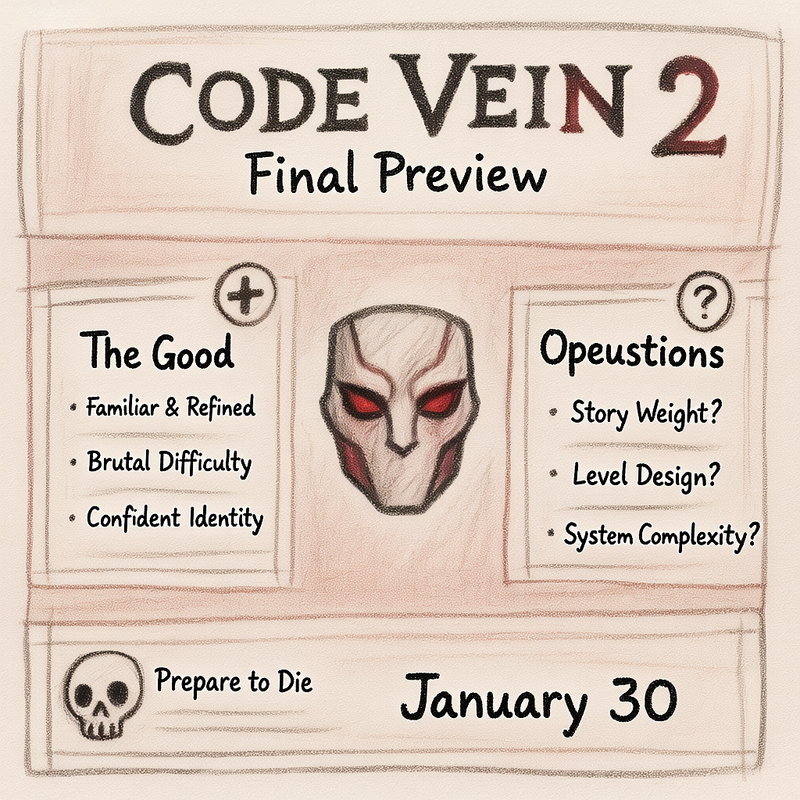
Sometimes the best endorsement a soulslike can get is watching a seasoned game journalist admit they got completely demolished. IGN’s Mitchell Saltzman published his final Code Vein 2 preview on January 5, 2026 after three hours of hands-on playtime, and his honest assessment boils down to this: the sequel feels familiar but way more confident, the combat refinements work beautifully, and the bosses will absolutely destroy you. That last part? That’s a feature, not a bug.
The Time Travel Hook Actually Works
Code Vein 2 ditches the original’s story and cast entirely, focusing instead on the Resurgence, a cataclysm that corrupted everything it touched and created beings called Revenants. One hundred years ago, legendary heroes managed to seal the Resurgence during an event called the Upheaval, but the seal is now weakening and causing existence-erasing explosions across the world.
Here’s where it gets interesting. Your nameless protagonist teams up with Lou Magmell, a Revenant girl with time-traveling powers who literally gave you her own heart to resurrect you after you died during a mission. Lou can follow someone’s Pathos to leap into the past, which becomes the game’s central mechanic. You travel back 100 years to meet the legendary heroes before they failed, help them with personal quests and challenges, then return to the present where those same heroes have been corrupted into monstrous boss fights you must defeat.
This creates emotional stakes the original Code Vein struggled to establish. In Saltzman’s preview, he helped Josée Anjou rebuild her domain in the past, leaving her grateful and hopeful. When he returned to the present and unsealed her, several years of tragedy had transformed that grateful hero into a blind, masked sword-wielding demon. Knowing the person behind the monster adds weight to fights that traditional boss encounters lack.
When Good Combat Gets Great
Saltzman emphasized that Code Vein 2 is all about refinement and iteration rather than radical reinvention. The stamina-governed combat with light attacks, heavy attacks, dodging, and blocking remains intact. Blood Codes still function as hot-swappable classes that change your stats, defense, and max Ichor capacity. But the layers stacked on top of that foundation have been significantly improved.
Jails now offer more variety with new options like Ivy (spikes emerging from the ground with chargeable targeting), Bat (growing wings and sending swarms), and Reaper (area-of-effect scythe attacks) joining returning options like Ogre, Hounds, and Stinger. The preview also showcased Bequeathed Formae, powerful subweapons including a Battle Axe called Idris’s Conceit and a Longbow named Statesman’s Longbow. Combined with Defensive Formae options, the customization depth becomes genuinely overwhelming.

The Partner System Gets Smarter
One of Code Vein’s defining features was AI companions fighting alongside you, but that design choice divided players. Some loved having backup during tough encounters. Others found the AI unreliable or felt the companion presence trivialized difficulty. Code Vein 2 addresses both preferences through the assimilation mechanic.
You can still summon partners like Josée to fight as AI co-op teammates, dealing damage and distracting enemies. But now you can also choose to assimilate them into yourself, removing their physical presence while granting significant stat boosts and powerful new abilities. Solo players get a viable option without feeling punished, while those who prefer companions can maintain that experience. Partners can also perform Restorative Offerings to revive fallen players, though on cooldown to prevent spam.
The Difficulty Spike Is Real
Here’s where Saltzman’s preview gets brutally honest. He describes the difficulty gap between exploration and boss fights as enormous. During regular combat encounters while exploring dungeons, he felt confident experimenting with different weapons, Formae combinations, and strategies. The enhanced animations and responsive controls made trash mob encounters feel fluid and satisfying.
Then he hit the first boss. What followed was a grueling test of pattern recognition, resource management, and precise execution. He eventually prevailed after multiple attempts, learning attack patterns and finding windows to land hits while managing Ichor consumption for healing and offensive abilities. Success felt hard-earned rather than cheap.
The second boss broke him completely. Saltzman admits he got hard stuck, unable to progress further in his preview session. The boss moved faster than anything he’d faced, had an extremely dangerous second phase he barely got to see, and possessed nasty attacks he couldn’t consistently dodge. It’s worth noting this was still relatively early in the game, suggesting the difficulty curve ramps up aggressively.
Does It Fix the Original’s Problems
The first Code Vein received mixed reception despite its ambitious vision. Critics praised the character customization, anime aesthetics, and interesting Blood Code system, but knocked it for repetitive level design, a convoluted story, and boss fights that lacked the memorable impact of Dark Souls or Bloodborne classics. The question is whether Code Vein 2 addresses these issues.
Based on preview coverage, the story structure certainly feels more focused. Time travel provides clear narrative hooks and emotional investment rather than environmental storytelling that requires reading item descriptions. Director Hiroshi Yoshimura emphasized that traversing difficult dungeons with partners and overcoming challenges together defines the series identity, suggesting boss design received extra attention this time.
Level design remains to be seen. Saltzman’s preview focused on the Sunken Pylon dungeon and some outdoor motorcycle sequences, but not enough to judge whether the sequel fixes the original’s maze-like corridors that confused more than they challenged. However, the interconnected shortcuts and elevator unlocks mentioned suggest Bandai Namco understands what makes soulslike level design satisfying.
The Systems Complexity Question
One concern mentioned in multiple previews is whether Code Vein 2 goes too far with customization options. You’re juggling seven weapon types, numerous Jails with unique Drain Attacks, Bequeathed Formae subweapons, Defensive Formae abilities, Combat Formae specials, Support Formae buffs, Blood Codes that rescale six attributes, partner assimilation benefits, and more. That’s genuinely a lot to track.
Saltzman noted that he could only begin to wrap his head around these interconnected systems in a few hours of play, but imagined they’d be engrossing when built up over an extended game. The question is whether casual players will bounce off the complexity or appreciate the depth. Bandai Namco is clearly targeting hardcore soulslike fans who love build crafting and optimization rather than trying to appeal to everyone.
What About Co-Op
Here’s the controversial bit: Code Vein 2 has no cooperative multiplayer. The first game allowed friends to join your world and tackle challenges together, a feature borrowed from Dark Souls that many players enjoyed. The sequel removes that entirely, doubling down on the single-player partner system instead.
This decision makes sense from a design perspective. The partner characters are deeply integrated into the story, with personal arcs and specific abilities tied to narrative progression. Allowing random players to drop in would dilute that focus. But it’s undeniably a feature removal that will disappoint players who preferred human co-op over AI companions, regardless of how improved the assimilation system might be.

The Character Creator Matters More Than Ever
Saltzman didn’t spend much time discussing customization in his preview, but it’s worth emphasizing that Code Vein 2’s Character Creator Demo launches January 23, letting players create up to 64 characters a week before the full game. For a series where character appearance and fashion are almost as important as combat, that level of commitment to customization speaks volumes.
Given that you’ll be staring at your protagonist for potentially 50-plus hours while getting repeatedly demolished by bosses, having granular control over every visual detail matters. The original Code Vein became somewhat legendary for its absurdly detailed creator, and the sequel appears to maintain that reputation.
The Final Verdict (So Far)
Saltzman’s assessment concludes that Code Vein 2 feels like a promising sequel that iterates on its already solid core with improved combat, refined systems, and some intriguing new twists. The time travel narrative provides emotional stakes the original lacked, the partner assimilation system gives solo players a viable path, and the boss difficulty seems appropriately punishing for the genre.
But questions remain. Will the level design improve beyond the original’s confusing mazes? Can the story maintain momentum without drowning in anime melodrama? Are there enough memorable boss encounters to justify the brutal difficulty? Will the systems complexity enhance or overwhelm the experience? We’ll find answers when Code Vein 2 launches January 30, 2026 on PlayStation 5, Xbox Series X|S, and PC.
FAQs About Code Vein 2 IGN Preview
How long did IGN play Code Vein 2?
Mitchell Saltzman played approximately three hours of Code Vein 2 for IGN’s final preview before the January 30 launch. He progressed through exploration sections and two boss fights before getting stuck.
Who is Lou Magmell in Code Vein 2?
Lou Magmell is a Revenant girl who revived the protagonist by giving him her own heart after he died during a mission. She has the power to travel through time by following someone’s Pathos, making her central to the game’s time-hopping story.
How difficult are the bosses in Code Vein 2?
According to IGN’s preview, the difficulty spike between exploration and bosses is enormous. The reviewer beat the first boss after multiple attempts but got completely stuck on the second boss, unable to progress further despite extended tries.
Does Code Vein 2 have multiplayer co-op?
No, Code Vein 2 does not feature cooperative multiplayer like the original game. Instead, it focuses entirely on the single-player experience with AI partner characters who can fight alongside you or be assimilated for buffs.
What is partner assimilation?
Assimilation allows you to absorb partner characters into yourself rather than having them fight alongside you. This removes their physical presence but provides significant stat boosts and powerful abilities, giving solo players a viable option.
Is Code Vein 2’s story connected to the first game?
No, Code Vein 2 features a completely standalone story with new characters, locations, and plot. Players don’t need any knowledge of the original game to understand what’s happening in the sequel.
What did the preview say about combat improvements?
The preview emphasized refinement and iteration, with more responsive animations, smoother controls, and expanded customization through new Jails, Formae options, and weapon types while maintaining the core stamina-based combat system.
Can casual players enjoy Code Vein 2?
The preview suggests Code Vein 2 targets hardcore soulslike fans with complex build crafting and punishing difficulty. Casual players may struggle with the systems complexity and boss challenges, though the partner system provides some accessibility.
Conclusion
IGN’s final preview paints Code Vein 2 as exactly what a sequel should be: familiar enough to satisfy fans while refined enough to address criticisms. The fact that an experienced reviewer got absolutely destroyed by early bosses is honestly the best marketing Bandai Namco could ask for in a genre where players wear difficulty like a badge of honor. Whether the time travel story maintains emotional weight throughout a full playthrough, whether level design improves beyond the original’s repetitive corridors, and whether the systems complexity enhances rather than overwhelms remain open questions. But based on three hours of hands-on time, Code Vein 2 appears confident in its identity as an anime soulslike that doesn’t apologize for being exactly that. If you loved the first game despite its flaws, the sequel delivers more of everything that worked while smoothing rough edges. And if you bounced off the original due to clunky combat or confusing mechanics, the refined approach might warrant a second look. Just be prepared to die. A lot. Because if IGN’s Mitchell Saltzman couldn’t beat the second boss after multiple attempts, the rest of us are in for a brutal ride come January 30.