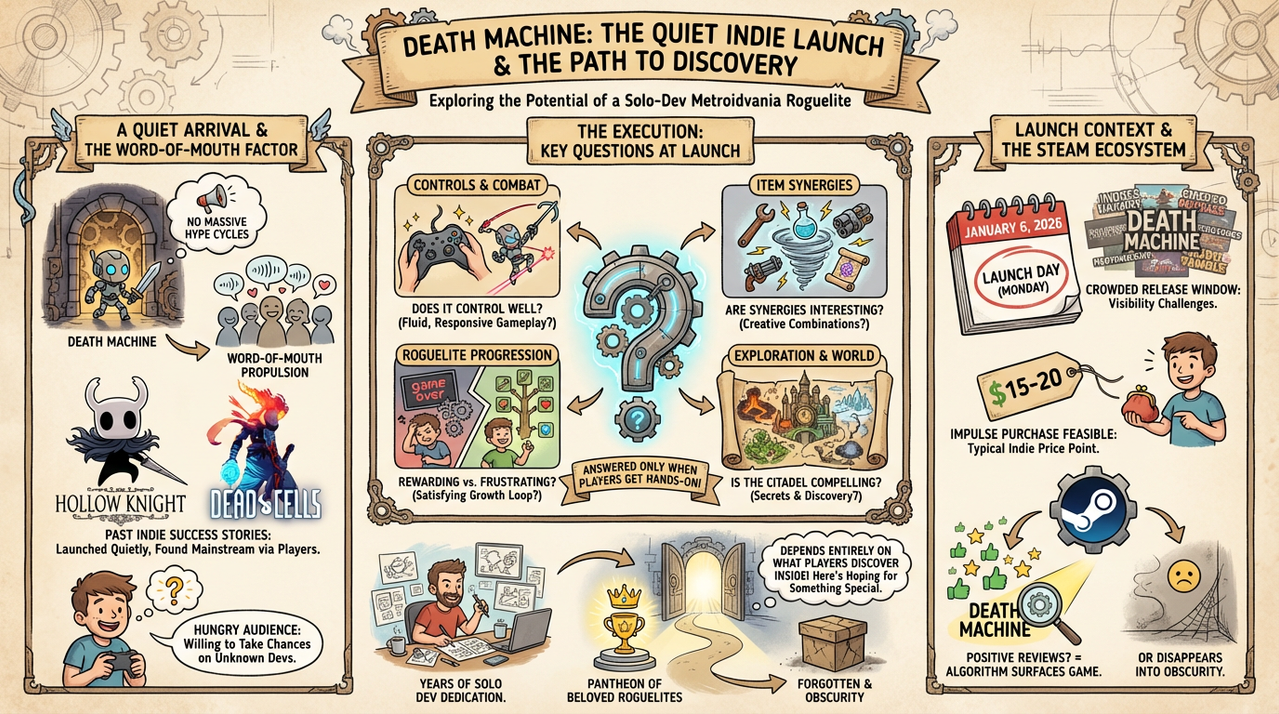
Death Machine drops on Steam this Monday, January 6, 2026, bringing its blend of classic metroidvania exploration and roguelite item systems to players who crave punishing mechanical citadels and deals with ancient demons. Developed solo by Philip Froelich, the game combines pixel art aesthetics with a dark fantasy setting where you harvest skulls from enemies, manipulate ancient spirits, and navigate a twisted mechanical world that resets with each death. The launch trailer showcases the game’s striking visual style and promises 200+ items to discover across multiple runs.
What Death Machine Actually Is
Death Machine marries classic metroidvania exploration with a roguelite item system that changes how you approach each run. You explore an interconnected mechanical citadel, discovering new areas, abilities, and shortcuts in the traditional metroidvania style. However, death resets your progress and changes the layout, creating the permanent tension of roguelite design where every run could be your last.
The core gameplay loop involves choosing between focused exploration to discover new items and powers or aggressive combat to hoard skulls taken from enemies. These skulls serve as currency you can cash in at Sanctuaries with your patron, presumably some ancient demon who’s helping you navigate this nightmare machine for their own mysterious purposes. The item system features over 200 items that synergize in unexpected ways, creating the build variety that makes roguelites endlessly replayable.
The Mechanical Citadel Setting
The game’s setting revolves around a perilous mechanical world that feels equal parts dark fantasy and industrial nightmare. According to the launch trailer and Steam description, you’re conquering a mechanical citadel filled with ancient spirits you can manipulate for assistance. The pixel art aesthetic gives everything a retro feel while the mechanical environments and grotesque enemy designs create oppressive atmosphere.
The name Death Machine apparently refers to both the world you’re exploring and a literal machine that broke the world according to cryptic dialogue in promotional materials. Some cataclysmic event involving this machine destroyed everything, and now you’re somehow using the same machine that broke the world to unbreak it. This sounds appropriately metal and mysterious for a game about harvesting skulls and making demon pacts.
The Solo Developer Behind It
Philip Froelich developed Death Machine entirely solo, handling programming, design, art, and presumably most other aspects of production. Solo development has become increasingly common in the indie metroidvania space, with games like Hollow Knight, Axiom Verge, and Environmental Station Alpha proving that small teams or individuals can create genre-defining experiences when given adequate time and creative vision.
Death Machine has been in development for at least several years based on its Steam page creation date in September 2025, though Froelich likely worked on it significantly longer before creating public-facing materials. The game’s relatively polished presentation and substantial content scope suggest years of dedicated work refining systems, creating art assets, and balancing the roguelite progression.
Solo development carries enormous risks and challenges. Developers must handle every aspect of production without specialization, often leading to burnout or projects abandoned halfway through development. However, solo developers also maintain complete creative control without compromise, resulting in highly focused visions that larger teams might dilute through committee decision-making. Death Machine’s uncompromising aesthetic and hardcore difficulty suggest Froelich never had to explain his choices to nervous publishers worried about mass appeal.
The Roguelite Metroidvania Hybrid
Combining metroidvania and roguelite genres creates interesting tensions that developers solve in different ways. Traditional metroidvanias emphasize persistent progress through an interconnected world, with unlocked shortcuts and new abilities opening previously inaccessible areas. Roguelites reset progress on death, forcing players to start over with only knowledge and meta-progression carrying forward. Merging these philosophies requires careful balancing so neither element dominates.
Death Machine appears to lean heavier into roguelite structure than games like Dead Cells or Rogue Legacy that maintain more traditional metroidvania persistence. Each run lets you choose between exploration focus or combat focus, suggesting the world layout changes significantly between attempts. However, the game presumably maintains some metroidvania permanence through unlocked shortcuts, discovered items added to the pool, or abilities that persist across deaths.
The Item System That Drives Everything
With over 200 items available, Death Machine’s roguelite system likely generates the kind of broken build combinations that make or break runs. The best roguelites create emergent gameplay through item synergies developers didn’t necessarily anticipate. Players discover that combining three specific items creates an overpowered loop that trivializes encounters, then share these discoveries with the community, creating a meta game of theorycrafting and experimentation.
The skull harvesting mechanic adds risk-reward decision making to every encounter. Do you play safe and progress slowly, or do you greedily chase skull drops to maximize your purchasing power at the next Sanctuary? Dying with a massive skull hoard presumably loses everything, creating the tension that makes roguelites compelling. That one more room mentality keeps players engaged far longer than they intended because maybe just one more skull will give you enough currency for that crucial item.
The Crowded January Launch Window
Death Machine launches January 6, 2026, putting it squarely in one of the year’s most crowded release windows. Major titles launching in January 2026 include Kingdom Come: Deliverance 2, Dispatch, Civilization VII, Sniper Elite Resistance, and numerous other high-profile games across all genres. Indie releases also flood the market in January as developers avoid the holiday shopping period dominated by AAA blockbusters.
However, the metroidvania roguelite niche isn’t particularly saturated in early January 2026 based on available release calendars. Death Machine launches alongside other roguelites like Oddcore and Dead Engine later in the month, but each targets different audiences. The pixelated metroidvania space has proven extremely receptive to quality releases regardless of launch timing, with word-of-mouth driving sales for games that deliver on their promises.

What the Early Buzz Suggests
Death Machine hasn’t generated massive mainstream hype compared to bigger indie releases, but metroidvania and roguelite communities have taken notice. The game appeared in several January 2026 indie roundups highlighting promising smaller releases. Rogueliker.com included it in their new roguelikes and roguelites list, calling attention to its metal-sounding name and intriguing premise of pixelated metroidvania with roguelite item systems.
The lack of preview coverage or extensive hands-on impressions before launch suggests Froelich either chose not to pursue traditional marketing or lacked resources for press outreach. Many successful indie metroidvanias have launched with minimal advance coverage, relying instead on strong launch day reception and organic word-of-mouth to build audiences. Hollow Knight famously launched to relatively little fanfare before becoming one of the decade’s defining indie success stories.
The game’s Steam page shows healthy wishlist numbers based on SteamDB data, suggesting at least modest launch day sales. However, the real test comes in the days and weeks after release when player reviews determine whether Death Machine gets buried or breaks through to broader recognition. Metroidvania fans are notoriously particular about what they embrace, demanding tight controls, fair difficulty, and satisfying progression before recommending games to others.
The Pixel Art Debate
Death Machine’s pixel art aesthetic will inevitably spark the tired debate about whether indie developers rely too heavily on retro visuals. Critics argue that pixel art has become a lazy default for indie games, allowing developers to avoid learning modern art pipelines while banking on nostalgia. Supporters counter that pixel art remains a legitimate artistic choice that can achieve striking visuals when executed skillfully.
Death Machine’s art style appears deliberately chosen to evoke classic metroidvanias like Super Metroid and Castlevania: Symphony of the Night while adding darker, more oppressive atmosphere. The mechanical environments and grotesque enemy designs wouldn’t work as effectively with realistic 3D graphics or clean vector art. The pixel aesthetic creates visual cohesion that reinforces the game’s themes of industrial decay and ancient evil.
Why Metroidvania Roguelites Keep Getting Made
The combination of metroidvania exploration and roguelite progression has proven commercially viable and critically successful enough that developers keep returning to it despite the crowded space. Dead Cells sold over 10 million copies. Hades won Game of the Year awards. Rogue Legacy and its sequel both found devoted audiences. The formula works because it satisfies multiple player desires simultaneously.
Metroidvania fans get the exploration, ability-gating, and interconnected world design they crave. Roguelite enthusiasts get the build variety, permanent tension, and endless replayability they demand. The genres complement each other surprisingly well despite seeming philosophically opposed on surface level. Metroidvania provides the structure and sense of place, while roguelite elements add variety and stakes that keep each run feeling fresh even after dozens of hours.
However, the success of Dead Cells, Hades, and similar titles creates enormous pressure on new entries to differentiate themselves or risk being dismissed as derivative. Death Machine’s demon patron system, skull harvesting mechanic, and focus on item synergies hopefully provide enough unique identity to stand apart from established genre leaders. Without something memorable, even good metroidvania roguelites get lost in the shuffle.
Frequently Asked Questions
When does Death Machine release?
Death Machine launches on Steam on Monday, January 6, 2026. The game is PC-only with no announced console ports at this time.
Who developed Death Machine?
Philip Froelich developed Death Machine entirely solo, handling all programming, design, art, and other production aspects.
What type of game is Death Machine?
Death Machine is a metroidvania roguelite that combines classic interconnected exploration with roguelite item systems and permadeath. You explore a mechanical citadel, harvest skulls from enemies, and make deals with ancient demons across multiple runs.
How many items are in Death Machine?
The game features over 200 items that can synergize in various combinations to create different builds and strategies across runs.
Is Death Machine similar to Dead Cells?
Both are metroidvania roguelites, but Death Machine appears to emphasize exploration and item synergies more heavily than Dead Cells’ combat-focused design. The mechanical citadel setting and demon patron mechanics also differentiate it thematically.
What platforms is Death Machine available on?
Death Machine launches exclusively on PC via Steam. Console ports haven’t been announced.
How long is Death Machine?
Run length hasn’t been disclosed, but as a roguelite metroidvania, expect individual runs to take 30-90 minutes with dozens of hours needed to experience all content and unlock everything.
Does Death Machine have a demo?
No demo has been announced based on available information. Players will need to purchase the full game to try it.
The Indie Metroidvania That Might Surprise Everyone
Death Machine arrives without the massive hype cycles that accompany bigger indie releases, but that’s often when the best surprises happen. Hollow Knight, Dead Cells, and countless other indie success stories launched with relatively little fanfare before word-of-mouth propelled them to mainstream recognition. The metroidvania roguelite audience is hungry for quality experiences and willing to take chances on unknown developers if the game delivers.
What matters most is execution. Does Death Machine control well? Are the item synergies interesting? Does the roguelite progression feel rewarding rather than frustrating? Is the mechanical citadel compelling to explore? These questions can only be answered after launch when players actually get their hands on the full game. Philip Froelich spent years building this solo, and Monday we’ll find out if that dedication resulted in something special or just another decent indie that gets forgotten within weeks.
The crowded January release window could hurt visibility, but it could also help if players looking for something different stumble across Death Machine while scrolling through new releases. The $15-20 price point typical of indie metroidvanias makes impulse purchases feasible for genre fans. If the first wave of player reviews trends positive, Steam’s algorithm will surface the game to relevant audiences. Sometimes that’s all an indie game needs to find its people. Death Machine launches Monday, January 6, 2026 on Steam. Whether it joins the pantheon of beloved metroidvania roguelites or disappears into obscurity depends entirely on what players discover when they finally enter that mechanical citadel for themselves. Here’s hoping Philip Froelich built something worth the years of solo development hell it undoubtedly required.