Metroid Prime 4: Beyond launched last month to solid reviews and strong sales, but there’s one aspect everyone keeps complaining about – that bland, aimless open world desert hub where you ride around on a motorbike. Turns out Nintendo knew it was a problem. They saw player attitudes toward open world games change during the game’s lengthy development. And they decided to ship it anyway because, in their own words, “backtracking development again was out of the question.”
The Open World Compromise Nobody Wanted
In a recent interview with Famitsu, translated by ResetEra and Nintendo Everything, the Metroid Prime 4 development team explained how the controversial hub came to be. When the project started, Breath of the Wild had just revolutionized open world design, and the internet was filled with people saying they wanted an open world Metroid game. Nintendo listened, but they also recognized a fundamental problem.
Metroid’s core design philosophy – unlocking new powers that let you access previously blocked areas – is fundamentally incompatible with open world’s “go anywhere from the beginning” ethos. You can’t have both freedom and ability-gated progression without one undermining the other. Nintendo’s solution was to create a limited open world hub that connects to more traditional Metroid exploration areas, with the motorbike providing satisfying movement and pacing between intense exploration segments.
When Everything Changed
Here’s where it gets interesting. The development team admitted that by the time they finished the game, player attitudes toward open world design had shifted dramatically. The Breath of the Wild honeymoon period ended. Gamers started complaining about bloated open worlds filled with repetitive content, lengthy travel times, and shallow activities designed to pad playtime. The very design philosophy Nintendo had embraced at the project’s start was now being criticized.

But Metroid Prime 4 had already been rebooted once. Originally announced at E3 2017, the game was being developed by Bandai Namco until Nintendo pulled the plug in January 2019, deciding the project wasn’t meeting expectations. Development restarted from scratch at Retro Studios, the team behind the beloved original Prime trilogy. Asking them to fundamentally redesign the game’s structure years into development wasn’t realistic.
| Timeline | Event |
|---|---|
| E3 2017 | Metroid Prime 4 officially announced |
| 2017-2019 | Development under Bandai Namco |
| January 2019 | Development rebooted, handed to Retro Studios |
| 2019-2025 | Development under Retro Studios with Nintendo’s open world hub design |
| Development Period | Team realizes open world attitudes have changed |
| December 2025 | Game launches with controversial hub intact |
The Vision Was Nintendo’s
The interview makes it clear that the open world hub was part of Nintendo’s “original vision” for Prime 4, strongly suggesting it wasn’t Retro Studios’ design choice. The implication is that Nintendo only realized the flaws after Retro had already begun rebuilding the game around that structure. By then, changing course would mean another complete restart, potentially delaying the game by several more years.
Nintendo also mandated that Samus gain psychic abilities in this entry, originally as an explanation for controlling the Charge Beam’s directional shot. After Retro took over, Nintendo asked them to expand those psychic powers into a broader gameplay feature. These mandated design elements shaped the entire project before Retro ever got their hands on it.
Divorced From the Times
The development team made another revealing admission. During Metroid Prime 4’s extended development, shooting games and action games evolved significantly. Game speed increased across the genre. Fast-paced movement mechanics became standard. But implementing those changes would have disrupted the tempo Nintendo wanted for an adventure game, so they “actively chose to not take them into account.”

As the team put it, “I think this game is pretty much divorced from the changing of times.” It’s a candid acknowledgment that Metroid Prime 4 intentionally ignores modern design trends, for better or worse. The game that arrives 18 years after Metroid Prime 3: Corruption plays like a title designed in a different era, because in many ways, it was.
Why Metroid Resists Open Worlds
The fundamental tension Nintendo describes – between Metroid’s progression system and open world philosophy – is something fans and developers have discussed for years. Metroidvania design relies on carefully crafted, interconnected areas where backtracking becomes rewarding as new abilities unlock previously inaccessible secrets. It’s the opposite of open world design, which prioritizes player agency and freedom of movement.
Games like Hollow Knight and Ori and the Blind Forest succeed precisely because they reject open world tropes in favor of tightly designed, hand-crafted spaces. When you return to earlier areas in those games, it’s not padding – it’s meaningful exploration that reveals how interconnected the world actually is. The desert hub in Metroid Prime 4, by contrast, feels like empty space you have to cross to get to the good stuff.
The Cost of Caution
Nintendo’s decision to stick with their original vision rather than risk another delay is understandable from a business perspective. The game was already announced in 2017. Fans had been waiting for nearly two decades since the last Prime game. Another development reset would have pushed the release into the late 2020s and potentially cost tens of millions more.
But the creative cost is evident in the reviews and player reactions. IGN gave Metroid Prime 4 an 8 out of 10, calling it “an excellent, if relatively uneven, revival that reaches heights worthy of the Metroid name in its best moments.” That “uneven” qualifier keeps appearing in reviews, almost always in reference to the open world hub and the annoying supporting characters that populate it.
Lessons for the Industry
The Metroid Prime 4 story illustrates why game development is so challenging. Design trends shift during multi-year projects. What seemed innovative at the start can feel dated by the end. Features mandated early in development become impossible to remove without starting over. And sometimes you have to ship a game you know has flaws because the alternative is worse.
It also demonstrates the danger of chasing trends. Nintendo saw Breath of the Wild’s success and internet comments asking for open world Metroid, so they tried to deliver. But Metroid and Zelda are fundamentally different franchises with different design philosophies. What works brilliantly in one doesn’t necessarily translate to the other, especially when you’re adding open world elements to a series literally defined by gated exploration.
FAQs
Why does Metroid Prime 4 have an open world hub?
Nintendo designed the open world desert hub as a compromise between player requests for open world Metroid and the franchise’s core ability-gated exploration. The hub was influenced by Breath of the Wild’s success and internet discussions around 2017-2019.
Did Retro Studios design the controversial hub area?
No, the interview suggests the open world hub was part of Nintendo’s “original vision” for the game, not a design choice by Retro Studios, who took over development in 2019.
Why didn’t Nintendo remove the hub when they realized it was a problem?
Development had already been completely rebooted once in 2019 when it moved from Bandai Namco to Retro Studios. Nintendo stated that “backtracking development again was out of the question” and they had to move forward with their original vision.
When was Metroid Prime 4 originally announced?
The game was announced at E3 2017, making the total development cycle approximately 8 years before the December 2025 launch.
What other design mandates did Nintendo impose on Retro Studios?
Nintendo mandated that Samus gain psychic abilities, originally to explain the Charge Beam’s directional shot. After Retro took over, Nintendo asked them to expand this into a broader gameplay feature.
How did player attitudes toward open worlds change during development?
When development started around 2017-2019, Breath of the Wild had made open world games highly popular. By 2025, many players had grown tired of bloated open worlds with repetitive content and lengthy travel times.
Is Metroid Prime 4 still worth playing despite the hub issues?
Yes, reviews indicate the game reaches “heights worthy of the Metroid name” in its best moments, with IGN scoring it 8 out of 10. The hub is criticized but doesn’t ruin the overall experience.
Will there be updates to improve the open world hub?
Nintendo has not announced any plans to modify the hub design through updates or patches. The interview suggests they’re committed to the vision as shipped.
Conclusion
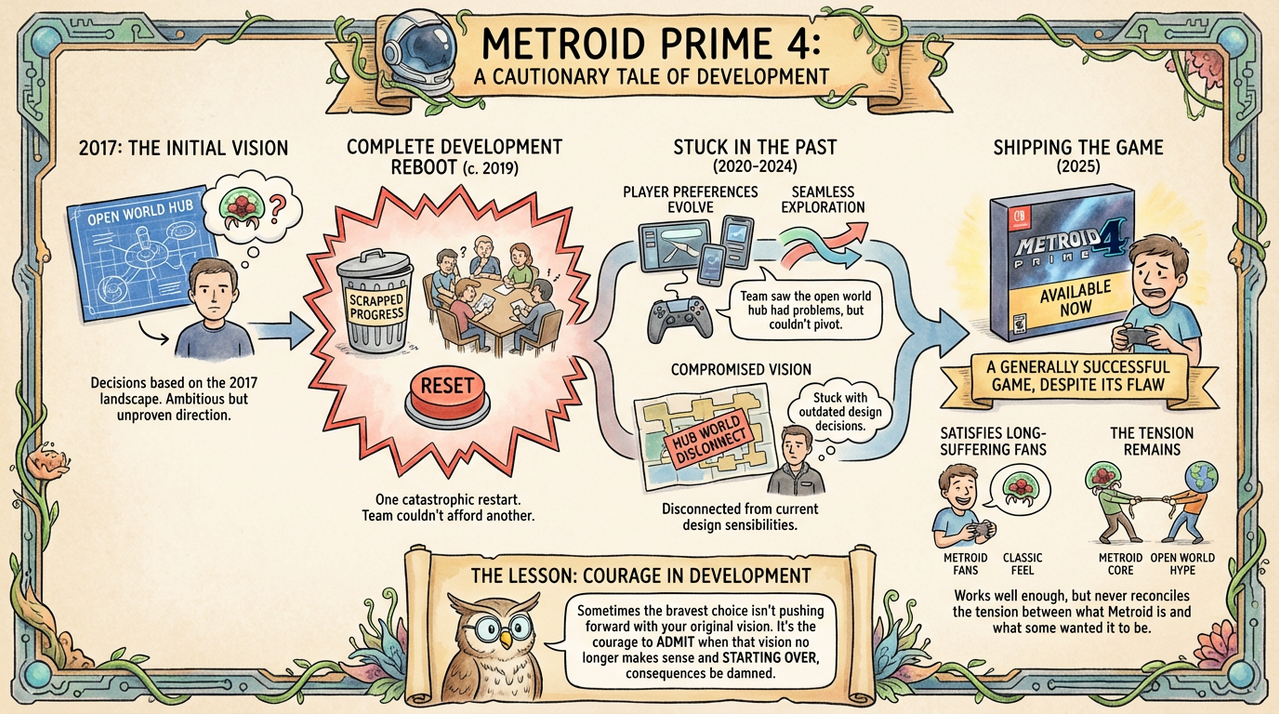
Metroid Prime 4’s development story is a cautionary tale wrapped in a generally successful game. Nintendo made decisions based on the landscape of 2017, stuck with them through a complete development reboot, and shipped a game in 2025 that feels disconnected from current design sensibilities. The team knew the open world hub had problems. They saw how player preferences evolved. But after one catastrophic restart, they simply couldn’t afford another. The result is a game that succeeds despite its most visible flaw, a compromised vision that works well enough to satisfy long-suffering fans but never quite reconciles the tension between what Metroid is and what some people thought they wanted it to be. It’s a reminder that in game development, sometimes the bravest choice isn’t pushing forward with your original vision – it’s having the courage to admit when that vision no longer makes sense and starting over, consequences be damned.